
You have a few free minutes near a familiar garden or public bench. Sitting outside appeals to you, but the place is not silent. People pass, leaves move and the light keeps changing. You do not need to turn that setting into an indoor meditation room before deciding whether a short practice fits.
An outdoor pause asks you to keep ordinary awareness available. A path remains a path for other people, weather can change and a practical interruption may need a response. Meditation does not give those things a lower priority. You can notice a sound as part of a practice and still act when the situation requires it.
This guide concerns an optional seated pause in a familiar, permitted place. It is not an invitation to travel somewhere isolated, a hiking guide or a claim that nature produces a particular health effect. The point is arranging attention while remaining part of the setting you actually occupy.
Quick answer: choose a place you can leave easily
Use a permitted, familiar seat away from routes that must stay clear. Check current conditions and local instructions, keep your eyes and attention available to the surroundings, and choose an ordinary sound or view if you want an external focus. Stop when conditions, responsibilities or your own preference change. A short attempt can finish before any timer or recording ends.
You do not need headphones, a special cushion or a photogenic view. If the available place requires more vigilance than you want to combine with meditation, choose an indoor session or ordinary outdoor time instead. Going outside and meditating are separate choices; neither requires the other.
Check the actual place before choosing a practice
Begin with somewhere you already understand: an accessible household outdoor area, a permitted shared courtyard or an ordinary public seating area you know. Check whether sitting there is allowed now. An attractive empty space may have a purpose, restricted access or conditions that are not obvious from a photograph.
Look at the current notices and relevant local information. For a managed park, use that park's own current guidance. The National Park Service trip-planning guide illustrates why local rules, weather, changing conditions and wildlife awareness matter. Its park guidance is not a meditation protocol or a substitute for the rules where you are.
Keep the plan within the place you actually know. This article does not assess a remote route, a shoreline, a rooftop or an unfamiliar natural area for you. You do not need a more dramatic location to make the pause worthwhile. If getting there becomes a separate excursion, plan that activity independently.
Share the space without needing it to become quiet
Choose a seat that leaves entrances, paths and access routes available. Keep your belongings close enough to manage normally without spreading them across another seat or walkway. You are using shared space, not temporarily reserving silence around yourself.
Other people may talk, walk past or use nearby facilities. Those activities do not become interruptions they owe you an apology for. If ordinary use of the area makes your selected practice inconvenient, you can change the practice, move to another permitted place or end.
Avoid photographing or recording passers-by as part of the session. You do not need a visual record to establish that you meditated. If you are with someone, agree separately about whether you are pausing quietly together or simply sharing the outing. Neither person has to participate or describe an experience afterward.
If another person asks a practical question, respond as the situation calls for. There is no requirement to protect a meditative appearance. A practice can include a normal conversation break and then end; returning is a choice rather than an obligation to recover lost minutes.
Choose conditions you can remain comfortable noticing
Check what the conditions are doing now, not just what you hoped they would be. A seat may be wet, a shaded area may become exposed or an ordinarily quiet corner may be in active use. The useful question is whether you want to sit there under those conditions.
Use ordinary clothing and weather precautions appropriate to the actual occasion and local advice. You do not need to endure cold, heat, glare or insects to maintain a posture. Moving or going indoors is a practical response, not evidence that your attention lacks discipline.
Do not stare toward the sun or use an intense light as a focus. Choose an ordinary part of the view that feels easy to look toward. If the light becomes unpleasant, change your gaze or stop. No particular direction, distance or fixed visual target is required by this editorial approach.
Respect wildlife and local restrictions without turning an encounter into a meditation exercise. Do not approach, feed or try to hold an animal's attention. A sound can remain unidentified. You do not have to find its source or move off a permitted route to complete your experience.
A practical framework: arrive, notice, respond
Arrive as an ordinary user of the place
Before beginning, look around normally. Notice the seat, the nearby route and what you need to do next. Sit in a position you already find comfortable, with a straightforward way to change position or leave. This guide does not prescribe physical adjustments for pain or other personal health needs.
Let the pause fit an available gap instead of making the gap fit a recording. Include the time needed for the next ordinary task. If you are waiting for an appointment or meeting someone, keep that responsibility available rather than treating it as a distraction to be excluded.
Notice one external focus without searching for a special moment
If you want a simple focus, choose an ordinary sound that is already apparent or a stationary part of the view. It may be moving leaves, distant conversation or a patch of colour. You are not trying to identify every sound, count passing people or turn the view into a detailed observation record.
When attention follows a thought, notice that and choose whether to return to the focus. You can let the next sound be different from the last one. There is no need to keep a continuous bird song, preserve a quiet interval or wait for something more natural to replace an ordinary urban sound.
Respond when the setting needs a response
Remain free to check a relevant sound, make room for someone or end when the conditions change. Do not interpret every movement as material you must observe without acting. Practical judgment remains part of being in a shared outdoor place.
This is an editorial planning framework, not a standardised or clinically tested meditation programme. The NCCIH overview describes varied attention practices and limitations in what is known about benefits and safety. It does not establish an effect for this particular outdoor arrangement.
Choose a practice for the occasion you actually have
Explore SoulFul GLO's practice chooser for an overview of meditation, sound and movement. Keep the actual place and responsibilities in view when selecting a session. Sometimes the useful outdoor choice is simply sitting, talking or continuing your day.
Use a recording only if it fits the setting
You may prefer an existing guided practice, but inspect its instructions before starting. A recording that repeatedly directs closed eyes or reduced awareness may not fit this occasion. Choose guidance you understand and actually want to follow rather than treating the outdoor location as a reason to reinterpret unclear directions.
Check the actual playback arrangement while you are still preparing. You should know how to pause and what happens when the session ends. Do not assume that an app supplies offline listening, an automatic stop or a particular control. Confirm any feature you intend to rely on in the tool you use.
Headphones can change what you hear around you, so do not make them an entry requirement. This article does not assess their suitability for a particular public place. If audio would mask information you need, disturb others or require attention you would rather leave available, choose an unguided pause or another occasion.
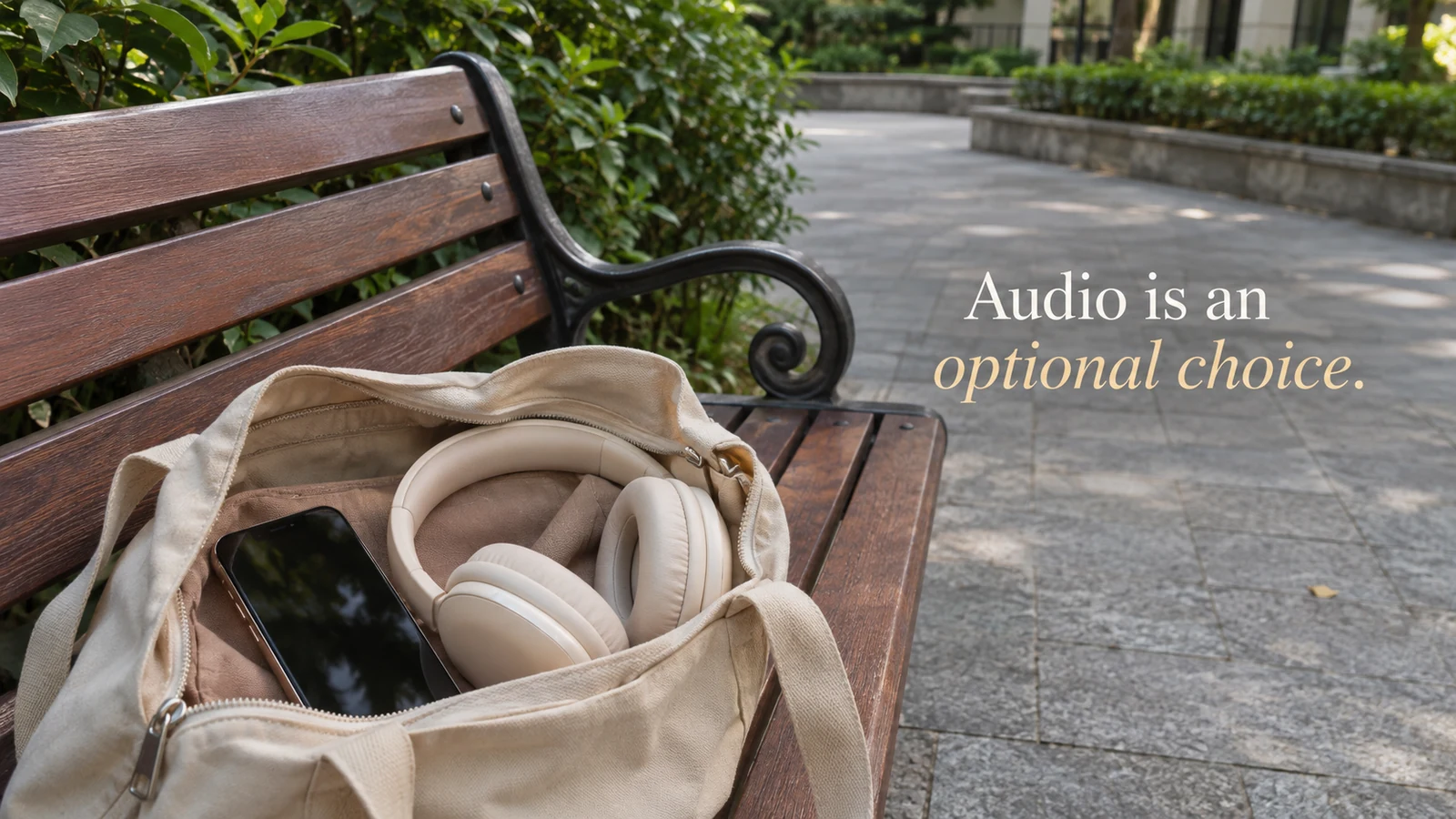
For the separate equipment decision, SoulFul GLO's headphones-or-speakers guide discusses checking an actual listening setting. An outdoor meditation does not have to include a sound journey. You can enjoy a familiar recording elsewhere without adding it to every pause.
Let ordinary sounds remain ordinary
A passing vehicle, footsteps and a distant voice can all be present without becoming signs or messages. Hearing something during meditation does not establish its meaning or give you information about another person's private experience. You can leave the sound undescribed.
You also do not need to decide that every sound is pleasant. If one is distracting, you can notice that plain preference and make a practical choice. The goal here is not to prove equal appreciation of all surroundings or remain seated until your judgment changes.
If you want to document natural details, do that as a separate activity. SoulFul GLO's nature-observation journal guide concerns writing situated observations and retaining uncertainty. Meditation in this article does not require notes, species names or a record of what you heard.
Two fictional pauses with different endings
A usable seat becomes inconvenient
In this invented example, Mira chooses a familiar courtyard bench during a free gap. She sits with an ordinary open gaze and notices nearby leaves. A maintenance team arrives to work in that part of the courtyard. She finishes and leaves the route clear rather than making the activity a test of concentration.
Her pause is shorter than she expected. She does not need to start again indoors to complete an imagined requirement. The useful observation is practical: that place was available at the beginning and became inconvenient. It does not establish anything about meditation's effects.
The planned audio gives way to ordinary listening
Another fictional reader, Tomas, has a recording in mind for a familiar park visit. When he arrives, its instructions seem poorly matched to the awareness he wants to keep. He leaves the recording for another occasion and takes a brief seated pause without it.
He notices ordinary nearby sounds and finishes when it is time to meet his friend. He has not tested whether outdoor meditation is superior to audio or whether the park produces calm. He made one choice about one occasion, and his friend does not need to share it.
These examples are fictional illustrations, not testimonials. They show that changing a plan can be the useful outcome of preparation. There is no correct duration or required feeling hidden in either story.
Finish while the next step is still straightforward
When you decide to finish, look around normally and attend to the next activity. Check that you have your belongings and leave the area as required. There is no need to hold a particular expression or delay responding to another person to preserve the session.
If the practice was unwelcome, you can stop choosing that arrangement. Meditation can involve difficult reactions and should not replace needed care. Seek appropriate qualified help for concerning symptoms rather than attempting to solve them by staying outside longer or finding a quieter place.
Frequently asked questions
Does an outdoor meditation require a natural setting?
This optional approach does not require wilderness, a scenic view or a particular kind of sound. The relevant details are permission, current conditions, an ordinary usable seat and the awareness you need to retain.
Must I close my eyes?
No closed-eye requirement is supplied here. Choose guidance that fits the setting and your preference. The separate eyes-open meditation guide covers arranging a relaxed gaze at home; outdoor conditions still need their own judgment.
What if people keep walking past?
Shared space remains shared. Leave routes available and decide whether the ordinary activity fits your pause. You can choose another permitted place or finish without requiring other people to become quieter.
Is outside meditation better for anxiety or sleep?
This article establishes no such comparison or treatment effect. A personal preference for an outdoor setting is not evidence of a clinical result. Use appropriate care for health concerns and keep optional practice separate from treatment.
Keep an indoor option available
Read SoulFul GLO's eyes-open home meditation guide if an ordinary room suits the occasion better. You do not need to prove you can meditate outside before choosing the setting you prefer.