
You follow a yoga lesson in a room without a mirror and wonder whether your position looks like the demonstration. You turn towards the dark television screen, trying to catch a reflection. Now you are moving to obtain an image while also trying to follow the next instruction. The reflection has become an additional task, even though the lesson never asked for it.
A mirror can have a place in particular teaching. It can also become a way of repeatedly checking appearance. The useful question is what information the actual practice needs, who can help you understand it and whether you are adding a visual test that the teaching does not supply. Your outline is not a complete assessment of a movement.
This guide offers a practical plan for participating without improvising a mirror check. It does not assess alignment, teach poses or establish that mirror-free yoga is safer. Keep unfamiliar movement questions with an appropriately qualified teacher. A lack of a reflection is not an instruction to close your eyes, copy a photograph or rely on an unclear sensation.
Quick answer
Choose a lesson whose directions and demonstration you can understand. Establish what the teacher expects you to watch and when. If you cannot tell what an instruction means without seeing yourself, pause and ask for clarification rather than changing the movement to obtain a reflection. Follow the arrangements actually offered, keep stopping available and leave appearance comparisons outside the task.
The aim is not to prove that you can practise without visual help. It is to separate usable instruction from a self-imposed requirement to resemble an image. You can prefer a live introduction, request a clearer demonstration or choose another lesson when the current format does not provide enough information.
Separate seeing the teacher from seeing yourself
A clear view of the demonstration and a reflection of your own body answer different questions. One shows what this teacher is explaining. The other shows an image from a particular angle. Neither, by itself, explains how a movement relates to your circumstances or whether it is appropriate for you.
If the teacher is hard to see, address that actual problem. You may need a clearer screen arrangement, another place in the class or a different lesson. Adding a mirror does not supply missing instruction. SoulFul GLO's guide to seeing the yoga teacher considers that separate access question.
Keep your observation specific. I cannot see the teacher's hands is a useful description. My shape is wrong is an interpretation that leaves the underlying question unclear. You can ask what the instruction means without first proving an error through a reflection or recording of yourself.
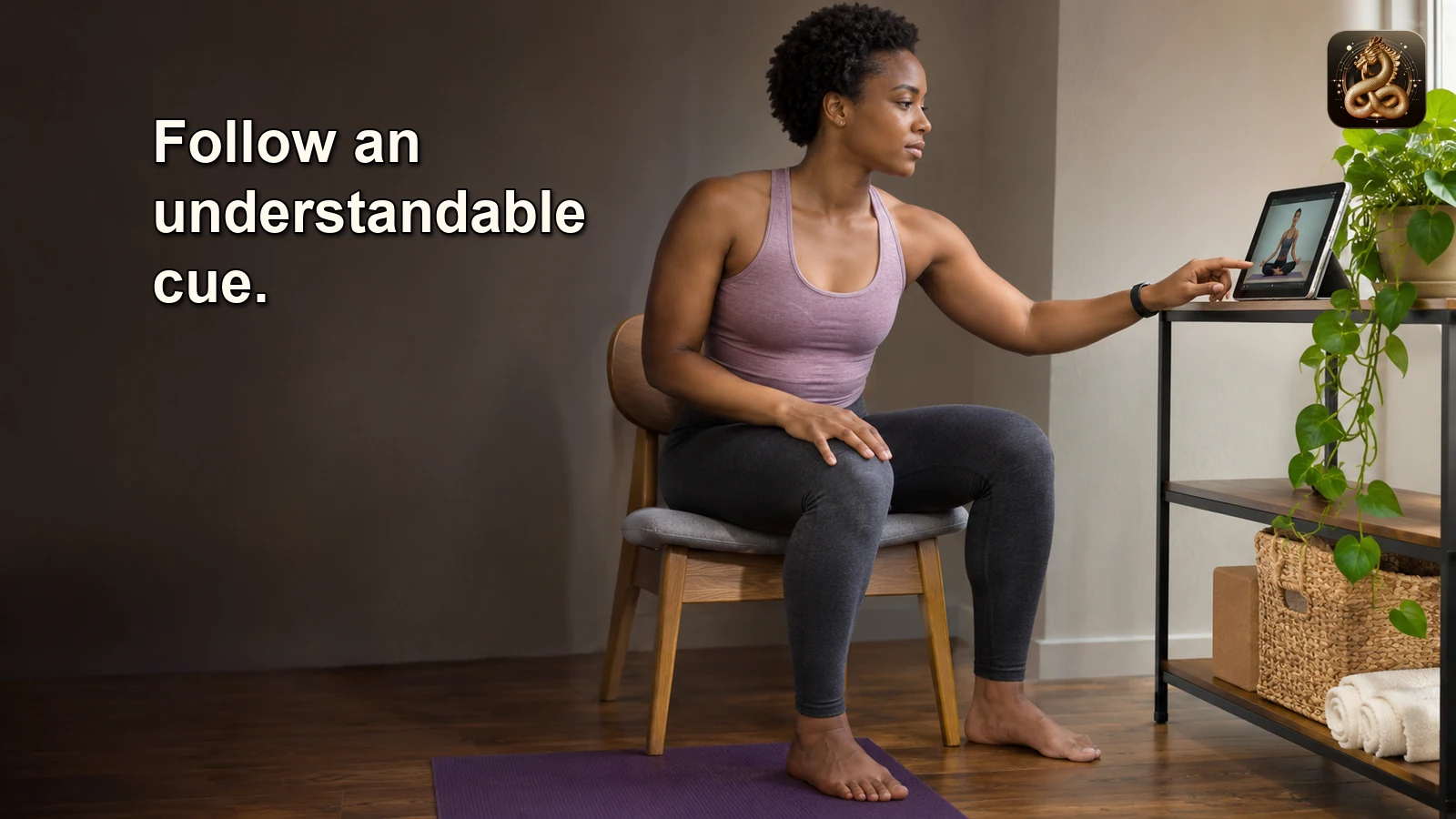
A mirror is a teaching tool, not a verdict
Kripalu's discussion of classroom awareness includes mirrors among several tools that may be used to meet students' needs. The article places such tools within teaching and individual support. It does not establish that every student needs a mirror, or that every mirrored image provides enough information to change a movement independently.
That distinction leaves room for different practices. An instructor may deliberately use a mirror for a particular learning purpose. Another session may rely on demonstration, verbal explanation and supported options without one. Ask how the actual lesson is arranged rather than treating either environment as automatically superior.
You can also notice what you are using a reflection to do. Are you answering a specific question the teacher has explained, or repeatedly comparing your appearance with theirs? Those are different activities. Naming the difference can help you decide what clarification you need, without diagnosing your response or making a rule about every mirror.
Start with one understandable instruction
Before beginning a recording, identify how the teacher introduces the movements and what experience is assumed. Use a preview as a viewing task when needed. You do not have to copy an unfamiliar position while trying to establish whether the explanation is complete.
If you are in a class, ask how newcomers obtain clarification. You might say that you tend to look for a reflection when uncertain and would like to know what to attend to instead. The teacher can explain the actual approach available in that setting. A useful answer identifies the instruction; it does not simply tell you to stop worrying.
Choose a small focus within the teaching you understand. It might be hearing the next cue before acting or knowing which option the teacher has explained for a transition. This is an attention choice, not a replacement technique. Avoid adding a universal instruction about gaze, breathing or body position from an unrelated article.
Notice when appearance becomes the main task
A comparison can start with a practical question and end as a general judgment about your body. You may be checking whether your arm is in the described place, then evaluating how the whole position looks. Pause the movement if the original instruction has become unclear. You do not need to keep moving while deciding what the comparison means.
Return to the specific question you can ask. Perhaps you do not understand which part moves first, whether an option was offered or how to finish. Those questions can receive a teaching answer. A broad judgment such as not looking like a yoga person is not the same kind of information, and this article does not treat it as evidence of capability.
Avoid turning awareness of comparison into another score. You do not need to count every appearance thought or maintain a particular attitude throughout the session. A practical return can be brief: identify the instruction, seek clarification if necessary and decide whether to continue. If the exercise remains unwelcome, stopping or another activity is available.
Keep the room arrangement ordinary
Do not move furniture or balance a device in an unstable position merely to obtain a reflection. Keep routes and the space needed for the actual activity clear. A dark screen, window or small mirror may provide an incomplete image while drawing attention away from the lesson.
You can discuss the room with the teacher without asking for a remote assessment of a pose. For example, explain that your home practice area has no mirror and ask whether the selected lesson assumes one. If it does, find out what introduction or alternative the provider offers instead of inventing your own equivalent arrangement.
If you choose a different orientation in an in-person room, use the actual class arrangements and ask before relocating equipment. Facing away from a mirror must not mean losing necessary access to the teacher or blocking another participant. A preference about reflections remains one part of a shared room, not permission to change everyone else's setup.
A small plan for the next session
First, choose the actual resource and identify the directions it supplies. Second, check that you can see or otherwise receive its demonstration and cues. Third, name the question that makes you want a reflection. Fourth, ask the teacher when that question concerns unfamiliar technique. Finally, choose whether the available teaching gives you enough information to participate.
During the session, keep the difference between instruction and appearance visible. Follow what is explained rather than adding a requirement to copy the teacher's outline. Afterwards, keep one practical observation about the arrangement: a cue was understandable, a screen position was unhelpful or another introduction would be preferable.
The simpler option is to choose a live beginner introduction and say what you do not understand. No home experiment is required before asking. Another simple outcome is deciding that you want a different activity today. Your ability to leave a practice does not depend on explaining every comparison thought.
A table for finding the actual question
Use the table to turn a vague urge to check your outline into a specific decision. These are examples of questions, not instructions for changing a pose. An unresolved technique question belongs with appropriate teaching, while an appearance judgment need not become a movement target.
| What you notice | Question to identify | Practical next step |
|---|---|---|
| I cannot see the demonstration | Is necessary instruction unavailable? | Ask about the view or another teaching format. |
| I want to copy the outline | Which actual cue am I trying to understand? | Return to that specific explanation; clarify if needed. |
| The mirror is part of the lesson | What purpose has the teacher explained? | Follow the actual instruction rather than general comparison. |
| I keep judging the whole image | Is there an unanswered movement question? | Pause; choose whether to continue without inventing a visual target. |
You do not need to work through every row. Choose the one that describes the current uncertainty. If no question about the actual teaching remains, avoid searching for a new visual fault simply to complete the table. It is a practical reference, not a checklist for monitoring yourself throughout a class.
Fictional demonstration: the reflection in the television
Nina uses a prerecorded introduction in her living room. She can hear the cues but sometimes turns towards a dark television screen to compare her outline. During one transition, she notices that turning to see the reflection makes her miss part of the explanation. She stops the recording instead of repeating the movement while looking sideways.
After watching the explanation as a separate viewing task, she can describe what remains unclear. She cannot tell which part of the transition the instruction refers to. The missing information is not solved by seeing her outline. She chooses to ask about an appropriate live introduction rather than adding a mirror to the room and guessing.
In this invented example, the useful change is identifying the teaching question. Nina does not discover that her position was correct or incorrect, and the article does not supply that assessment. She also does not need to criticise herself for wanting visual help. She can use that preference when choosing instruction that fits her needs.
Another fictional participant, Tomas, attends a class where a mirror is deliberately used for a short explained exercise. He asks about its purpose and follows the instruction he understands. That is different from using every reflection as an opportunity to compare his entire appearance. Neither example proves that all yoga should happen with or without mirrors.

Leave health and technical assessments with the right people
NCCIH's yoga guidance emphasises qualified instruction and the possibility of injury. A reflected image or a comfortable feeling cannot independently certify a movement. Seek appropriate individual advice for relevant concerns, and stop if participation becomes painful or you feel unwell.
This guide does not promise that changing your relationship with a mirror improves confidence, body image, balance or another outcome. It offers a way to ask a clearer question and avoid inventing a visual demand. Those modest practical choices can matter without becoming a treatment claim or another standard you must meet.
Choose an understandable movement practice
Explore SoulFul GLO's practice-selection guide when deciding between movement, meditation and listening. Keep each resource's teaching requirements attached to it. The absence of a mirror does not establish that a recording provides an appropriate introduction for every reader.
Frequently asked questions
Does yoga require a mirror?
This guide establishes no universal requirement. Some teachers use a mirror for a particular learning purpose; other arrangements may not. Check the actual class or recording. If an instruction remains unclear, seek clarification rather than using the presence or absence of a reflection as the complete answer.
Should I close my eyes to stop comparing?
Do not add that instruction from this article. Your gaze and visual access may matter to the actual activity. Use the teacher's appropriate guidance and participation options. Removing visual information is not a substitute for understanding an unfamiliar movement or obtaining advice about a relevant concern.
Can I use a phone recording instead?
A recording is not automatically a technical assessment. It also raises privacy and consent questions if other people are present. Ask what teaching help is actually available instead of assuming that filming yourself supplies it. This guide does not recommend recording a class or sharing images for public judgment.
Is looking different from the teacher a mistake?
A visual difference alone does not answer the movement question. Ask about the specific instruction you do not understand and keep personal circumstances in view. Do not change a position solely to make an image resemble someone else's body. Appropriate individual teaching remains important.
Keep a metaphor separate from a physical demand
Read SoulFul GLO's yoga metaphor guide when an image in the teacher's language is the confusing part. Clarifying the actual request is a different task from evaluating your outline, and neither requires you to guess.