
A class description can tell you the length, location and type of yoga without explaining whether a teacher might touch a participant. If that matters to your choice, you can ask before booking. You do not need to explain a personal history to request a class where instruction remains verbal or demonstrated.
The useful question is more specific than whether a teacher is friendly or experienced. Find out what optional physical assistance means in that particular room, how permission is requested, and what happens when someone prefers no touch. A clear answer helps you decide whether the arrangements suit you.
Quick answer: ask what will happen
Ask whether the class includes hands-on adjustments, whether each proposed contact is explained beforehand, and how you can choose verbal guidance instead. State a no-touch preference plainly if that is your choice. Check how to change your mind during class. Treat an unclear answer as information to resolve before booking, rather than assuming that registration gives permission for physical contact.
This guide concerns questions and communication, not instructions for adjusting another person's body. It cannot establish whether a particular class or physical movement is suitable for you. It also does not supply a legal opinion about a provider's duties.
Start by finding out what “assistance” means
Descriptions such as supportive teaching, individual attention and adjustments can mean different things. One teacher might offer a spoken suggestion from across the room. Another might demonstrate an alternative. A third might propose physically guiding part of a movement. Ask which of those is intended before deciding what you are agreeing to.
You could write: “Does this class use hands-on adjustments? If so, what would a participant be told before any contact, and can I take the whole class with verbal guidance only?” This asks about observable arrangements. It leaves the provider room to describe their actual process rather than simply reassuring you.

If the answer names a consent card or another signal, ask how that signal is used. Does it indicate a general preference, start a conversation, or stand in for a request about a particular action? A card's existence alone does not tell you how a teacher checks a participant's current choice.
Keep your inquiry proportionate. You are trying to understand a class, not assemble a dossier on the instructor. A short, concrete exchange may be enough. If the response introduces unfamiliar terms, ask what a participant would actually see and hear when the teacher proposes assistance.
Know the scope of the policy you are reading
Yoga Alliance's Scope of Practice sets a standard for its members: physical adjustments require specific, explicit, informed permission; permission on an earlier occasion does not establish permission later, and it can be withdrawn. Its Code of Conduct places that standard within members' professional responsibilities. These are association policies, not a statement that every yoga provider belongs to the organization or follows an identical process.
That distinction matters when reading a studio website. A reference to the organization is not independent proof of what happens in a room. Ask the provider how their arrangements work. You can use the policy's emphasis on specific permission to formulate a practical question without claiming that you have verified a teacher's conduct.
For the original wording and its membership scope, consult the linked Yoga Alliance Scope of Practice and Code of Conduct. Do not turn a registration label into a guarantee of safety, comfort or competence for your particular circumstances.
State a preference without giving a personal explanation
A usable preference can be brief: “I want verbal instruction and demonstrations only. Please do not give me hands-on adjustments.” That tells the teacher what you want them to do. It does not require a reason, a diagnosis or an account of an earlier experience.
You might send the preference before booking and repeat it privately on arrival. Those are different moments: an administrator may answer a message while another person teaches. Ask whether you need to speak to the class teacher directly. Avoid assuming that a note in a booking system automatically reaches everyone who might assist.
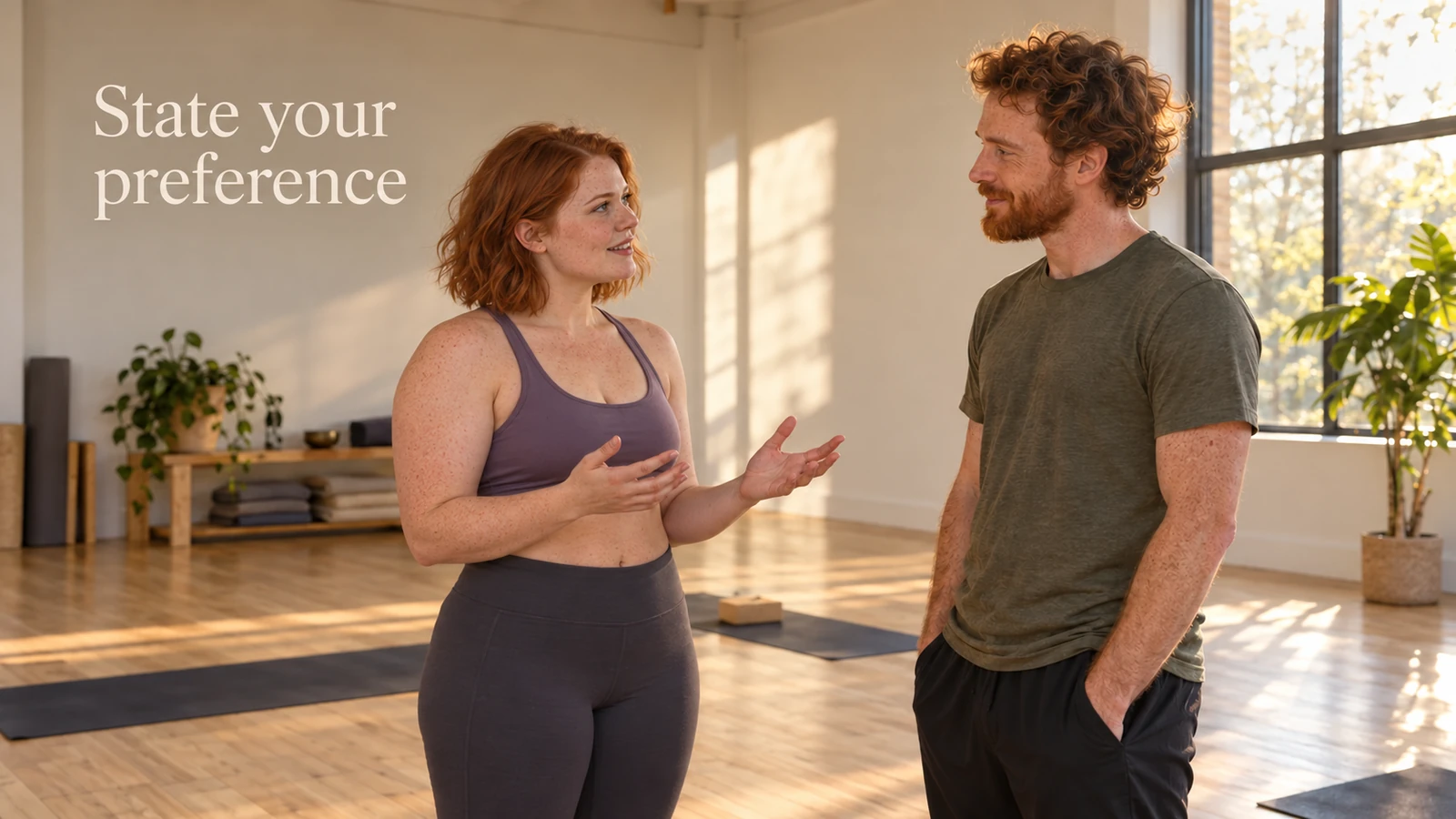
If you want some kinds of assistance but are uncertain about others, say that a general yes would not represent your choice. Ask the teacher to explain any proposed contact and wait for your answer. You can decide whether that arrangement is sufficiently clear before taking part.
A preference is also allowed to be simple even when your feelings are complicated. “No touch today” can be enough to communicate the relevant action. You do not have to find a polished explanation before asking for the class conditions you want.
Ask how a choice can change during class
Before the session, ask what you should do if your preference changes. You might want to stop an adjustment that you initially accepted, or decide that you no longer want any contact. A useful arrangement makes room for a current answer instead of treating an earlier answer as permanent.
Agree on ordinary words that you can actually use, such as “Please stop” or “Verbal guidance only.” This is not a special technique or a guarantee that every interaction will go smoothly. It is a way to avoid discovering halfway through a class that you and the teacher understood a signal differently.
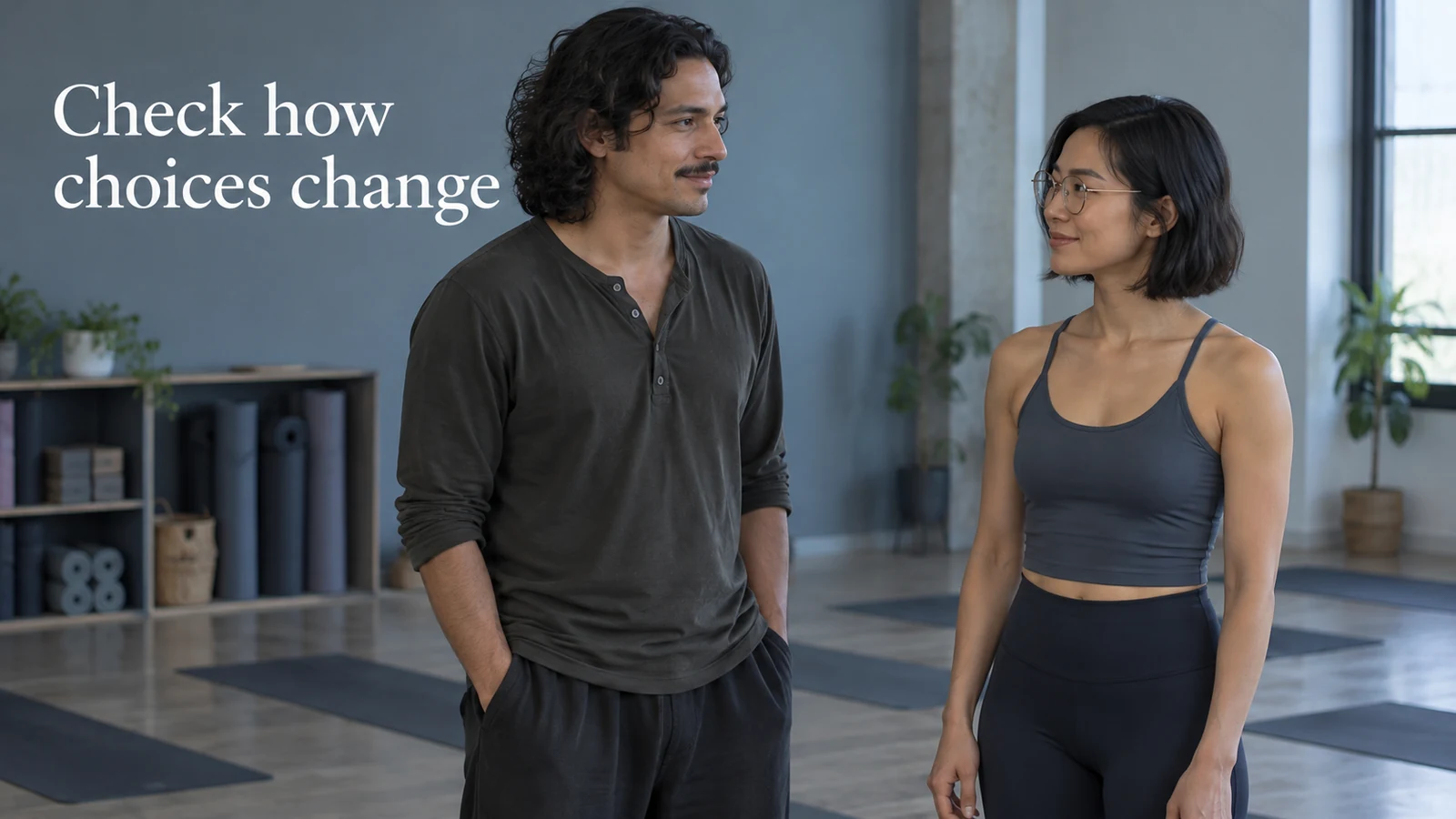
You do not need to continue a contact in order to be polite. If something is unclear, you can ask for it to stop while you clarify. Where the class format would make that communication difficult for you, consider whether another format would better match what you need.
Notice whether the teacher answers the practical question. “Everyone loves adjustments” describes other people's reported preferences, not yours. “We discuss what I propose and wait for your answer” gives you something more concrete to evaluate, though it remains a provider's description until observed.
Compare the available no-touch alternatives
Ask what instruction looks like when physical contact is declined. Possibilities might include a demonstration, a verbal description or a different position in the room from which you can see the teacher. These are examples to ask about, not promises that a specific class offers them.
Check whether the alternative requires a different booking or additional time. It is better to learn that a class cannot offer the arrangement you want before you travel. A provider can describe a limitation clearly; you can then choose whether to proceed, ask about another class or look elsewhere.
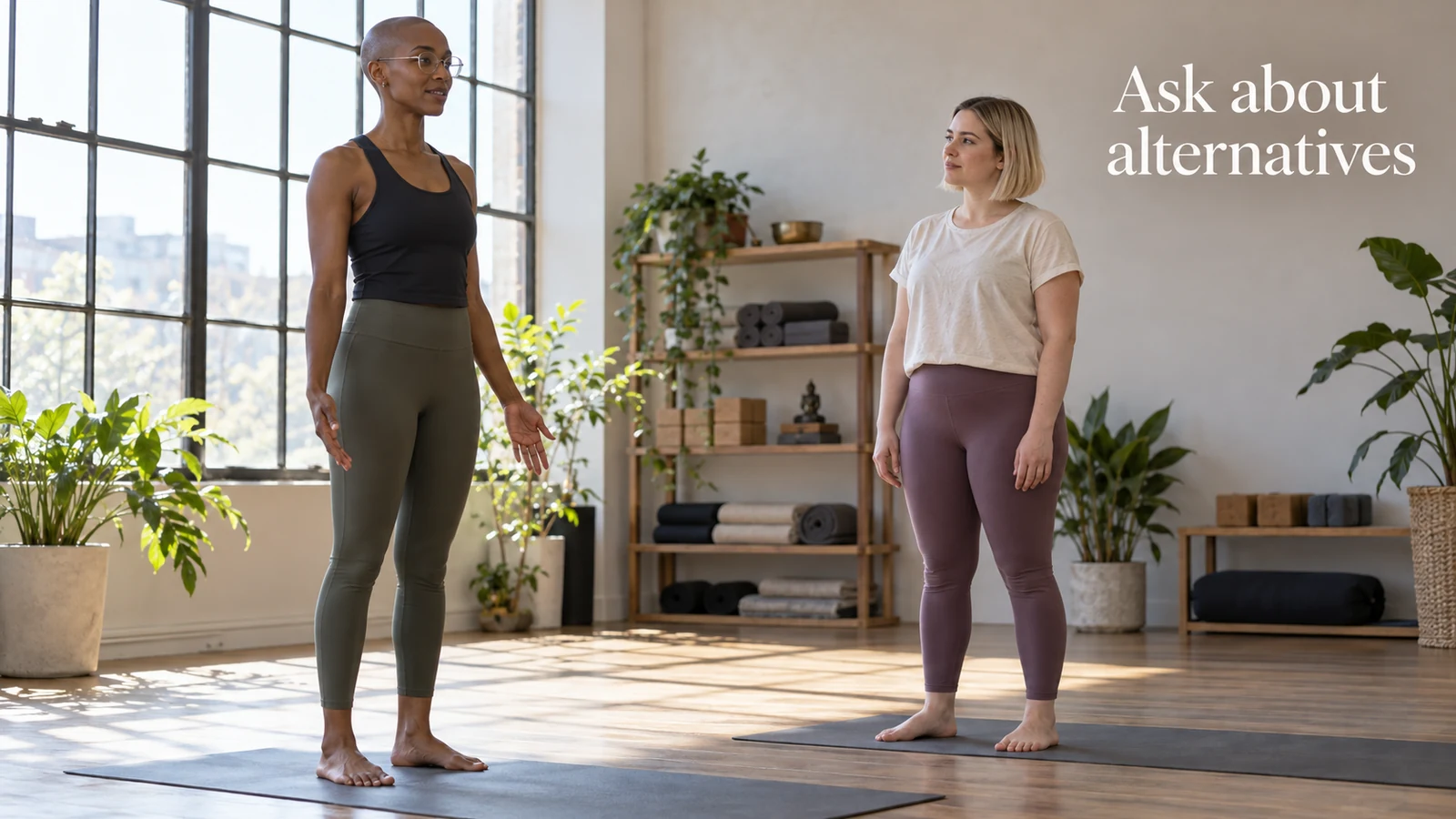
You need not negotiate yourself into a class that does not fit. A clear no-touch preference and a clear account of the available teaching format give you a basis for a decision. They do not oblige you to enroll once the questions have been answered.
CTA: If the wider group format is also unfamiliar, read our guide to questions before a first meditation group: https://soulfulglo.com/blog/first-meditation-group-questions. Its questions about participation and practical arrangements can help you prepare a separate inquiry about a group setting.
Fictional example: a first visit with a clear preference
Mira is comparing two local classes. The first listing says that participants receive individual corrections. She does not know whether that means spoken cues or physical contact. She sends a short message asking what corrections involve and whether she can attend without hands-on assistance.
The provider replies that adjustments are optional and suggests speaking to the instructor on arrival. Mira asks one follow-up: “Can you confirm that verbal guidance only is available throughout this class?” She wants to understand the actual option, not rely on the word optional alone.
On arrival she gives the teacher the same preference. She does not offer a private explanation, and she does not present her choice as a criticism of other participants. The purpose of the exchange is simply to make her requested arrangement clear to the person teaching.
This is an invented example of communication. It is not a testimonial, a report about a real studio or evidence that a particular approach produces a health benefit. A real provider might answer differently, leaving a different decision to make.
Fictional example: an earlier yes no longer fits
Jon has attended a class before and previously accepted assistance. This time he wants instruction without contact. He tells the teacher before the session: “I preferred hands-on help last time. Today I want verbal guidance only.”
He also asks whether another assistant will be working in the room and how to communicate his preference to that person. This addresses a practical gap: one conversation may not reach everyone involved. He is not asked by this example to explain why his choice changed.

Suppose a teacher instead treats the earlier yes as settling the question. Jon can repeat his current preference and decide whether to participate under the arrangements offered. The example does not tell him to tolerate contact while trying to produce a more persuasive reason.
The difference between these examples is the starting point, not the legitimacy of either preference. A first-time participant and a returning participant can both ask what will happen today. Familiarity with a room does not remove the need for clear communication.
Keep a short record of the arrangement, not a private case history
If a written answer helps you remember the details, keep the practical parts: which class, who answered, what alternative was described and whether you need to speak to the teacher. Do not add sensitive personal information merely because a booking form offers an open text box.
A short note also helps distinguish your request from the provider's response. “I asked for verbal instruction only” and “the studio confirmed that option” are different facts. Keeping them separate prevents a hoped-for arrangement from becoming a remembered promise that was never actually made.

Recheck the arrangement when the teacher or class format changes. You do not need to repeat an entire conversation automatically, but a different instructor may use a different process. Ask the question that remains relevant rather than assuming that a studio-wide label explains every session.
Questions readers often ask
Do I have to explain why I do not want an adjustment?
You can communicate the preference without providing a personal explanation. A practical statement tells the teacher what you are requesting. Whether the class can offer the arrangement is a separate question to resolve with the provider.
Does a consent card settle every proposed contact?
Ask how the specific provider uses it. A visible signal can communicate a preference, but its meaning and the teacher's request process still need to be clear. Do not infer that a particular card supplies all the information you need.
Can I change my preference after accepting assistance before?
State your current preference. Yoga Alliance's member policy does not treat previous permission as future permission. For the class you are considering, ask how the instructor handles a changed choice and make sure the available arrangement is clear.
What if the class cannot offer verbal guidance only?
Ask whether another class or format is available, then decide whether it suits you. You do not have to book while the arrangement remains uncertain. This guide cannot evaluate a provider or determine a suitable movement practice for you.
Choose with the unanswered question in view
Before booking, reduce the exchange to three things you understand: what contact might be proposed, how your current choice is requested and respected, and what instruction is available when you decline. If one remains unclear, ask about that point specifically.
CTA: For a separate look at the physical space you might use for a personal practice, read our small-space gentle yoga guide: https://soulfulglo.com/blog/small-space-for-gentle-yoga. Space planning does not resolve a class's contact policy; use each guide for its own practical question.