
A meditation listing can tell you when to arrive without telling you what will happen when you get there. Is it a guided session or a silent meeting? Can you use a chair? Are newcomers expected to introduce themselves? Those are ordinary questions, and the answers may matter more to your decision than an inviting photograph of a quiet room.
You do not need to decide whether you are a meditation person before asking. Start with one actual group you are considering and find out how it operates. This guide offers practical questions for choosing an optional session, whether it takes place in a room or online. It does not recommend a provider or establish that a group suits a particular health need.
Quick answer
Before joining a meditation group, ask who leads it, what the session includes and what newcomers are expected to do. Clarify seating or access needs, participation alternatives, costs and booking terms, and any recording or personal-sharing arrangements. Use the answers to decide whether this particular meeting fits you. You may ask for clarification, choose another format or decide not to attend.

Treat a group listing as an invitation to learn more, rather than a commitment. A welcoming description does not answer every practical question, and attending once does not require you to return. The questions below are examples you can adapt. They are not a certification checklist or proof that a service is safe or effective.
Find out what kind of meeting it is
Begin with the actual structure. Ask whether the time is mainly guided meditation, silent practice, discussion, instruction or a combination. Find out whether the advertised length includes introductions and a closing conversation. A meeting lasting an hour may contain several different activities; its title alone does not tell you how long any one practice lasts.
Ask whether the session stands alone or belongs to a course with earlier material. If newcomers can join midway, find out what preparation is expected. You may prefer an introductory meeting, or you may be comfortable reading a short explanation first. Neither choice requires you to judge the group or your own ability.
Check how the group describes its approach and any religious or cultural context. A tradition, secular class and informal community meeting can have different purposes. Ask about unfamiliar terms rather than assuming all meditation groups teach the same thing. You can respect a practice's context while deciding that another format better fits what you are seeking.
A useful question is: Could you describe the order of a typical meeting and which parts are optional? That invites a concrete answer. It is more informative than asking whether the session is relaxing, because an organiser cannot guarantee what your experience will be.
Ask who leads and how questions are handled
Find out who is responsible for the session and how to contact them with an ordinary practical question. Ask about their relevant training and experience. NCCIH specifically recommends asking about the training and experience of an instructor whose meditation or mindfulness practice you are considering. A clear answer provides information to assess; it is not an endorsement from this article.
Avoid treating a title, social following or polished venue as a substitute for that answer. Different approaches have different training routes, so do not invent a universal credential that every facilitator must hold. If a provider makes a particular qualification claim, look for information about what it means and who issued it.
Ask when newcomers can raise questions. There may be time before the session, a designated discussion period or a separate contact route. Knowing the arrangement can spare you from trying to resolve an important uncertainty while everyone else is settling down. You do not have to explain your whole personal history to ask how a session works.

If a listing promises treatment or specific health outcomes, separate those claims from a general meditation meeting. Ask what service is actually being offered and consult an appropriate health professional about individual concerns. Meditation should not replace conventional care or delay help for a medical problem, as NCCIH advises.
Clarify the participation choices
Ask what participants are invited to do, including whether instructions involve closing the eyes, using imagery, movement, chanting or speaking. The point is to understand this meeting, rather than to obtain permission to ignore its purpose. If an activity does not fit you, ask the facilitator what alternatives they actually offer.
For seating, describe the practical arrangement you need. You might ask whether chairs are available, whether you may bring an ordinary support or whether a particular area is accessible. Do not assume that a floor cushion in a photograph is the only option, or that the venue can provide equipment that its organiser has not confirmed.
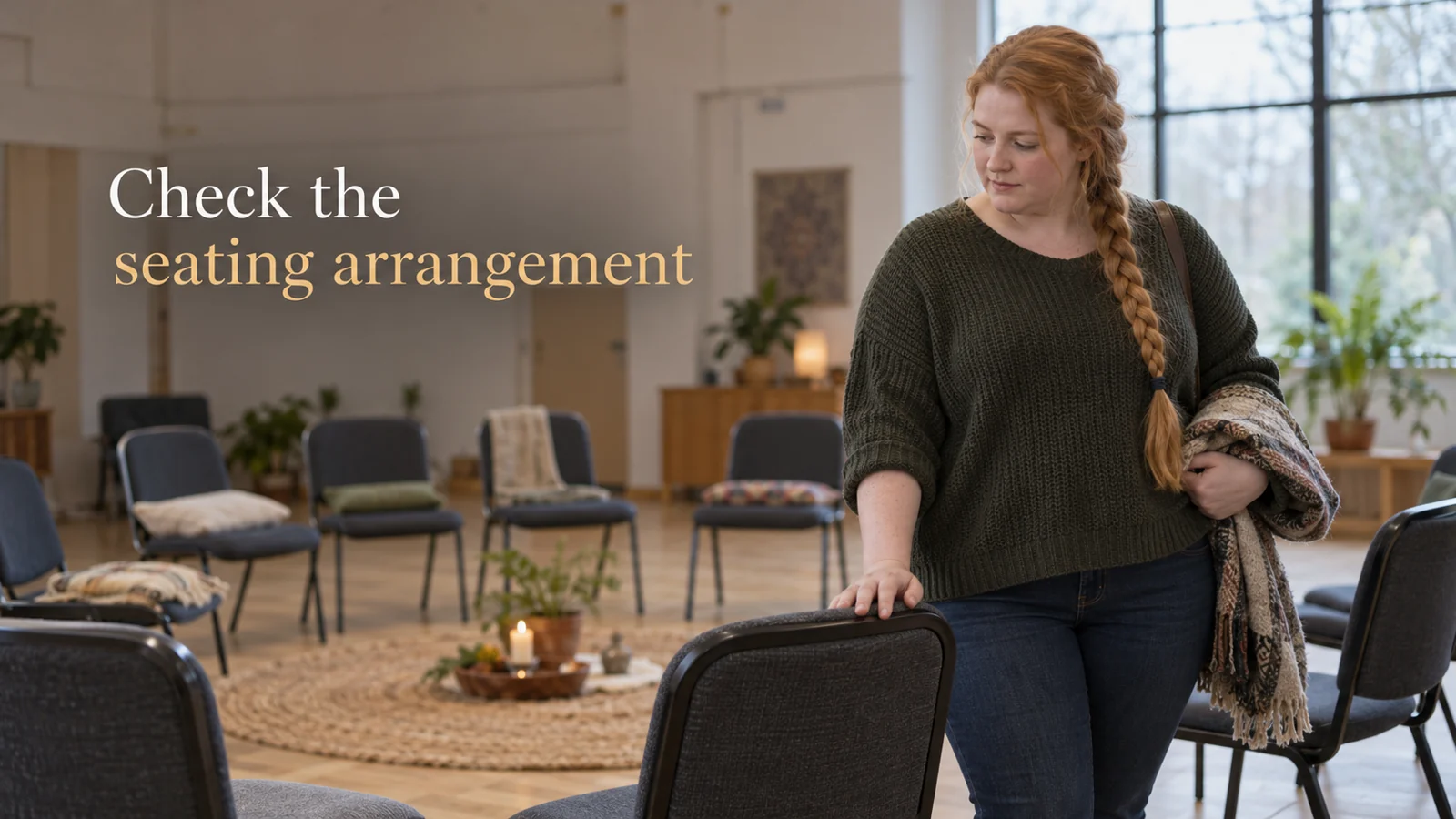
Clarify what happens if you need to pause, leave early or step away from an online session. A facilitator may explain a way to do so without interrupting others. Knowing the arrangement beforehand does not bind you to remain uncomfortable. An unresolved essential need is a reason to postpone booking or choose another setting.
If imagery instructions are the uncertainty, explore SoulFul GLO's meditation-without-visualization guide. It explains how to identify the particular demand in an instruction and ask about a literal alternative. Use that distinction to form your question; it does not establish which alternatives a group provides.
Check the practical access and cost
For an in-person meeting, confirm the actual entrance, arrival time and room arrangements with the provider. A building address may not identify the entrance you need. If stairs, facilities, transport timing or a late arrival could determine whether attendance is workable, ask about those points before making plans.
For an online meeting, check the platform, joining instructions and whether an account or installed application is needed. Use the organiser's legitimate information rather than links forwarded without context. You can check your own camera and microphone controls before joining, but do not assume a successful device test establishes access to the actual meeting.
Read the current price and booking terms. Ask whether payment is required, whether a donation is optional and what cancellation arrangements apply. A free introduction may differ from the following sessions. Treat unclear wording as a question to resolve rather than guessing what you will be charged.
Bring or use only what the organiser says is needed and what fits your circumstances. A first visit does not need to become an equipment purchase. If a specific item is required, ask whether an alternative is accepted or supplied. This guide does not recommend particular products or predict what a venue has available.
Know what sharing and recording mean
Find out whether introductions or discussion are optional, and what kind of information people are asked to share. You may be comfortable giving a first name but not describing why you came. Ask the organiser how someone can participate without disclosing personal experiences, rather than assuming every meeting expects a public account.
Ask whether the session is recorded, photographed or streamed, and who can access any recording. For online groups, ask how participant video, names and chat are handled. A general statement about a supportive environment does not answer these questions. Clarify the actual arrangement before sharing something you would prefer to keep private.

A group agreement can express expectations about confidentiality, but you cannot verify how every participant will behave later. Choose what you disclose with that limit in mind. Do not copy another person's account into your own notes or share identifying details merely because you heard them during the meeting.
Keep your own questions proportionate to the choice you are making. You can ask about the recording policy without asking for a list of everyone attending. If the answer is unavailable, decide whether you are willing to proceed with that uncertainty. You do not have to resolve every unknown in order to decline.
Use a short inquiry instead of a personal introduction
You can gather several practical answers in one concise message through the provider's stated contact route. For example: I am considering your introductory session. Could you tell me the usual order of activities, whether chairs are available and whether discussion and recording are involved? Adapt the wording to the questions that actually affect your decision.
Avoid sending sensitive details just to establish that your question deserves an answer. A practical access request may need specific information, but you can begin by asking how the provider handles that request and through which appropriate route. This example is a draft for your use; no message needs to be sent to anyone as part of reading the guide.
When the reply arrives, separate answered questions from assumptions. If the organiser confirms chairs but says nothing about early departure, the second question remains open. A friendly tone does not fill the gap, and a brief factual answer is not automatically unfriendly. Follow up on the missing point if it matters.

Two fictional first-visit decisions
A room that works, with one remaining question
In this fictional example, Noor finds an introductory group near an activity she already attends. The organiser confirms chairs and a short guided practice followed by discussion. Noor is comfortable with the location but does not want to speak about personal experiences in a group.
She asks whether listening during the discussion is an accepted option. If the answer is yes and the other arrangements fit, she can choose to attend. If speaking is central to this particular session, she can choose a different meeting. The decision concerns the format, without turning either choice into a judgment about her willingness to practise.
After attending, Noor may note whether the actual structure matched the description and whether she wants another visit. She does not need to grade her calmness or commit to a course immediately. These are imagined choices, not a customer account or evidence of a group's results.
An online session with an unclear recording policy
In another fictional example, Daniel likes the time offered for an online meditation group. The listing describes guided practice but does not explain whether participant video or discussion will appear in a recording. That uncertainty affects whether he wants to join with a camera.
He asks about the recording and participation options before booking. If he receives a clear arrangement he is comfortable with, he can make an informed choice. If the answer remains unclear, he can postpone or use another format. He does not need to test a privacy concern by joining and disclosing first.
Noor's question concerns speaking; Daniel's concerns recording. The same reassuring phrase would not answer both. Use the examples to identify the missing fact in your own situation, then ask the person responsible for that actual arrangement.
Review the fit after one visit
If you attend, compare the meeting with the information you received. Was the order understandable? Were the stated participation choices available? Did the practical arrangements work? Record concrete observations if you want to. One subjective experience does not establish a provider's effectiveness or tell you what everyone else experienced.
You can return, ask a follow-up question, try another format or stop. A group may be welcoming and still unsuitable for your schedule or preferences. If practice causes concerning distress, stop and seek appropriate support rather than treating attendance as a commitment to continue through it.

Frequently asked questions
Do I need experience before joining?
Ask the actual organiser. Some meetings introduce the practice; others assume earlier instruction or membership in a course. A newcomer-friendly label is useful starting information, but the session description and a concrete answer tell you more about what preparation is expected.
Must I share why I came?
Find out the group's actual participation expectations. You can choose what personal information to disclose and ask about alternatives before attending. If a required part of the format does not fit you, another meeting or individual practice may be a better option.
Does a group guarantee a better practice?
No particular personal result follows from joining. The group offers a setting and a structure you can assess. It does not prove health benefits, replace individual care or establish that practising alone is less worthwhile. Your choice can remain practical.
Can I choose individual practice instead?
Yes. A question about a group can end with a decision to use another format. You do not need an unsuccessful visit to justify that choice. Select guidance whose instructions and scope you understand, and seek qualified advice for health concerns.
To explore individual options, read SoulFul GLO's meditation overview. Check the actual available guidance and choose what fits your circumstances. A group meeting, an individual session and no session today are separate choices; none needs to be a test of commitment.