
You finished something that mattered to you: the final part of a personal project, a course you chose or an ordinary task that had taken several attempts. You want to remember the completion in your own voice. A short entry can preserve what ended, what you contributed and why you chose to mark it.
Choose a completion you personally want to remember. This guide offers a speaking plan, a preparation table and a fictional demonstration. You can use them to organise the entry around what finished, what you contributed and what you want to say about it now. Keep only the parts that help you speak.
Quick answer
Name the achievement in specific terms and say how you know that part is complete. Describe your contribution and any help or circumstances you want to acknowledge. Give your current response its own sentence, including mixed or neutral feelings. Close when the account contains what you want to keep. A recording can mark a completion without proving your worth or promising future results.
Choose what counts as the completed part
Use an endpoint you can describe. “I finished assembling the personal photo booklet I planned” gives a different starting point from “I am finally organised.” The first identifies an item and a chosen completion. The second makes a much larger judgment that the recording need not establish.

You might have completed one bounded part of a larger project. Say that part accurately: the first draft, the introductory session or the arrangement you had agreed to make. The wider project can remain unfinished. Keeping that distinction allows you to mark real progress without calling everything complete.
The Open University’s guidance on recording and reviewing development discusses accurate achievement records in an educational and career context. It also asks readers to consider circumstances that affect plans. That supplies a useful recordkeeping distinction. The private spoken exercise here is an original editorial adaptation, not formal evidence for a qualification or a clinically validated intervention.
Keep the subject personal enough to mean something
Choose the occasion because you want to remember it, rather than because it would sound successful to an imagined listener. Completing a small project may matter because it was something you freely wanted to make. Returning to an activity may be worth noting even when nobody else knows about it.
Say why you selected this completion in ordinary terms. Perhaps you wanted a usable booklet, a finished object or the experience of following through on a chosen activity. Try naming the detail you want to remember: turning the pages or using the object you made.
An ongoing quality is a different subject. SoulFul GLO’s voice-journal guide to personal values considers a quality you want to practise and one action related to it. Here, the focus is a completed endpoint. You can record either kind of reflection without requiring the achievement to certify a permanent character trait.
Make a small plan before recording
Check the actual recording arrangement
Use a place where you can speak without unintentionally capturing another person’s conversation. Check the tool’s recording, save and access controls. Include only information you are comfortable retaining there. A private-sounding entry title does not establish who can access a device, account, recording or transcript.
A few words on paper can hold the subject if that helps. You do not need a script or a performance voice. Choose a comfortable position and keep controls easy to use. Writing remains an option when speaking is inconvenient or would disclose the subject to people nearby.
Name the completion before explaining it
Begin with what finished and the timing you actually know. “This afternoon I completed the booklet I had planned” is enough context for an opening. If the date is uncertain, use an honest broad reference instead of inventing a precise one. A plain subject label can help you find the recording later.
Say what you mean by complete. Perhaps the pages are assembled, the final session has ended or the agreed task has been handed over. Use the actual endpoint rather than an emotional test. You can know that an object is finished while still feeling tired, uncertain about it or interested in revising it someday.
Describe your part and the conditions around it
Choose a few actions you actually took. You selected, arranged, checked, attended, practised or returned to something. Add the help or circumstances that matter to this account. Those details make your contribution understandable without requiring either a heroic story or a reason to dismiss it.

Receiving help does not erase your action. Equally, doing a substantial part yourself does not make everyone else’s contribution disappear. Give each part its appropriate place. Avoid assigning motives to another person or claiming that you know how they evaluate the finished result.
Give your present response a separate place
You might be pleased with one detail and relieved that a demanding task is over. You might have expected excitement and instead feel fairly ordinary. Say what you recognise now, or leave the feeling unnamed. The achievement and your present response can be recorded without making either depend on the other.

Finish after the account or add one sentence about why you want to retain it. There is no required recording length or compulsory lesson. You can mark this ending without immediately setting a larger goal, making a public announcement or promising to repeat the achievement.
A table for the parts of the spoken account
Use the table as an optional preparation aid. Its rows distinguish the jobs of different sentences. You need not answer every question, read the table aloud or make the recording sound like a formal interview.
| Part of the account | Optional question | Keep clear |
|---|---|---|
| Completed endpoint | What exactly finished? | Name the bounded result. |
| Completion evidence | How do I know that part is finished? | Use an actual state or event. |
| Contribution and support | What did I do, and what helped? | Give each contribution its place. |
| Present response | What do I want to say about it now? | No prescribed emotion or next target. |
A fictional demonstration: Ravi finishes a photo booklet
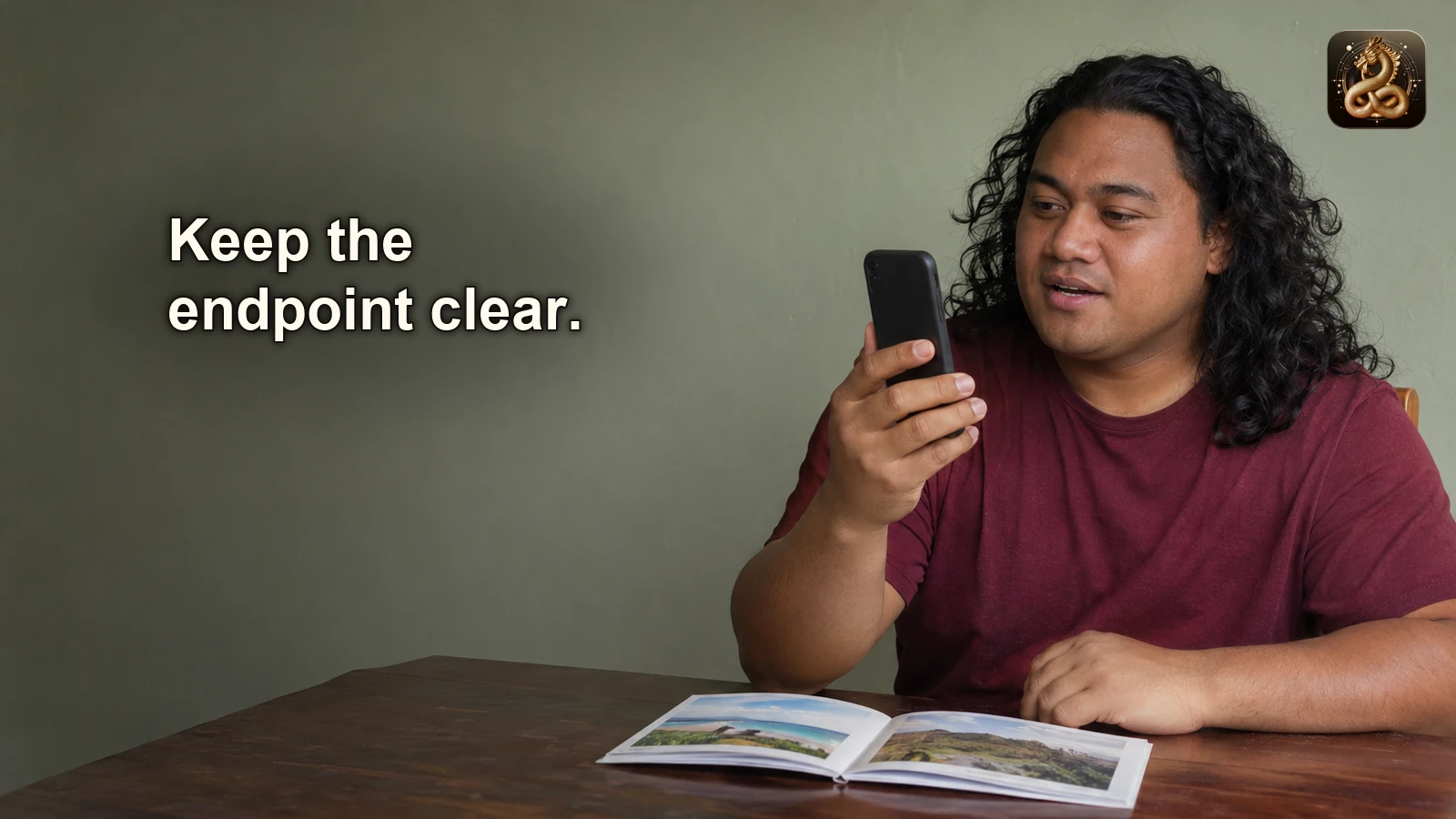
Ravi is an invented adult who has made a small personal photo booklet. He selected pictures he was permitted to use, added short labels and assembled the pages. The booklet is the item he planned, even though he could always choose to make another edition. He wants a private voice note about reaching this endpoint.
His opening is, “The little photo booklet is assembled now. I put the pages in the order I chose and checked the labels this afternoon.” When he listens back, the opening identifies what finished and when he checked it.
He adds his contribution: “I came back to it after leaving the loose pages on the shelf. The part I particularly wanted was having the pictures in one place.” He has included a concrete action and his reason for taking it. Those details are enough; he leaves the earlier pause as ordinary background.
He acknowledges support: “A friend helped me understand the binding instructions. I assembled the pages myself.” Both actions remain visible. He does not know how the friend would assess the booklet, so he leaves that response out of the recording.
His current response is mixed: “I like being able to turn the pages. I am also tired of choosing labels, so I am leaving it alone tonight.” He can enjoy one feature and want a break from the activity. Neither response changes the actual state of the booklet.

He ends with, “That is the completion I wanted to remember.” For a shorter entry, he could keep the opening and add, “Having the pictures in one place matters to me.” These two sentences preserve the endpoint and its personal meaning. This invented example demonstrates a way of composing the entry, not a testimonial or evidence of a wellbeing effect.
Choose a separate method for a learning question
SoulFul GLO’s hobby-learning journal guide is useful when you want to retain an attempted step, an instruction source and a question to revisit. Choose that task when it fits. A completion entry can stay with what you finished without requiring a technical review of how you made it.
When you start minimising the achievement
You may hear yourself saying it was only a small thing or that someone else would have done it faster. Ask what information that sentence adds. If the useful detail is that the booklet took several attempts, say that directly. Otherwise, return to the completed part.
Keep factual limits when they are relevant. Completing a first draft is different from completing the finished document, and attending an introduction is different from gaining a qualification. Accurate naming can coexist with appreciation. You do not need to inflate the record to give it a place.
A comparison with another person may also rely on information you do not have. You may see their finished item without knowing their time, resources or support. That uncertain comparison need not become the measure of your account. Describe your own conditions at the precision you actually know.
When the recording becomes a new assignment
You may move quickly from the finished task to everything you should do next. Notice the change of subject. You could finish the current recording with, “That belongs to another entry,” or keep a separate note if a practical reminder would help. Return only if you want to add something about the completion.
If an actual responsibility remains, keep its status clear. Perhaps a finished object still needs returning, or somebody is waiting for an agreed update. Recording your achievement does not complete that action. Handle the practical arrangement through its ordinary route rather than treating the voice note as evidence that everything is settled.
A leisure project can also end and remain ended. You might put the booklet on a shelf and leave the tools packed away. Another project can wait until you want one. If no follow-up is needed, the entry can close with what you completed and where you chose to leave it.
Check only what helps you keep the recording
After stopping, use the tool’s actual controls to check that the entry saved if you intend to retain it. Replay can help with an unclear beginning or a detail you want to verify. Listening to every pause is optional. An ordinary spoken account can contain restarts and imperfect phrasing.

If you notice an error, distinguish correcting a fact from polishing the story. A wrong date can receive a short clarification. An expression that sounds less impressive than you intended can simply remain ordinary. There is no need to turn the record into a speech for a future audience.
A transcript, if created, is another representation with possible mistakes and its own access arrangements. Check its wording before relying on a quotation or specific fact. This article does not establish that any particular journaling service supplies transcription, secure storage or a retrieval feature.
Keep wellbeing expectations proportionate
The useful outcome here is a findable account of a completion you chose to mark. Check whether the opening names the subject and the account includes what you wanted to remember. You can keep that version, use writing instead or decide the occasion needs no saved record. These are personal recording choices, not tests of a health effect.
Journaling is optional self-care, not medical treatment or a replacement for appropriate professional support. Change the subject or stop if the exercise becomes distressing, uncomfortable or repetitive in a way you do not want. No positive ending or confident self-description is required.
Frequently asked questions
Does an achievement need to be large?
Choose a completed endpoint you personally want to record. Its size does not determine whether the account is understandable or worth retaining for your purpose. Keep the description accurate and resist inventing significance for an imagined audience.
Can I record a partial completion?
Name the bounded part that is finished and identify what remains unfinished if relevant. A completed chapter, introductory session or project stage can be recorded as that part. Avoid presenting an intention or an ongoing attempt as a finished outcome.
What if someone helped me?
Describe your contribution and the relevant help separately. Acknowledging another person does not require removing your own actions from the account. Keep their private thoughts uncertain, and omit identifying details that the entry does not need.
Must I feel proud while speaking?
No particular feeling is required. You can record pleasure, relief, tiredness, uncertainty or an ordinary neutral response. The file can preserve what happened without becoming a test of how you should feel about completing it.
Keep another reflection format available
Explore SoulFul GLO’s journaling overview when comparing spoken and written reflection. Choose the format that suits what you want to keep. A single completed endpoint and an honest account of your part can be the whole entry.