
A journal entry can contain one sentence you want another person to read and several pages you would rather keep to yourself. Sharing the sentence is a separate editing decision. You can prepare a small copy for a particular reader without handing over the notebook, forwarding the whole document or inviting questions about everything around it.
The useful work happens before sending: choose a purpose, select the passage, check what its context reveals and inspect the actual copy. This guide offers an ordinary personal-writing workflow between consenting adults. It does not guarantee confidentiality or anonymity, and it is not guidance for legal evidence, clinical records, safeguarding concerns or workplace complaints.
Quick answer
Make a separate copy containing only the passage you want to share. Identify the intended reader and what you are asking them to do with it. Check names, surrounding details, quotations and missing context. Mark any edits that could change the apparent meaning. Read the finished copy on its own, confirm the destination and decide whether you still want to share it.
You can also describe the thought in a new sentence instead of quoting the entry. Choose that option when the original passage needs too much private background to make sense. A summary and an excerpt serve different purposes; label which one you are giving so the reader understands what they are seeing.
Decide what the reader needs to see
Begin with a modest purpose. Perhaps you want a friend to comment on the wording of a description, understand why an ordinary arrangement mattered to you or enjoy a small observation. Write the request separately from the passage. “Would you read these two sentences and tell me whether the setting is clear?” gives the reader a specific task.
Check that the person wants to receive the material. Quiet company, friendship or having shared something before does not establish agreement to read a personal account today. A brief invitation can name the subject without exposing the entry: “I wrote about our class project. Would you like to read a short description?” Leave room for a refusal or another time.
The request can include an ordinary boundary, such as asking them not to forward the copy. That communicates your preference; it cannot enforce control over every later copy. If the passage would be unacceptable outside this exchange, reconsider whether sending it fits your circumstances. A smaller description, an in-person conversation or keeping it private may suit you better.
Work from a separate copy
Keep the original entry apart from the version you are preparing. For paper, you might transcribe the selected lines onto another sheet. For a digital entry, use a separate document after checking its actual access arrangement. Avoid assuming that renaming an existing shared file changes who can open it.
Choose the smallest passage that serves the purpose. Start and finish at points where a reader can follow the thought without seeing adjacent private material. If a sentence depends on a name or incident explained earlier, decide whether a short contextual note is enough. Expanding the excerpt repeatedly can turn a limited invitation into a much wider disclosure.
Preserve a private source pointer if you want to find the original later: a date, notebook label and page reference may be enough. The reader does not necessarily need that pointer. Keep administrative details out of the shared copy when they add information unrelated to your request.
Check what the remaining details reveal
Removing a name does not necessarily make someone unrecognisable. A distinctive role, location, date or combination of events may identify them to the intended reader. Read the passage for the picture created by all its details together. Consider whose experience is being described and which parts are yours to explain.
Pay particular attention to another person's messages or exact words. A private entry may include material you received for a different purpose. Instead of reproducing it, you could describe your own response without quoting the message. Where permission is relevant, ask rather than assuming that possession of a quotation makes sharing it appropriate.
A photograph of a notebook can include more than the selected lines: another page, a label, a reflection or objects nearby. Transcribing a passage into a separate copy may give you more control over what you include, although it does not make the destination secure. Review the actual file you intend to send, not merely the text you meant to select.
The Federal Trade Commission's sharing guidance notes that online material can reach a wider audience and be copied. Its page addresses young people; those general cautions are relevant here, but it does not certify this adult journaling workflow or any particular app's privacy.
Keep omissions and new wording understandable
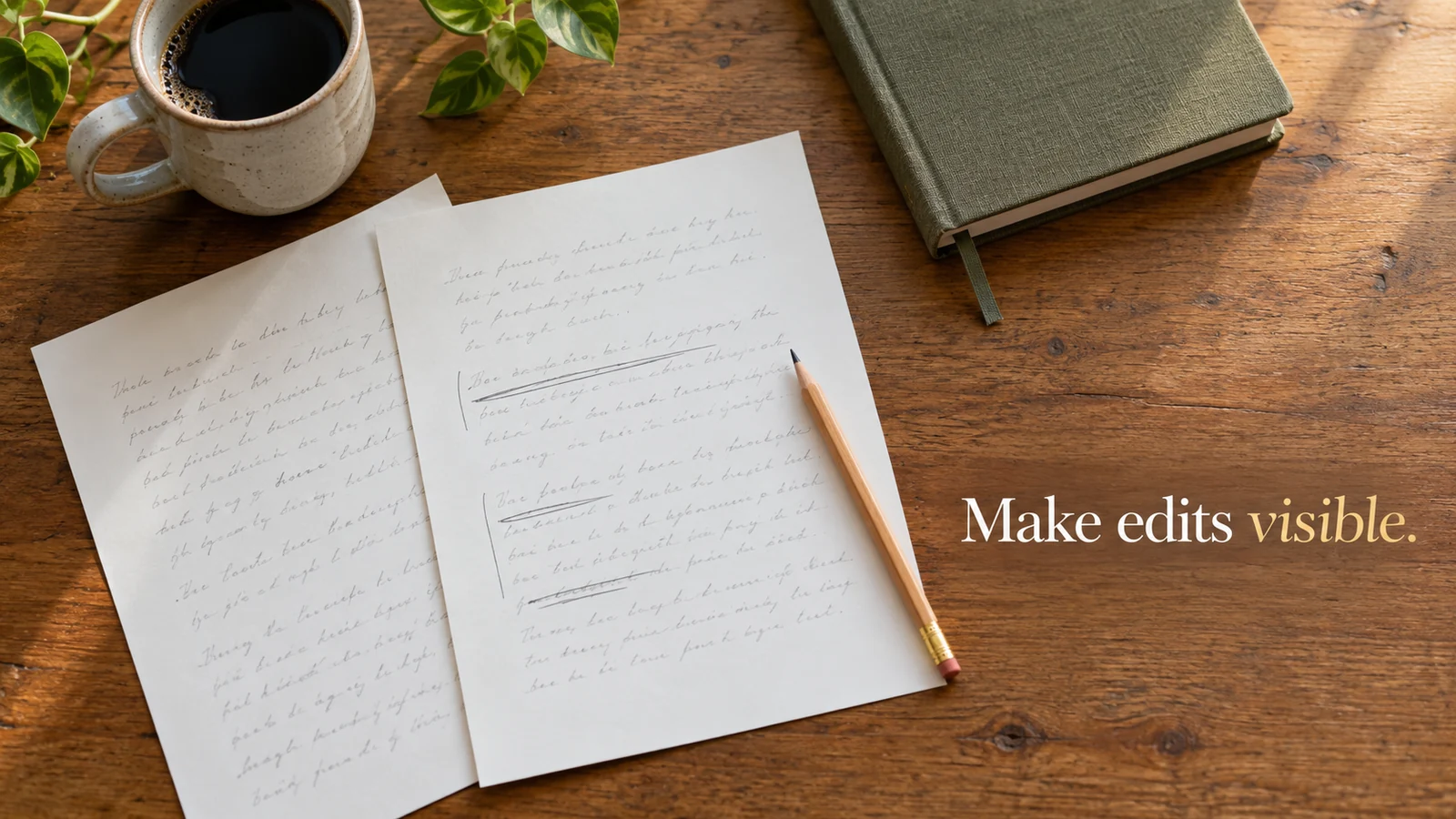
An excerpt can be shorter than the original without pretending to be the whole entry. A plain label such as “Selected passage from my journal” establishes that boundary. If you remove words within a passage, explain an omission where it matters to meaning. You need not display sensitive removed material to show that editing happened.
Be careful when deleting a qualification. “I thought the room was empty, but I had not checked the back corner” has a different meaning from “The room was empty.” The shorter version turns uncertainty into a claim. Read for changes in certainty, sequence and who did what, especially after joining sentences from different places.
If you rewrite the passage substantially, call it an adapted passage or a new summary. That lets you improve clarity without presenting today's wording as an exact historical quotation. Keep any original and revised versions you want privately, using their actual dates rather than making a later explanation appear to have been written earlier.
For a different writing exercise, SoulFul GLO's guide to adapting a journal prompt explores changing the question before writing. You can use that approach for a new entry while leaving the wording of an older entry intact.
Read the copy as someone without the notebook
Set the original aside and read only the prepared version. Can the reader tell whether the words describe a past event, a current interpretation or an imagined example? Add a short introduction if needed. “This is a description I wrote after the class; it reflects what I remember” may be more useful than adding another page.
Check references such as “there,” “that day” and “she.” Replace or explain them only as far as your purpose requires. A passage can remain deliberately general. The reader does not need every identifying detail to give feedback on a sentence's clarity or understand that an arrangement mattered to you.
Then read your request again. Does the copy supply what the person needs to answer it, or have you included unrelated material because it was nearby? Remove unnecessary additions. If the exchange now concerns something different from the invitation, ask whether the person wants that conversation before sending the expanded version.

Fictional example: asking about a description
Imagine a fictional writer, Leena, wants feedback on a description of a community pottery class. Her original entry also contains personal reflections about other matters. She asks a friend whether they would read two sentences about the room. The friend agrees to comment on the setting, so Leena makes a separate copy of those sentences.
One sentence begins “After that conversation, the shelves looked different.” It depends on private context absent from the excerpt. Leena decides that she wants feedback on the room itself, so she writes a new description instead of pretending the original sentence stands alone. She labels the result “A description adapted from my notes,” with a request about whether the shelves are easy to picture.
Before sending, she checks that the attachment contains only that description. She leaves the notebook closed and does not photograph it. These choices illustrate a controlled editing scope, not a guarantee about what her friend will do with the copy. Leena is an invented character, and the example supplies no evidence of a wellbeing outcome.
Fictional example: keeping a thought but changing the form
A second fictional writer, Tomas, wants to explain why a shared meal stayed in his memory. His entry includes a relative's private message and a description of several people. Initially he selects most of the page. Reading the copy alone, he realises that his actual purpose concerns one observation: he enjoyed making space for a longer conversation.
He chooses to write a new sentence about that observation and leaves out the message and other people's descriptions. He tells the intended reader that this is his present summary, not a quotation from the journal. The narrower version still serves his purpose without requiring him to disclose the page as evidence that the thought is sincere.
The example does not mean every account should be reduced to a positive statement. Tomas could have wanted to express disappointment or uncertainty. The editing question would remain the same: which words serve this particular exchange, and what unrelated information would accompany them? The appropriate amount of detail depends on the writer, recipient and circumstances.
Check the destination before sending
Inspect the actual recipient, audience and attachment in the tool you will use. A group conversation differs from a message to one person. A shared document may have access arrangements different from an attached copy. Consult the provider's current instructions for its controls; this article does not prescribe universal settings or claim that a particular service prevents copying.
If you notice an uncertain destination or unexpected content, pause the send and resolve it. Do not rely on the filename as proof of what the file contains. Open the final copy and check the beginning, ending and any notes around the passage. This is a review of your intended disclosure, not a security certification.
Afterward, the reader may ask about material beyond the excerpt. Decide separately whether to answer. Sharing one passage does not commit you to supplying the full entry. You can also change your mind before sending without finding a better explanation for the decision. The writing already exists whether or not it receives an audience.

Frequently asked questions
Do I need to share the original page?
No. You can provide a selected transcription, an adapted passage or a present-day summary, with a clear label. Choose a form that suits the reader's agreed purpose. An image of the original may disclose adjacent material that an excerpt does not need.
Is replacing names enough to protect privacy?
It may reduce some identifying detail, but other context can still identify people. Consider the passage as a whole and the actual audience. This guide cannot determine anonymity or establish that a particular disclosure is safe.
Can I ask someone not to forward it?
Yes, where that request fits the exchange. It expresses a boundary rather than guaranteeing control over future copies. Choose what to share with that limitation in mind and avoid treating a promise as a technical protection.
What if I change many words?
Label the result as adapted or summarised rather than presenting it as an exact quotation. You can keep the original entry unchanged and record a separate date for the new version. Accuracy about the form helps the reader understand the material.
Does sharing make journaling more useful?
That depends on what you want from the exchange. This article offers editing choices, not a promise of insight, connection or therapeutic benefit. A private entry can remain private; the decision to share is optional.
For the separate question of where a whole entry lives, read SoulFul GLO's private journaling guide. It considers ordinary access and storage choices before you decide what to record.