
A question in a journal can assume something that is not true for you. It might ask what you learned from a difficult day when you do not want to give that day a lesson. It might ask about a partner you do not have, or describe a feeling you have not experienced. You can change the question before deciding whether to answer it.
Adapting a prompt is an ordinary writing choice. The printed wording is a starting point, and you remain responsible for what you choose to put on the page. This guide offers an editorial method for changing the premise, scope or language of a personal reflection question. It is not a psychological assessment or a treatment exercise.
Quick answer
Read the question once and identify what it assumes. Keep any part that is useful, remove the assumption that does not fit and narrow the question to an event or time you actually want to describe. Try the revised wording with one sentence. If you still do not want to answer it, choose another question or leave the page.

For example, change the fictional prompt “What did this setback teach me?” to “What happened, and is there anything I want to note about it?” The second question leaves room for no lesson. It also lets the writer describe an event without calling it a setback. Neither version guarantees insight; the useful version is the one you choose for this entry.
Identify the assumption before changing the answer
Look at the nouns and verbs in the question. Does it assume that you are grateful, ready to forgive, working toward a goal or responsible for changing an arrangement? Does it name a relationship, job or living situation that is not yours? You can notice the mismatch without supplying an answer that makes the original wording appear correct.

Suppose a fictional question asks, “How did your family support your goals this week?” A writer might have received no such support, might not have a goal in mind or might prefer not to write about family. Those are different reasons for changing the question. A replacement could be “Was there any practical support I want to record this week?” It can also be “I do not want to write about support today.”
Keep the revision close to your purpose. If you wanted to remember an ordinary afternoon, you do not have to turn it into an evaluation of your relationships. Ask what you noticed that afternoon. If the prompt raises something distressing, leave it aside and use support suited to your circumstances rather than treating the page as a requirement to continue.
Change one part at a time
Make the time frame smaller
A question about your whole life may be too broad for the entry you want to write. Replace “What always gets in my way?” with “What interrupted the task I tried this morning?” The smaller version concerns one occasion. It does not require you to establish a permanent pattern or explain your character.

Use words you would ordinarily use
A prompt might use a phrase such as “highest self” when you would rather describe an ordinary choice. You could ask, “What choice would I be comfortable making here?” This changes the vocabulary without requiring you to agree with the original idea. You can retain the question's practical topic while leaving its language behind.
Allow uncertainty in the response
Questions beginning with “Why did they” can encourage guesses about another person's motives. If you do not know, try “What did I observe, and what am I uncertain about?” You can record an interpretation as an interpretation. The prompt does not give you access to someone else's intentions.
Try the wording with one sentence
Write a short response to the revised question and check whether it describes what you meant to write about. You might find that the topic is useful but the time frame is still too wide. Change that part or stop. This is a practical test of the wording, not a score for the entry or evidence that the exercise has improved your wellbeing.

If you are using the same question on several dates, keep the revised wording beside your response. Later entries may concern a different question even when the heading looks similar. Recording the words you actually answered can help you understand the context when you choose to reread the notebook.
Keep a question and a task separate
Some prompts ask for reflection and a decision at the same time. “What is bothering you, and what will you do to fix it?” contains two jobs. You may want to describe an event without choosing an action. Split the question: “What do I want to record?” can stand alone. A separate question about action can wait until you actually want to consider it.
This distinction matters when the original question implies that an answer must end with a plan. An entry can contain uncertainty, a small observation or an unfinished thought. If a practical task does emerge, decide separately where to keep it. The SoulFul GLO guide to journaling without a to-do list explores that boundary between a reflection and an action record.
Explore another writing format
If you want a different starting point, read SoulFul GLO’s journaling-after-meditation guide. Its questions offer another context for reflection; you can choose one, adapt it or leave it aside. This prompt-editing method works without a paid app or a special notebook.
Worked example: a question that assumes gratitude
Imagine a fictional writer, Noor, opens a notebook after a frustrating afternoon. The supplied question says, “What are you grateful for about this experience?” Noor wants to describe a cancelled arrangement and does not feel grateful. Answering a different question would let the entry reflect that actual position rather than make a positive interpretation a condition of writing.
She identifies the part she wants to keep: writing about the afternoon. She removes the requirement to appreciate it. Her revised question is, “What happened with the arrangement, and which detail do I want to remember?” A possible first sentence is, “The visit was cancelled after I had already set off.” That records an event without deciding what the event should mean.
Noor could also write about something she appreciated, if she wanted to. The revision leaves that choice open. It does not prescribe a negative response or suggest that gratitude is always unsuitable. The practical issue is whether the question permits her actual answer. Noor is an illustrative character, not a real customer or evidence of an emotional benefit.
If you use this example, begin with your own words rather than copying the fictional answer. Choose an ordinary situation you are comfortable recording. You can change “what happened” to “what I noticed” when the event itself is already clear, or stop after noting that the original question does not fit. There is no required amount of detail.
Worked example: a question that asks for certainty
A second fictional writer, Ellis, sees the question, “Why did your colleague ignore your idea?” Ellis knows that a suggestion did not receive a reply during a meeting. He does not know whether the colleague heard it, disagreed or intended to return to it later. The question contains an explanation that the available information has not established.
He changes it to, “What response did I observe, and what information am I missing?” His entry can describe the unanswered suggestion and his reaction without presenting a motive as fact. If he later wants to clarify the meeting, that is a separate practical choice. Writing the entry does not require him to send a message or initiate a discussion.
The revised wording can still make room for frustration. A factual description does not require Ellis to feel neutral or dismiss his reaction. He can write, “I felt disappointed when there was no response,” while leaving the reason uncertain. This example concerns an ordinary ambiguous exchange, not a method for assessing harassment, coercion or another situation requiring appropriate support.
Keep your revision visible when context matters
You may want to keep both the supplied question and the wording you answered. Label them plainly, such as “Original question” and “My question today.” That makes the change understandable if you reread the page. It also prevents a later reader, including yourself, from assuming that an answer concerned wording you deliberately chose not to use.
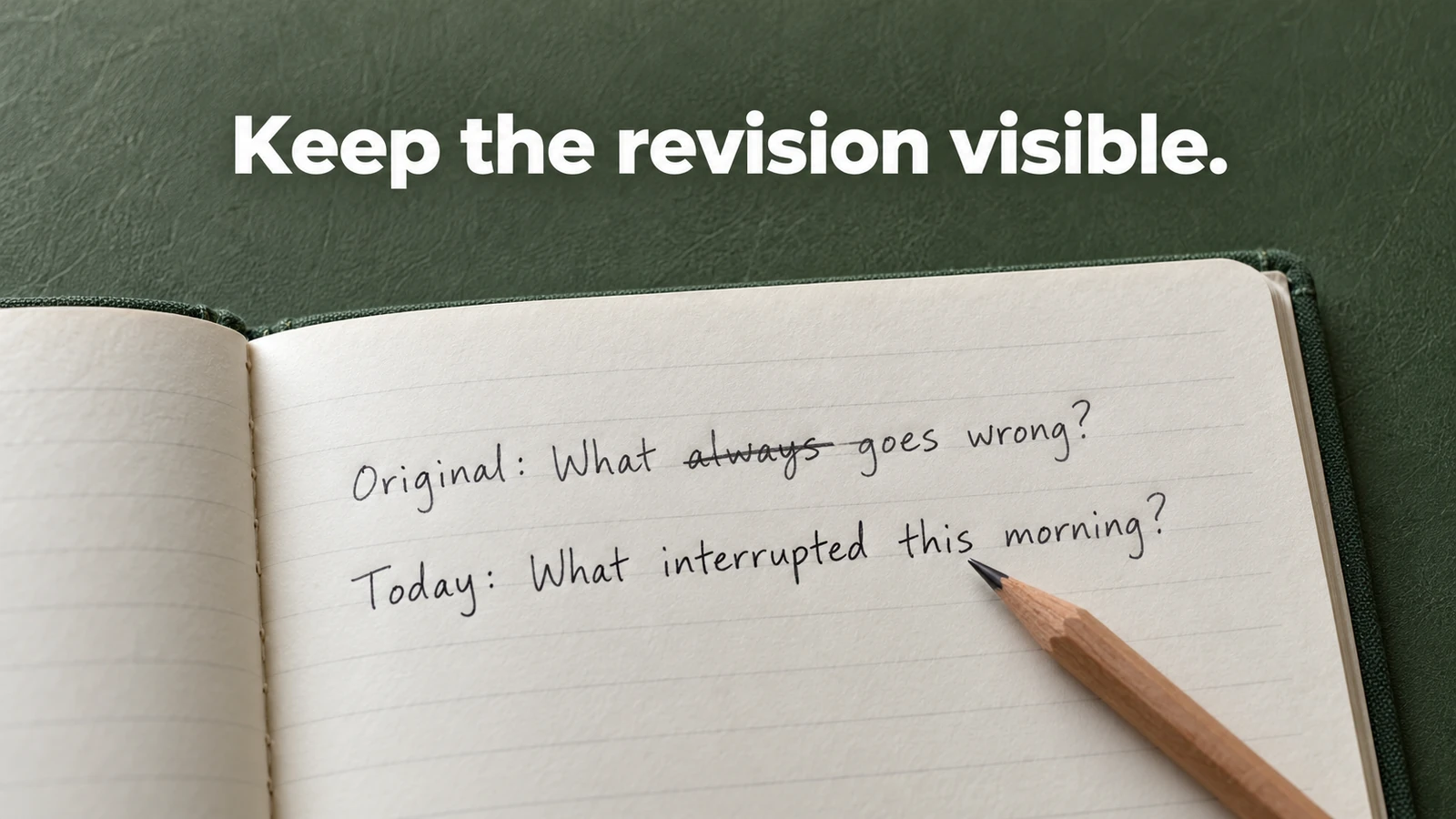
For a private notebook, this can be as simple as writing the revised question above the entry. You do not need a formal log of every edit. If you record dates, use the actual date of the revision rather than making a new question appear to be part of an earlier entry. Keep later interpretation separate from the original record.
Revising a personal prompt differs from changing a questionnaire used by a clinician, researcher, employer or other formal process. This article concerns optional personal writing. If a form has a defined purpose or scoring method, follow the appropriate instructions and ask its provider about unsuitable wording rather than treating a rewritten response as equivalent.
Choose when to leave the prompt
Editing is optional. You may find that the subject itself is something you do not want to write about. In that case, replacing a few words will not necessarily make the question useful. Choose another topic, write without a question or close the notebook. A prompt does not create an obligation to disclose personal information, reach a conclusion or continue through distress.

Privacy can be another reason to skip a question. Consider who may see the notebook or device before recording names, relationship details or sensitive events. The shared-household journaling guide discusses ordinary choices about access and storage. A discreet question or label does not guarantee privacy, and this article does not provide concealment advice or a security assessment.
Frequently asked questions
Can I disagree with a journal prompt?
Yes. For optional personal writing, disagreement can be your response. You might explain which assumption does not fit, replace the question or choose another subject. You do not need to make the original wording true in order to use a notebook.
How much should I change?
Change the part that prevents the question from serving your purpose. That might be one word, a time frame or the entire premise. Try the revised version with a sentence before spending time polishing it. If the subject is unsuitable, choose something else.
Does changing the question make earlier answers invalid?
No. They remain responses to the questions you answered then. Keep the wording and context visible when you compare entries. Different questions may invite different material, so do not treat a change in answers alone as proof that your wellbeing or circumstances changed.
What if the prompt comes from a formal assessment?
This method is for optional journaling, not for altering a scored assessment or official record. Ask the relevant provider how to handle wording that does not apply. A personal rewrite should not be presented as an equivalent assessed response.
Do I need a new prompt for every entry?
No. You can reuse a question, write without one or adapt it as your purpose changes. A familiar question may suit an ordinary check-in. Keep its actual wording with the entry when that context matters to you.
Choose your next reflection
For a separate reading exercise, explore SoulFul GLO’s guide to reviewing old journal entries. Keep today’s question with today’s response, then decide whether you want to return to it later. You can finish after a single useful sentence.