
You set an intention to make time for drawing on Saturday mornings. Then your work hours change, and Saturday morning is no longer free. You still want to draw. The words you chose describe an arrangement you no longer have, so repeating them without a change may leave you practising a plan that cannot happen as written.
Revising an intention can be an ordinary response to new information. If you use manifestation as a form of reflection, you can keep what still matters and change the part that depends on a time, place or resource you no longer have. A revised sentence does not guarantee an outcome or make a practical constraint disappear. It can give you a clearer action to consider.
Quick answer
Write down the part of the intention you still want, the specific circumstance that changed and one action you can realistically choose now. If no action fits, date a short note and pause the intention. A useful revision describes what you can do under the present conditions. It does not require you to say that the original plan has already worked or that a different plan will definitely succeed.

Name what changed in plain words
Start with the difference between the earlier arrangement and the current one. “The community room is closed until June” gives you a circumstance to account for. “Nothing is working” may describe how it feels, but it does not tell you which part of the plan needs attention. You can write both lines if they matter, then use the concrete one to make the revision.

Check whether the change is established or expected. If the building is closed today and the reopening date is unclear, keep those two facts separate. You can make a plan for this week without assuming it must last all spring. If the venue is still open but may close, you might want a fallback rather than a full change now.
Some changes come from a decision you made: you no longer want to use the first method, or the activity no longer suits the time you can give it. That can be enough information. You do not have to prove a dramatic outside obstacle to make a different choice.
Separate the purpose from the original method
Look for the part of the intention that would still make sense if the original means went away. A Saturday drawing group may have been a way to make art, to see friends, or to use a room where you had space for materials. Those purposes overlap, but different alternatives would serve them.

If the point was having a place to use larger paper, moving the session to a crowded kitchen table may not serve the same purpose. If you simply want to draw more regularly, one small sketch while waiting for water to boil may suit an ordinary day. The change does not have to look like a scaled-down copy of the earlier plan. It needs to serve something you actually want.
Sometimes the purpose no longer matters as much as it did when you wrote it. You can say that clearly rather than preserving it through a series of increasingly indirect substitutes. Setting an intention aside leaves room to recognise a different priority without making a claim about what will happen next.
Use the constraints that are actually present
List the practical limits that affect the next action: the time you have, the place you can use, the money you are comfortable spending or the support that is genuinely available. A short list often tells you enough. Avoid filling the page with every problem that could arise.

An intention about working on a small project may need to reflect a shared space. “I will work at the dining table every evening” depends on other people's use of that table. “I will check whether the table is free on Tuesday and choose a small piece I can put away” accounts for the arrangement without assuming the rest of the household has made the same choice.
Do not force the revision into a schedule merely because the old sentence named a schedule. You can choose a condition you can recognise: “When the room is available and I still have energy, I will open the folder and look at the next drawing.” If that condition rarely happens, it is information you can use rather than evidence about whether you believed strongly enough.
Keep other people's choices separate
If your intention depends on someone else taking part, SoulFul GLO's guide to manifestation intentions and other people's choices can help you distinguish your own action from their response. A change in availability can call for a new invitation or a different arrangement.
Give the revised intention an action and a boundary
Try a sentence you can read without having to translate it into a plan. “I want to make time for drawing, and I can try a short sketch on one afternoon that is free” keeps the purpose and action close. You can name which afternoon after you check your actual week. The sentence does not require you to describe a future practice as an accomplished fact.
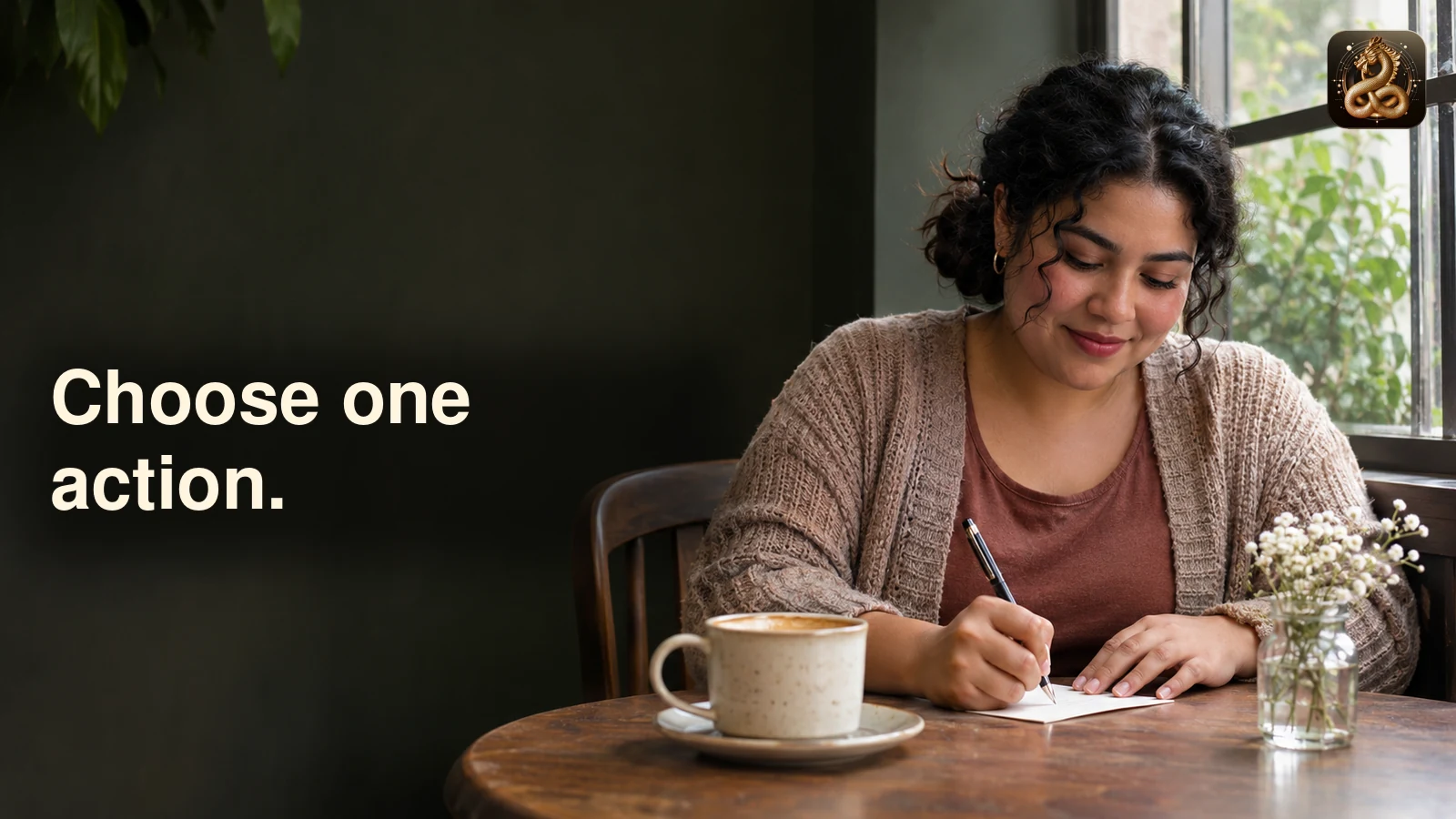
A boundary can make the action easier to assess. You might decide to keep it to materials you already have, use one session before changing your calendar or stop after a manageable first step. The boundary is there to tell you where this particular attempt ends. It does not need to set the permanent size of the activity.
If you use the intention during meditation, you can read it once and choose a practice you already understand. Return to the practical sentence afterwards if you want to decide whether to act. Time spent reflecting does not have to include repeated affirmations, imagining a result or checking whether the revision feels convincing.
Choose between replacing, pausing and letting go
Replace the original sentence when you know what part of it you are changing and can name a different action. Keep the older wording if it helps you remember why the change was necessary. Adding a date can distinguish the version you are trying now from the version that once suited your circumstances.
Pause when the missing information would change the plan. For example, you may want to attend a short class but cannot check the new session time until the organiser publishes it. “I will revisit this when the times are available” is enough. You can decide later whether the class still serves the purpose you had in mind.
Let the intention go when it no longer describes something you want to do. A private note such as “I am using that time for something else now” can mark the change without turning it into an evaluation of your earlier decision. The original intention can have made sense when you wrote it.
If several parts of the plan have changed at once, make one note that says which part you are reconsidering first. A later opening time and a longer journey might both affect whether you can attend a class. Before looking for a different class, it may help to ask whether you still want to make that journey. The answer can narrow the search without requiring you to solve both constraints immediately.
Try reading the revised sentence tomorrow without the earlier page beside it. If it says only “make it work in another way,” add the one action or question you intend to use. If it describes something you would have to persuade someone else to do, bring it back to your own choice. The wording can stay short.

Two ordinary revisions
Anya wanted to meet a friend at a weekly drawing group. The room closed for repairs. She notices that part of what she wanted was conversation while working on something small. Instead of finding a new weekly class immediately, she checks whether her friend would like to meet once at a table they can use. Her intention names the invitation she can make, and leaves the reply open.
Dev planned to read a few pages after dinner because he wanted to spend more time with books he already owned. His evenings have become busier. He tests keeping the book near a chair he uses in the afternoon. His intention becomes “I will read a page if I have a quiet pause here.” He does not treat the afternoon arrangement as proof that his evenings will settle down.
The examples are fictional. Each keeps a purpose and changes a means. Neither assumes the action will work every time. A clear next observation might be that the table was useful or that the book was still difficult to reach. That information can shape another practical decision.
Keep the first test small enough to abandon without a new obligation. For example, borrowing a table for one afternoon tells you something about that space without asking you to book a series of sessions. If the first attempt shows the activity needs more room than you have, you can use that information before spending money or asking anyone to commit to a regular time.
Check the result at the level of the action
After trying the revision, look at what happened. Did you have the time you expected? Was the place available? Did you want to continue once you started? Those questions can tell you something about the arrangement without requiring a judgment about how well you manifested.
If you did not take the action, avoid filling the gap with an explanation you cannot establish. It may be clear that the space was occupied. It may be unclear why you did not feel like starting. You can name the fact you have and decide whether to keep the same wording, change one part or leave the subject for another time.
You can also notice a result that was different from your purpose. If sketching once felt pleasant but did not lead to a regular practice, both facts can stay in view. You do not have to turn a small observation into a promise of what will happen if you repeat the same words.
Frequently asked questions
Is changing the wording the same as giving up?
A change can mean that you still want the purpose and need another means. It can also mean the priority has changed. Read the earlier sentence and identify which part you are choosing to keep. You can make that choice without judging the original wording.
Can I revise the intention while the situation is still uncertain?
Yes, if the revised sentence makes the uncertainty visible. You can state the action you can take now, or the information you are waiting for before making another decision. Leave the unknown part open.
Do I need to keep the old intention?
Keep it if it helps you understand the change. A dated note can be enough. If you prefer to use only the present wording, you do not need an archive of every version.
Will a more realistic intention make the outcome happen?
A realistic sentence can clarify a choice you can make. Outcomes still depend on circumstances and other people. Use the wording as a reflection aid and judge the next action on what you can actually observe.
Choose a form that leaves room for revision
If you prefer an image to a sentence, use SoulFul GLO's guide to making a personal vision board without treating it as a prediction. Keep real constraints visible there, too. For a written intention, a dated sentence and one practical choice are enough to start.