
An ordinary journal entry often begins with a question and then tries to answer it. For a different writing experience, you can let one question lead to another and leave the answers outside the entry. The page becomes a record of what you are curious about, including where your knowledge ends.
This is an optional creative constraint. It does not uncover hidden truths, diagnose a problem or require you to reach a decision. Choose a modest subject you are comfortable recording, and stop if the format becomes repetitive, uncomfortable or simply uninteresting.
You do not need to turn every thought into a polished question. The useful task is to write a short sequence whose connections you can follow. A handful of genuine questions can stand as the whole entry without a summary explaining what you learned.
Quick answer: keep the next question connected
Choose one ordinary subject and write a question you do not already intend to answer on the page. Read it, notice a word or assumption worth exploring, and write the next related question. Keep guesses visible, avoid disguising accusations as questions and finish before you start filling space.

The entry itself can contain only questions. A date or simple subject heading may sit outside it if you want one. You do not have to add an answering voice, a lesson, a plan or a final declaration of insight.
Choose a subject small enough to stay with
Begin with something bounded: a shelf you rearranged, a hobby you tried or a familiar route you noticed differently. A question about your entire future can pull the entry in too many directions. A small subject gives the chain a shared reference.

Choose material you are willing to put into this particular notebook or device. A question can still reveal private information, including a name, place or implied relationship. Removing an answer does not make the subject anonymous or guarantee privacy.
Keep urgent decisions and matters needing professional support outside this creative exercise. A chain of questions cannot establish a diagnosis, meet a formal responsibility or replace a necessary conversation. You can choose a lighter subject or leave the page.
You may start from a detail rather than a problem. Wondering which part of a walk you remember can be enough. The format does not require a difficulty to solve or a negative feeling to transform into something positive.
Write a genuine opening question
Use ordinary words that make sense to you. Ask something whose uncertainty you are actually willing to leave on the page. “Which part of the afternoon am I still curious about?” opens a different entry from a question that already contains a verdict about the whole day.
Avoid beginning with a demand to explain your character. A sentence such as “Why am I always incapable of finishing?” assumes a permanent pattern and a harsh conclusion. If you want to explore a particular unfinished project, ask about that project and the details you know.
A question mark does not remove an assertion. “Why did everyone dislike the idea?” still assumes that everyone disliked it. You might instead ask what responses you noticed, which responses you did not hear and what you would need to ask directly.
You can also begin with a neutral question about an object or activity. “What am I noticing about this arrangement?” leaves room for interest without making improvement compulsory. The entry may remain exploratory even when no change follows.
Let one word carry the next step
Read the first question once. Choose a word or detail that invites another genuine question. If you asked about an afternoon project, the next line might concern which part you remember, how you are describing it or what remains unknown.

Keep the connection visible enough that you can follow it later. Each question need not introduce a new subject. Moving from a whole project to one material, then to a choice about that material, can give the chain a clear direction without requiring an answer.
Do not treat this as a puzzle in which the correct next line is hidden. More than one question may fit. Choose one that interests you now, and leave the others unwritten unless you actually want to pursue them.
Purdue OWL's prewriting resource uses questions as one route into writing. That provides a wider writing context, not evidence of a wellbeing effect. The question-only sequence here is an original editorial format, rather than a reproduction of its exercises or a therapeutic protocol.
Keep assumptions visible inside the questions
Notice whether a new line quietly supplies information you do not have. You might ask why a friend preferred one activity when you only know which activity occurred. A question about what you observed keeps that gap open more clearly than inventing the friend's preference.

Distinguish a wish from a prediction too. Wondering what you would enjoy is different from asking when a hoped-for outcome will certainly happen. You can explore an interest while leaving future events uncertain.
Use the question itself to acknowledge a limit when that matters. Ask which part is remembered, which part is guessed or what an ordinary source could clarify. You do not need a disclaimer on every line; attend to assumptions that change what the sequence claims.
Avoid using the chain to cross-examine yourself. Repeated questions about why you failed can reinforce one accusation without adding curiosity. You can change the wording, choose another subject or stop instead of trying to make that sequence feel productive.
Keep an answering voice out of this entry
The constraint is a writing choice, so keep it simple: after one question, write another question. If an answer arrives in your mind, you do not have to suppress it, record it or build a debate around it. Decide whether a new question still interests you.
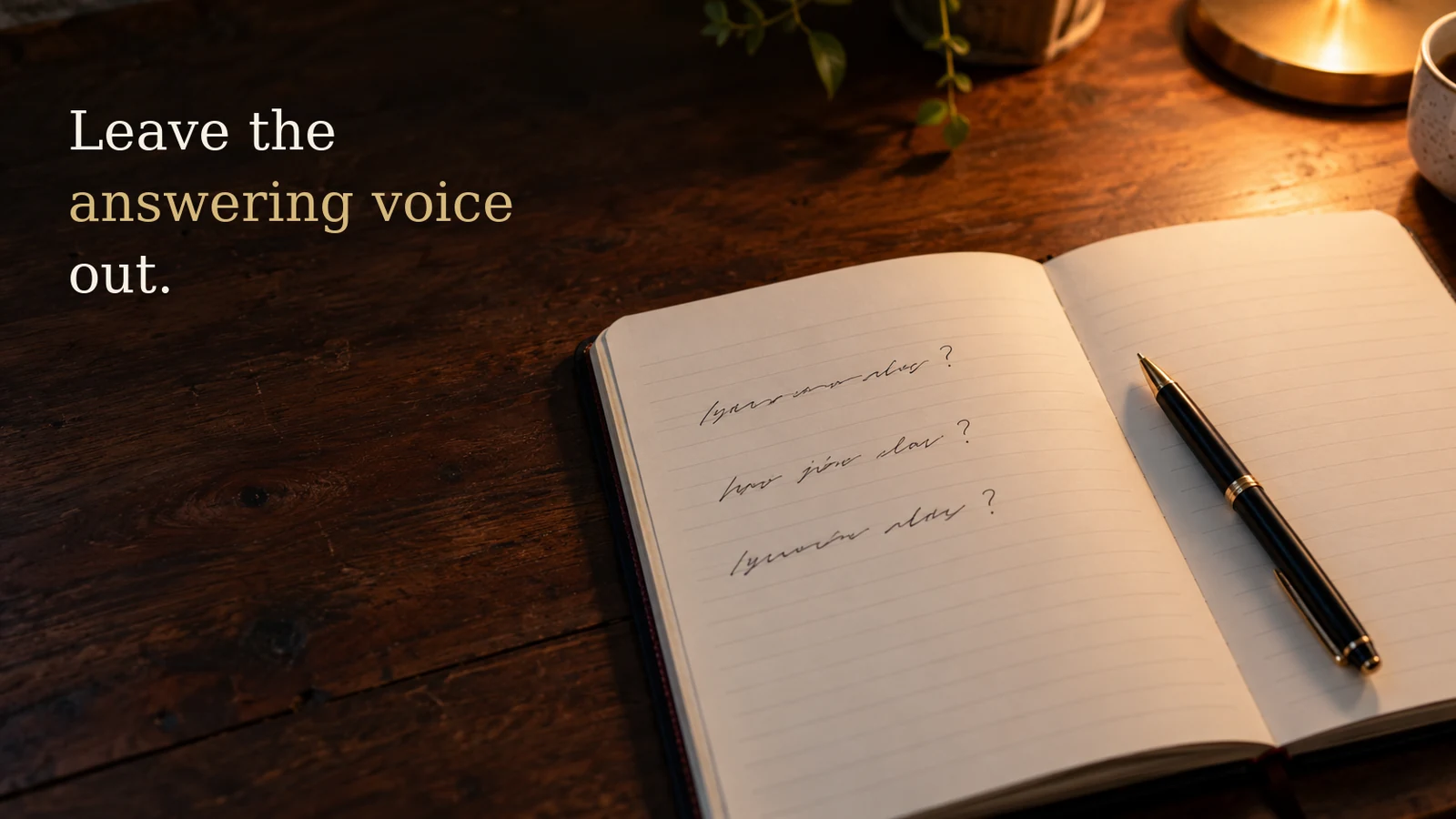
If you want to write the answer, you can end the question-only entry and begin ordinary prose separately. Mark that change plainly. There is no need to pretend the format remained unchanged or that choosing another form means you failed.
This differs from SoulFul GLO's two-voice dialogue guide, where explicitly authored viewpoints respond to one another. Here there are no alternating speakers and no reply supplied by an imagined authority. The questions remain your own writing.
It also differs from a list of prompts to complete. You are composing the sequence itself, rather than receiving a worksheet whose questions all need answers. A later question may qualify an earlier one or show that it was broader than you intended.
Allow a change of direction without losing the thread
A question about a hobby can lead to a question about the place where you tried it. That may be a useful turn if the connection is clear. You do not have to force every line back to the opening noun.
When the chain jumps somewhere unrelated, decide whether to start a separate entry or leave the new question outside this one. A blank line can separate two chains if you want both. Keep the division understandable without creating a complicated classification system.
You can return to an earlier question if a later one reveals an assumption in it. Rewrite it openly rather than making the original wording appear to have been different all along. This is a present writing experiment, not a requirement to preserve every draft.
Avoid expanding solely to make the entry look substantial. Several questions that repeat the same demand may add length without a new point of curiosity. You can finish after the last line that actually interests you.
Two fictional question-only entries
A small making project
The following short chain is original fiction, illustrating the form rather than reporting a real writer's experience. The subject is an unfinished paper model. Every line in the entry remains a question; no answering narrator joins it.
Which part of the paper model still interests me?
Is it the folded roof, the colour or the small doorway?
What am I remembering about making that doorway?
Am I curious about the shape itself or about trying another one?
What would I need to see before calling the shape finished?
Do I want to leave that question here for now?
The sequence moves from the project to one detail and then to the writer's uncertainty. It supplies no conclusion about motivation or a requirement to complete the model. Another chain could take a different direction from the same opening.
A familiar route noticed differently
This second invented entry begins with an ordinary walk. It does not ask the writer to identify plants, explain a health effect or reconstruct a complete account. The questions concern what was noticed and how it is being described.
Which stretch of the route am I thinking about?
What made that corner stand out this time?
Did I notice something new, or attend to something familiar?
Which part of that distinction can I actually remember?
What else might I notice without expecting the same impression?
Would another walk need to answer any of these questions?
The final question leaves future participation open. Neither example demonstrates an emotional result. Use the form if it interests you, with your own subject and vocabulary, rather than treating either chain as a script to reproduce.
Read back for curiosity, pressure and repetition
Read the sequence once without answering it. Check that every entry line is a question and that references remain understandable. A word such as that or they may need a clearer noun if you can no longer tell what it points towards.
Next, look for unsupported premises. Does a line assume another person's thoughts, an event you did not observe or a permanent quality about yourself? You can narrow the question or make the uncertainty explicit.
Notice the tone as well as the grammar. A technically correct question can still demand a confession or a positive ending. You can remove a line that does not belong in the kind of entry you want.
Finally, check whether each question adds anything. If two lines ask the same thing in different words, keep either, combine their subject into one clearer question or leave both if the repetition is deliberate. There is no required count.
End without supplying the answer
Stop after a question that feels like a reasonable place to leave the chain. You do not need to close with an explanation of why the exercise mattered. An unanswered page is consistent with the format you chose.

You can revisit later if you want, but no question becomes an assignment merely because you wrote it down. If you do answer one, distinguish that later writing from the earlier chain so its timing and form remain clear.
If the exercise becomes distressing or unhelpful, stop and choose an ordinary activity or appropriate support. Optional journaling is not a substitute for necessary care. This article makes no clinical claim about writing questions.
Explore another personal-writing option
SoulFul GLO's journaling information introduces text and voice reflection as options. Check actual current tools before relying on a feature. This question-only exercise can also be done on ordinary paper without a purchase.
Frequently asked questions
Does the whole article have to be questions?
No. The creative entry is the question-only part. Explanations, a date or a subject heading can sit outside it. Keep the boundary clear so the chosen constraint makes sense.
What if I already know an answer?
You may leave it unwritten, ask a different question or change to ordinary prose. The format is optional. It does not require you to erase knowledge or pretend to be uncertain.
Must every question lead to a decision?
No. A chain can explore a detail or interest without choosing an action. Practical decisions belong to their real circumstances and may require information this writing does not provide.
Is question-only journaling a treatment?
This guide presents an editorial writing experiment, not treatment or a validated wellbeing intervention. Choose the form for interest and fit, with appropriate support for concerns beyond an optional journal entry.
Adapt a question when its premise does not fit
For the separate task of changing an existing prompt, read SoulFul GLO's prompt-adaptation guide. You can revise a question's premise without being obliged to answer it or continue this chain.