
You may have more than one thing to say about an ordinary experience. You enjoyed helping with a group display and also wanted more time for your own work. In a paragraph, one point can keep interrupting the other. A deliberately written dialogue lets you give each viewpoint a turn while making clear that you authored both.
This is an optional writing format, not a method for discovering hidden personalities, diagnosing an experience or resolving a serious decision. Choose a low-stakes subject you are comfortable recording. You can return to ordinary prose or stop whenever the format becomes cumbersome or the material no longer suits the exercise.
Quick answer
Choose one ordinary situation and two viewpoints you want to express about it. Give them descriptive labels, write a short turn for each, and let each reply address something the previous turn actually said. Mark guesses and unknowns. End with a separate author note describing what the exchange contains, without requiring either viewpoint to win.
Both voices are writing choices you control. They need not impersonate real people, represent permanent parts of your character or reach an agreement. A clear page identifies the situation, labels the turns and separates the invented exchange from events that actually occurred. That distinction matters even when the subject comes from your own day.
Choose an occasion small enough for two turns
Begin with a bounded occasion: taking part in a craft session, rearranging a shelf or deciding how to spend an optional afternoon. A question about your whole personality can become too large for a simple format experiment. Select something whose relevant details you can describe without needing a complete account of your life.
Write a short scene note before the dialogue. For example: "I helped arrange the display for half an hour, then left my own model unfinished." Treat that as your account of the occasion. If a detail is uncertain, say so. The exchange can explore your responses without improving the evidence for what happened.

Set aside subjects that call for appropriate professional advice or a real conversation. An invented exchange cannot supply another person's consent, answer a medical question or settle a financial obligation. For this exercise, the small writing task can be enough: show two things you want to say about an everyday event.
Name viewpoints rather than inventing authorities
Use labels that describe the actual statements you want to explore. "Keeping the shared project" and "Making room for my own work" are more specific than "Good me" and "Bad me". Avoid giving one speaker a title that makes its answer automatically correct, such as "The wise voice", unless you deliberately want to write fiction about that character.
The labels can be brief. "Shared project" and "Own project" may be sufficient once the scene note explains them. Keep the wording consistent through the entry so you can follow the turns. If a label stops matching what you write, revise it openly rather than forcing every sentence to fit the original name.

You can also use two fictional speakers, provided you identify the piece as an invented dialogue. That creates a different reading experience from a factual journal account. Neither name establishes an independent witness or a source of knowledge. The author still chooses every line and remains responsible for its claims.
Keep other people's perspectives outside the invention
A dialogue can tempt you to write the answer you wish another person would give. That answer remains your invention. For this format, use viewpoints you want to express yourself rather than presenting an imagined friend, teacher or partner as the source of reassurance, criticism or permission.
If you want to record something another person actually said, keep it in the scene note with appropriate attribution and limits. Use quotation marks only when you can support exact wording. A remembered summary can be labelled as such. Do not let a line copied from memory become an apparent transcript of a real conversation.
Make the first turns concrete
Give the first viewpoint one statement about the situation. A useful opening might be, "I liked seeing the display assembled." It says something specific without requiring a defence of the whole activity. Then give the other viewpoint a statement it can own: "I also wanted to finish the model I brought."

Put each turn on its own paragraph and repeat the speaker label. You do not need theatre notation, elaborate accents or quotation marks around every sentence. The labels serve navigation. Keep them visibly distinct from an author note, which sits outside the exchange and can describe what you are doing with the page.
Purdue OWL's guidance on writing dialogue discusses separating speakers into paragraphs in fiction. That supports a readability choice, not a wellbeing claim about this journal exercise. The two-viewpoint framework and fictional examples here are original editorial suggestions, not a clinical protocol.
Let a reply respond before adding a new point
Read the preceding turn before writing the next. Ask what it actually says. "I liked seeing the display assembled" does not mean "I want to spend every afternoon on group work." Replying to the larger invented claim changes the exchange. Keep the response close enough that the connection remains visible.
One reply might acknowledge the point and add a practical limit: "I liked that too; I wanted to leave time for my model." The acknowledgement need not cancel the second statement. Equally, the first viewpoint can ask a question without turning into a hostile cross-examination. You are choosing a writing sequence, not staging a compulsory argument.
Avoid repeating the same position with increasing force. If two turns say the same thing, combine them or stop. A new turn should add a detail, ask a relevant question, qualify a claim or show a real difference in emphasis. Longer dialogue is not automatically more complete or more revealing.
Separate known details from what the speakers suppose
Check statements about availability, deadlines and other people's preferences. "The tutor would have been disappointed" is a guess unless you have evidence. "I worried the tutor might be disappointed" describes your response. Neither sentence becomes better supported because it appears after a speaker label.
Use a short marker when needed: "I do not know", "I am assuming" or "I would need to ask". These phrases can remain inside a turn if the viewpoint recognises a limit. You can also put the uncertainty in the author note. Choose the placement that keeps the exchange readable rather than filling every line with qualifications.

Distinguish preference from prediction. Wanting more time for a personal project does not establish that extra time would have produced a finished model. You can retain the preference without promising an outcome. Likewise, enjoying shared work does not prove that everyone present enjoyed it equally.
This distinction also separates the exercise from SoulFul GLO's third-person journal scene guide. That guide changes the narrator of an account. Here, you are composing an exchange between two expressly authored viewpoints; the turn-taking structure is new writing rather than recovered speech.
Fictional example: two things about a class afternoon
Mika and the craft afternoon below are original fiction. The labels identify two statements the fictional writer wants to preserve, not independent people or verified experiences. Mika's scene note says she helped arrange a display, then packed away her unfinished model when the room closed.
Shared project: I liked seeing the pieces together. I had only seen my own part before the afternoon.
Own project: I liked that view too. I still wanted time to finish the small model I brought.
Shared project: Would leaving earlier have felt as if I was abandoning the display?
Own project: That is a worry I had, but I did not ask anyone. I cannot use it as their answer.
Shared project: I can keep the enjoyment of the assembled display without deciding what the others expected.
Own project: And I can keep the wish for more making time without saying the afternoon was wasted.
Mika ends with an author note: "Both statements concern this afternoon. I enjoyed the shared result and wanted more time for my own work. I have no information about the others' expectations." The note records what the writing contains. It does not require a decision about future classes or turn the exchange into evidence of a personal change.
Fictional example: a shelf left partly arranged
Another fictional writer, Arun, uses the labels "Keep the arrangement" and "Try another layout". He writes about a shelf he rearranged that morning. The lower row is finished, while two large books remain on the table. He is experimenting with dialogue form rather than resolving an urgent household problem.
Keep the arrangement: I can reach the small books easily now. I want to leave that part alone for a while.
Try another layout: I still need somewhere for the two larger books. The table is not where I want them to stay.
Keep the arrangement: Does changing the upper shelf mean starting all over again?
Try another layout: Not necessarily. I have not measured the other opening yet, so I do not know what would fit.
Arun's author note says, "The lower shelf is usable; the larger books have no chosen place. Measuring another opening is a possible separate task." He can stop there. The entry does not have to become a plan, and he does not need to call one viewpoint practical and the other resistant.
Add a closing author note without announcing a winner
Leave a little space after the last turn and use a heading such as "My note after writing". Describe what the exchange actually showed on the page: two preferences, an unanswered question, a repeated assumption or a detail you had left out. Avoid claiming that the dialogue uncovered a deeper truth merely because the ending sounds persuasive.
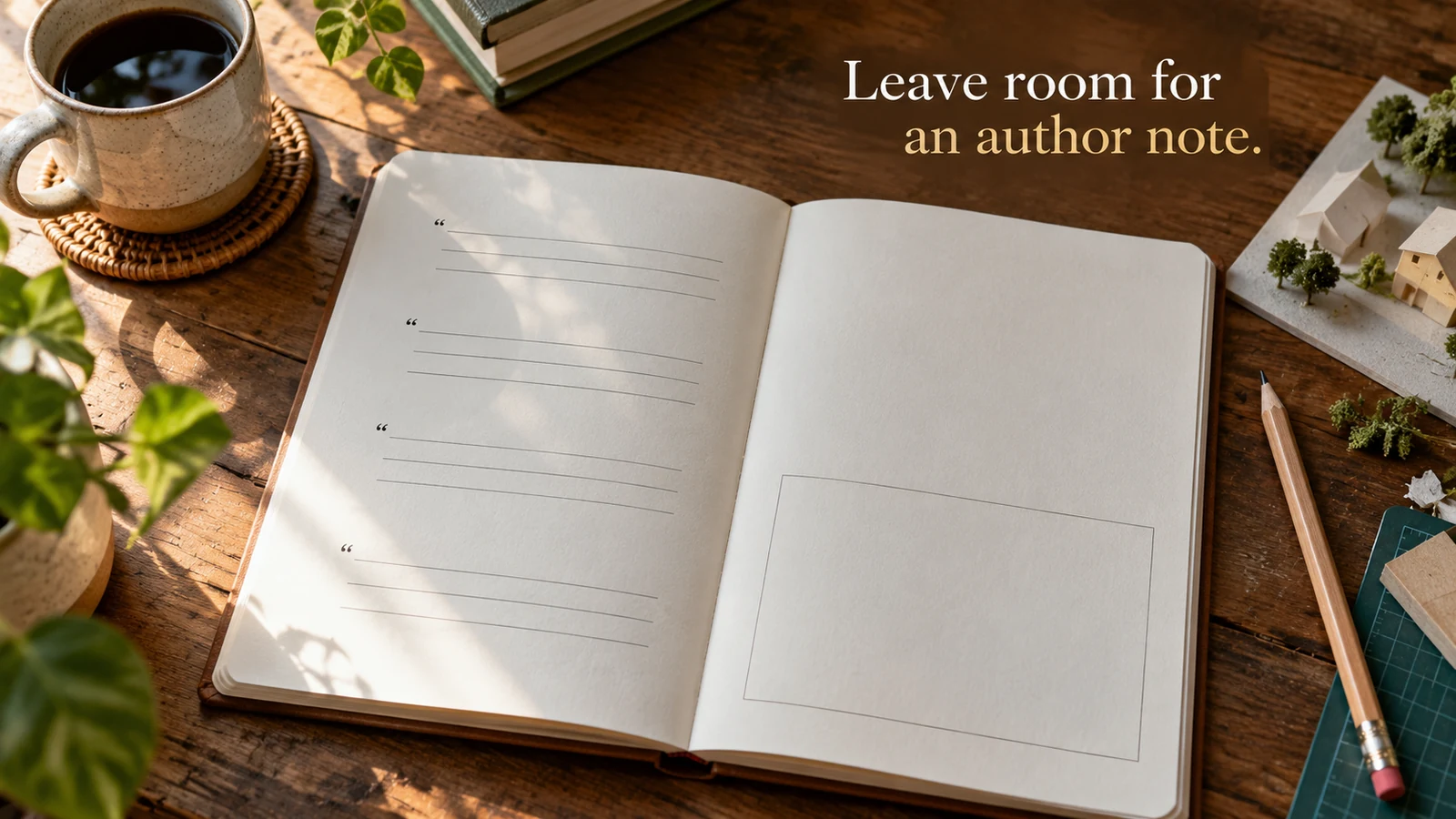
You may agree with one statement more than another. Say that as your present view, with the relevant reason. The other turn can remain in the entry without becoming an instruction you must follow. A journal page can contain an unresolved difference. Its completion does not require a vote, a compromise or a promise.
If a practical decision is genuinely needed, make it through an appropriate separate process. The dialogue does not establish deadlines, resources or other people's agreement. Carry a specific question forward only if it serves your actual situation. You can keep the writing as an experiment without assigning it work it cannot do.
Read back for labels, claims and repetition
Check that every turn has the correct label and that neither speaker changes its role without explanation. Read a confusing turn with the full viewpoint label restored. If a pronoun such as "they" has no clear reference, replace it with the specific person or group you meant, or remove the unnecessary claim.
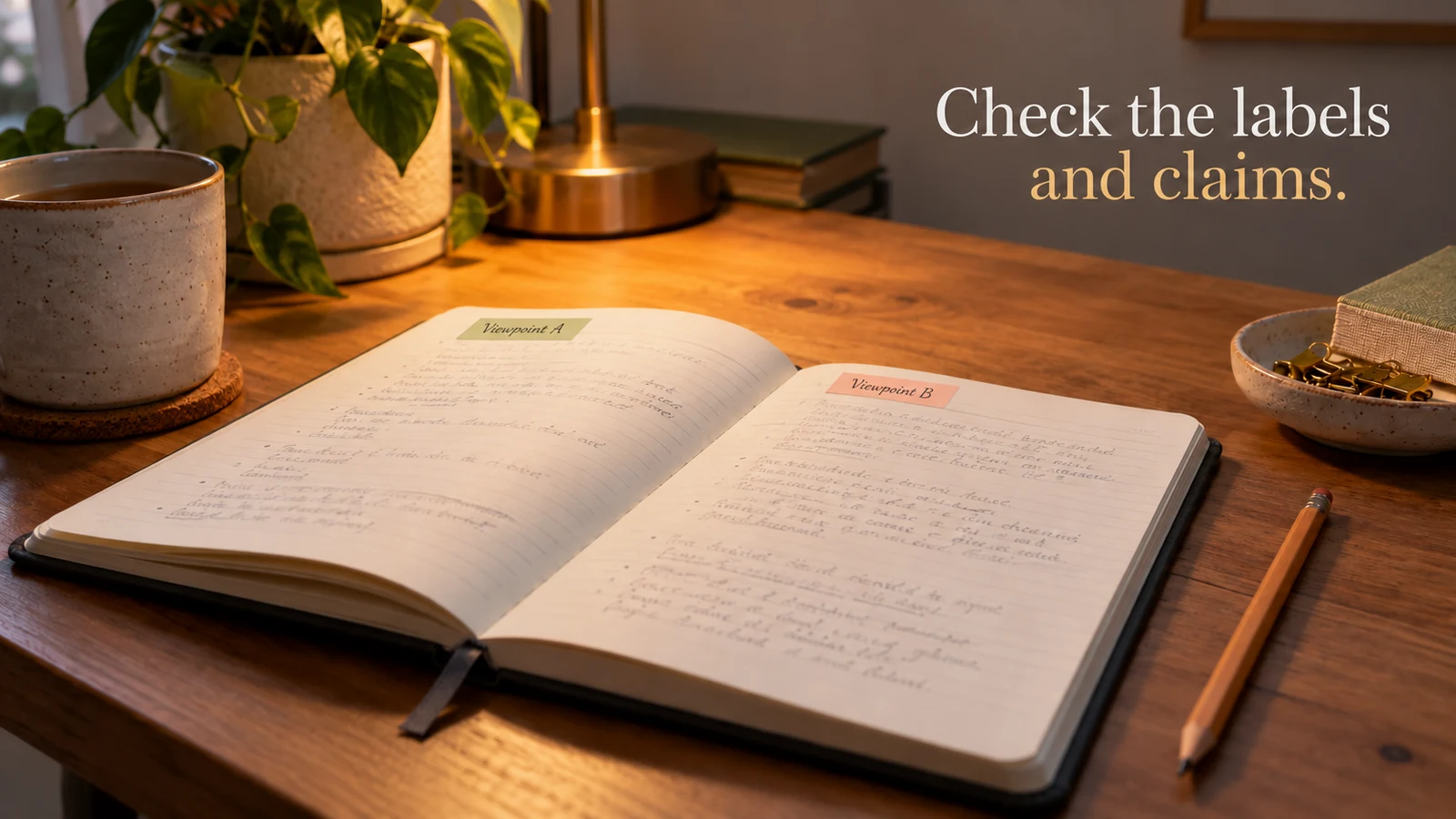
Then look for words that make a moment into a permanent description: always, never, lazy, sensible or selfish. You may want to record a judgment as a judgment, but it should not slip into the scene note as an established fact. Revise a broad claim to the particular action or preference the exchange actually concerns.
Finally, compare the closing note with the turns. Does it describe what you wrote, or introduce a conclusion that neither speaker supported? You can shorten the ending or leave it as a question. For the next entry, choose ordinary prose again if the labels distract from what you want to record.
Frequently asked questions
Do the two voices have to disagree?
No. They can emphasise different details, ask questions or agree about one part while differing about another. An invented conflict is unnecessary. Choose two statements you actually want to explore in writing rather than manufacturing opposition to fill the page.
Must I use my own name?
No. Descriptive labels can be easier to follow than names. If you invent speakers, label the exercise as fiction or an authored dialogue. Changing names does not make sensitive material anonymous or establish another person's point of view.
Can this tell me what someone else thinks?
No. Every invented reply is your writing. Ask the actual person where an appropriate conversation is needed, and keep their response separate from this exercise. The page cannot give consent, settle a disagreement or serve as an independent account.
What if the format becomes uncomfortable?
Stop, choose a more ordinary subject or return to a plain description. This is an optional writing arrangement, not therapy or a substitute for appropriate support. There is no requirement to keep writing until the speakers agree.
If the starting question is pushing the entry towards a conclusion you do not want, explore SoulFul GLO's guide to adapting a journal prompt. You can change the invitation and leave this dialogue as it stands.