
You begin an entry in one language and reach for a word from another. Perhaps it belongs to the conversation you are remembering, or it is simply the wording available at that moment. You can keep writing without deciding that the whole page must now change language. A personal notebook can contain more than one.
The practical question is what you want to understand when you return to the entry. You might recognise the original wording immediately. You might want a brief explanation beside one phrase. You might decide that translating the whole paragraph would add work without serving the record. Those choices can vary from one entry to another.

Quick answer
Write in the words you want to use. Keep the original entry, and add an optional gloss, meaning a short explanation of what you meant, wherever it would help you later. Label that explanation separately and date it if you add it afterward. You do not need a complete translation or a single language for the whole page.
This guide offers an everyday writing arrangement. It does not prescribe a language-learning method, assess fluency or make claims about mental health. The examples are short, original Spanish-English entries with personal English glosses. They illustrate a layout, not an exact translation method or a pattern every multilingual writer follows.
Decide what this entry is for
A personal reflection and a language exercise can share a notebook, but they have different jobs. If you want to remember an afternoon, you may prefer to write without checking each sentence. If you want to practise a language, you may deliberately spend time looking up words. Choose the activity you actually want today.
You can identify that purpose with a short heading or simply keep it in mind. An entry about a meal does not need to demonstrate your vocabulary. A practice page can include corrections without implying that your personal account was wrong. Separating those purposes can make the amount of work you choose more deliberate.
The Open University's Writing across cultures features author Xiaolu Guo discussing creative work across Chinese and English. Her account offers one writer's perspective, rather than evidence for this journaling arrangement or its effects on wellbeing.
Let the original wording remain available
You can begin in one language, continue in another and return to the first. You can also keep a whole entry in a single language. There is no required mixture or proportion. Choose wording that serves the record rather than making the page look like an example of how multilingual writing ought to appear.
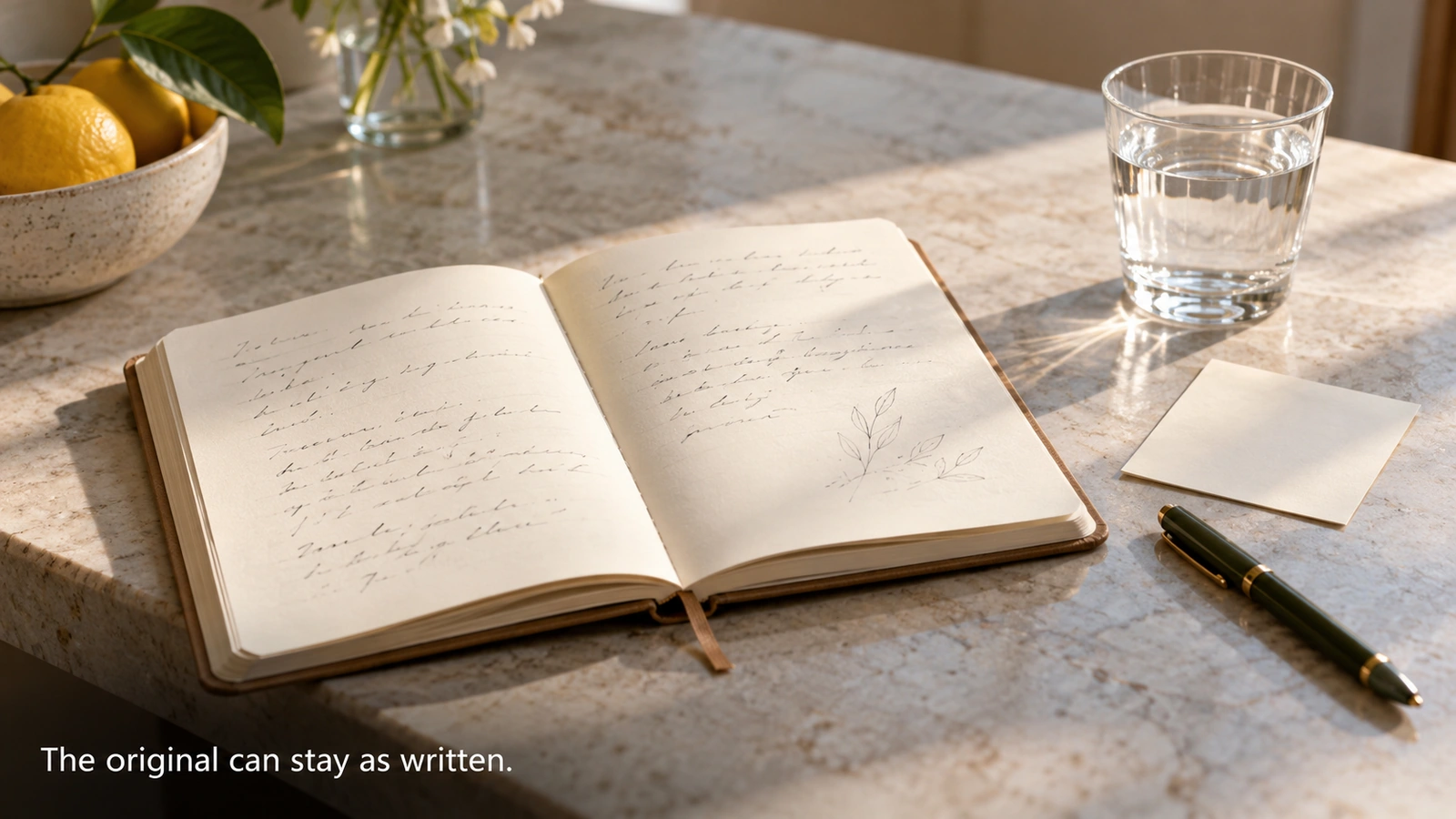
When a phrase feels important as written, leave it in the original entry. An explanation can sit beside it without replacing it. If you later choose a different wording, make that a new note where the distinction matters. The two versions may serve different purposes: one records the phrase you used, while the other explains it.
Avoid treating a language choice as proof of a hidden identity or a more authentic emotion. You may choose a word because it is familiar, convenient, connected with a particular setting or something else entirely. You do not have to explain the choice. The notebook can preserve the sentence without interpreting what its language says about you.
Use a gloss only where it helps
A gloss is a short explanation for the purpose of your note. It might describe what you meant by a phrase on that occasion. It does not have to supply a dictionary definition or an exact equivalent in another language. You can label it as your explanation so that it does not appear more authoritative than intended.

Use the gloss to record the part a translation might leave unclear: which conversation, what aspect of a place or why you chose a word on that day. For a temporary explanation, label it My meaning in this entry. That keeps a local note from becoming a claim about the word in every setting.
Three page arrangements to try
One continuous entry
Write the paragraph in the order it comes to you. If you want an explanation, add a short note below the paragraph and identify the phrase it concerns. This can suit a small notebook where columns would leave little room. You do not have to interrupt each language change with a heading or announcement.
Identify the sentence by its position or underline the words on your own page. When two phrases need explaining, give each note a matching number. Check that you can tell which explanation belongs to which phrase before adding more marks.
Choose a pointer that makes the original phrase and its explanation easy to pair. If there are only two short phrases, repeat each phrase at the start of its note. For the fictional market entry below, a note beginning 'lleno de voces: my meaning here...' points to particular wording; 'the market' alone could refer to the whole scene. If repeating the phrase would crowd the page, matching numbers beside the phrase and its note offer another option. Keep the original entry readable without the gloss.
Check the pair by asking what the note adds. Does it explain your use of those words, translate them for a later reader, or add a memory that arrived later? Give that addition an appropriate label. A translation and a personal association can both be useful, but they answer different questions. If you move a gloss, move its pointer too; if the connection becomes unclear, repeat the relevant phrase rather than guessing. These are layout choices for this notebook, not rules about how multilingual people should write.
Original wording with a nearby gloss
Leave space beside an entry when you expect to add a brief explanation. Label the margin or adjoining area with an ordinary heading such as My explanation. The location helps distinguish it from the original text. You can use the same language for the explanation or another one, according to your purpose.
This arrangement does not require matching each line with another. One note may concern only a phrase, while the rest of the entry stands as written. If you decide to translate a complete passage, label that separately. A short personal gloss and a complete translation should not silently become the same thing.
A later note on another page
If an older entry needs explanation, write a dated note where you have space and add a clear reference to the earlier page. Identify what you are clarifying and what you remain unsure about. You do not need to alter the old sentence to make it match your present wording.

The date matters because a later explanation reflects what you understand now. You may remember the original meaning clearly, or you may only have an interpretation. Label that difference in plain language. A present-day explanation does not automatically recover everything you meant when you first wrote the entry.
Fictional example: keeping one phrase without translating the page
Here the writer begins in Spanish and continues the scene in English. The second sentence adds a location instead of translating the first.
Original wording: "Hoy el mercado estaba lleno de voces. I stayed by the fruit stall."
My explanation, added on the same day: "I meant the overlapping conversations near the stall where I waited. I was recording the voices I noticed there, rather than describing every part of the market."
The gloss narrows the observation to the conversations near one stall. A reader returning to the page can distinguish that intended scope from the broader scene the original might suggest. The two original sentences remain together above the explanation.
Fictional example: adding an explanation later
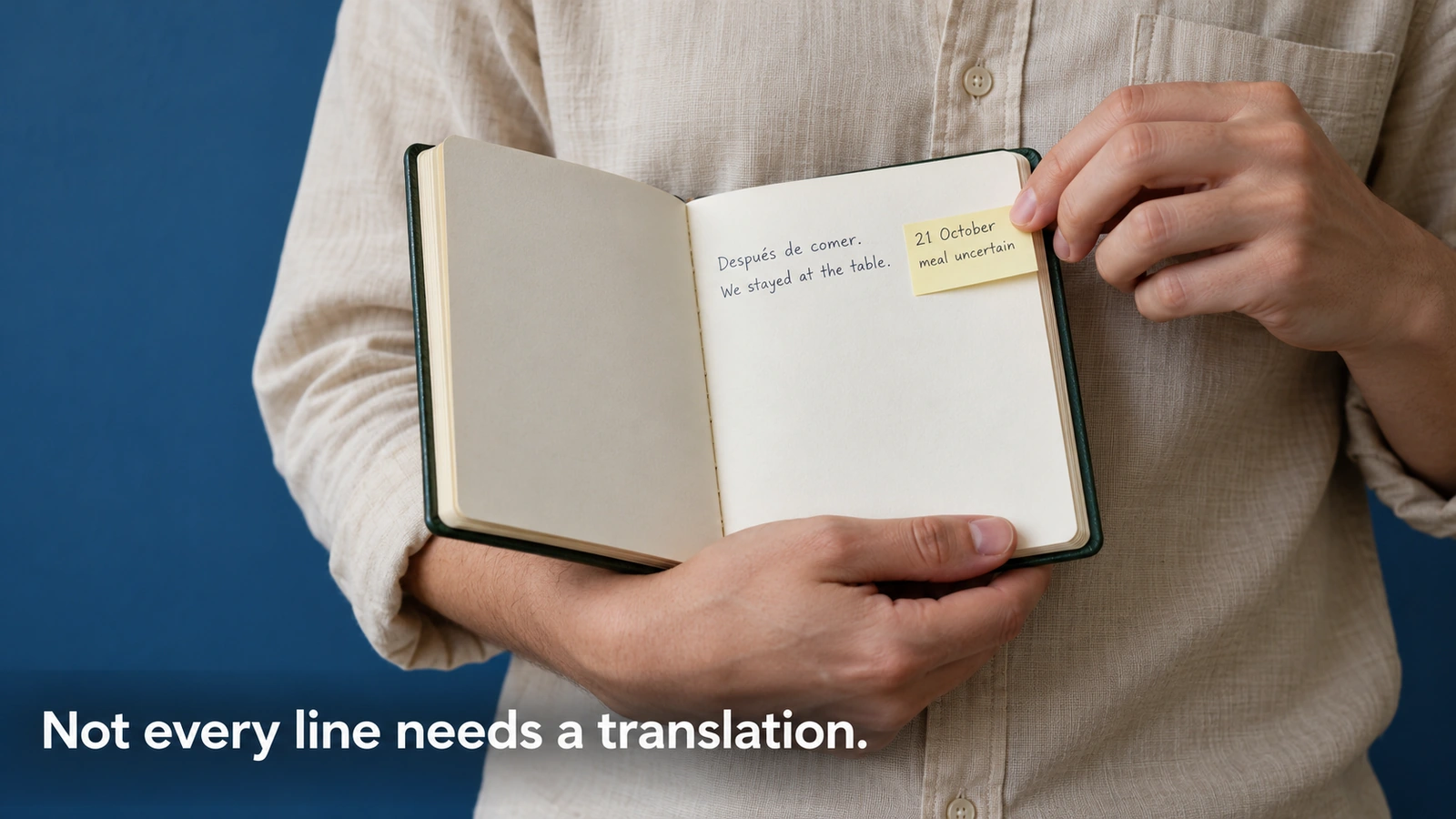
Here is a second original fictional entry, written on 12 June: "Después de comer. We stayed at the table." In Spanish, comer can refer to eating generally or to a particular meal. The RAE-ASALE dictionary lists midday and evening meal senses as well. These possibilities do not tell us which meal this invented writer meant.
My explanation, added 21 October: "I now think this was after lunch on that visit. The original does not name the meal, and I no longer remember whether it was lunch or dinner."
The date on the gloss separates the later interpretation from the June wording. Neither the Spanish phrase nor the English continuation has been replaced. A dictionary can establish possible meanings; it cannot recover this writer's memory. The tentative gloss therefore stays tentative, even though each word can be understood.
Keep your words separate from someone else's
An entry may include something you heard in a conversation. Distinguish an exact quotation you can establish from your recollection or summary. If you translate what another person said, label it as your translation rather than presenting it as their original wording. You can also describe your response without reproducing their words at all.
Consider which details you want to keep about other people. A name, private message or identifying context may be unnecessary for your purpose. Writing in a language another household member does not usually use is not a privacy guarantee. The content and the actual access arrangements still matter.
For a separate writing exercise, explore SoulFul GLO's guide to adapting a journal prompt that does not fit. It considers changing the question you choose to answer, which can be useful before deciding what language or wording you want for the response.
Choose a format you can read again
On paper, give the original and any explanation enough room to remain distinguishable. On a device, check whether the actual tool displays the scripts, punctuation and writing directions you use clearly. Try a small ordinary sample before relying on a longer entry. This guide does not claim any particular app supports every script or layout.

Automatic translation is a separate action, not a requirement of this method. Do not assume that sending an entry to another service keeps it within the same access arrangements. Check the actual tool and decide whether you want to provide the content. You can write your own short explanation or leave a phrase untranslated.
If storage and access are the main concern, explore SoulFul GLO's guide to private journaling in a shared household. It discusses ordinary choices about content, devices and notebooks; a language choice or a separate gloss does not establish confidentiality.
Frequently asked questions
Do I need equal fluency in both languages?
No fluency threshold is required for this optional personal writing arrangement. Use the words you want to keep, and mark uncertainty when it matters to understanding the entry. If your purpose is language practice, choose appropriate learning support separately. This guide does not assess accuracy or replace a teacher's guidance.
Can I write a word using a different script?
You can choose a form you recognise for your own notes. If you use transliteration, remember that your personal spelling may not match a published convention or someone else's usage. Label an uncertain form if helpful. You do not need to make a linguistic claim simply to keep a private record.
Must a gloss use another language?
No. A gloss can explain an original phrase in the same language, or another language you choose. Its job is to preserve the meaning you want for that entry. Keep it labelled as your explanation when it is approximate, personal or limited to the occasion you described.
Should I translate before sharing an entry?
Sharing and translating are separate decisions. Choose what you want to share and ask whether the other person wants to read it. If you provide a translation or explanation, distinguish it from the original. You can share a small description instead of the whole page, or keep the entry to yourself.
What if I do not want to explain anything?
Leave the entry as written. An explanation is available when it serves your purpose, and it does not need to follow every change of language. Close the notebook when you have recorded enough. You can return later, write a different entry or leave this one alone.