
You want to make a voice-journal entry, but today you would rather invent a small scene than retell something that happened. A red envelope on an empty chair becomes the starting point. Who put it there? What might an invented person do next? You can explore those questions as creative composition while making the status of the recording clear.
An imagined scene is different from a recollection, a plan or an account of someone else's private thoughts. The distinction should be audible, not left to a file title you might forget. Begin by saying that you are making up a scene, and keep that label available when the narration moves between invention and ordinary personal commentary.
Quick answer
Name the recording as an invented scene before narrating it. Choose a small fictional setting, one adult character and an ordinary action. Describe what happens in the scene without presenting it as a recovered memory or future event. If you want to comment afterwards, announce the switch into your present response. Finish without requiring the invented scene to explain your life or supply a lesson.
Decide whether fiction is the activity you want
This is an optional creative entry, not a guided visualization or a method for finding hidden memories. You do not need to see a detailed internal picture. You can compose from words, a simple premise or one ordinary action. If speaking fiction feels cumbersome, a written sketch or an account of something actual may fit better.
Keep the subject small and comfortable enough for a casual exercise. A fictional person finding an envelope or setting down a bag provides a bounded opening. There is no requirement to invent a crisis, revisit distressing material or make the scene reveal something important about you. Choose an ordinary subject you want to explore, and leave the exercise aside if it becomes unwelcome.
The Open University's Start writing fiction course introduces fiction through characters, ideas and writing practice. That is a creative-writing context. The spoken notebook arrangement here is an editorial suggestion, not a university-tested journaling intervention or evidence that recording changes wellbeing, memory or decision quality.
Give the entry an audible label
An opening such as “This is an invented scene for my journal” tells a later listener how to understand what follows. You can add the writing occasion and a short subject: “I am making up a scene about an envelope on a chair.” Those words identify a composition choice. They do not need to become an elaborate introduction or a performance.
Use a recording arrangement you already understand and a place where you will not capture other people's conversations. You need no music, sound effects or theatrical voices. This guide does not establish that any particular app offers editing, transcripts, private storage or a fiction mode. Choose writing when recording is not a practical or welcome option.
A title supports the spoken label rather than replacing it. “The envelope” could name a memory or a made-up scene. Make the opening understandable without relying on the surrounding screen.
Build one scene from a modest starting point
Choose one place, one fictional adult and an action that can actually happen within the invented scene. Perhaps the character arrives at a room and notices the envelope. You can describe the chair, the character's movement and a choice about what to do next. There is no need to explain the person's whole history before beginning.
A few concrete details usually do more work than a long catalogue. A folded corner, a chair beside a window or a bag placed on the floor can locate the action. Add a detail because it supports the scene you want to tell, rather than because a story seems to need a certain number of colours, objects or emotions.
You can leave something undescribed. The envelope's unknown contents need not become a mystery you must solve. A short unfinished action is an available ending for a journal experiment, even when a longer story might develop it further.
Keep the character fictional in a meaningful way
Make up the person rather than placing an actual friend's unspoken motives inside the story. An invented name alone does not remove a real person's identifying circumstances. If a scene closely resembles an actual private exchange, choose whether you want to record that experience honestly or invent a more separate setting instead of blurring the two.
You may give a fictional character a thought because you are authoring that character. Introduce it as part of the invented scene, not information you discovered about someone real. “In this scene, Noor wonders whether the envelope is hers” is a writing choice. It cannot supply an actual person's belief, intention or agreement outside the story.
Avoid making fiction carry a practical decision it cannot establish. A character receiving a friendly answer does not mean that someone in your life will answer that way. If you need information, consent or a response, use an appropriate real conversation separately. The recording can remain a creative piece without becoming rehearsal evidence for what another person will do.
Let the narration stay ordinary
Speak at a pace that lets you choose your next sentence. A hesitation does not require another take. You can describe an action, pause and decide whether anything else belongs. There is no obligation to sound like an audiobook narrator, imitate an accent or make every character audible through a different voice.
If you change a detail while composing, make the change easy to hear. “I want the envelope on the table instead” can be an author comment. You can then restate the scene from that point. Decide whether to keep the comment or start a new recording using controls you understand; no particular editing feature is assumed here.
A spoken correction does not need a plot explanation. You are allowed to choose a different object or ending because you are composing. If you want to discuss how those choices felt, save that for a separate closing note. Keeping composition and commentary recognisable can make a rough recording easier to follow without requiring it to become polished.
A table for the different kinds of statement
Use this comparison when the recording mixes a scene with your own observations. You do not need to classify every sentence aloud. A clear opening and a plain transition may provide enough context for an ordinary private entry.
| What you are saying | A fictional example | What it establishes |
|---|---|---|
| Opening label | This scene is invented. | The account is creative composition. |
| Scene action | Noor sets her bag beside the chair. | What happens within this fiction. |
| Authored character thought | In the scene, she wonders who left the envelope. | A thought you chose for a fictional person. |
| Composition comment | I want to leave the envelope unopened. | Your present choice about the writing. |
| Personal response | My note now: I liked the ordinary ending. | Your current response, not the scene's real-world truth. |
A small plan for one recording
First, name the activity and choose an ordinary premise. Say that the scene is invented before beginning the narration. You can use the same simple wording each time, but you do not need a script. The purpose is an audible boundary between fiction and an account of your actual day.
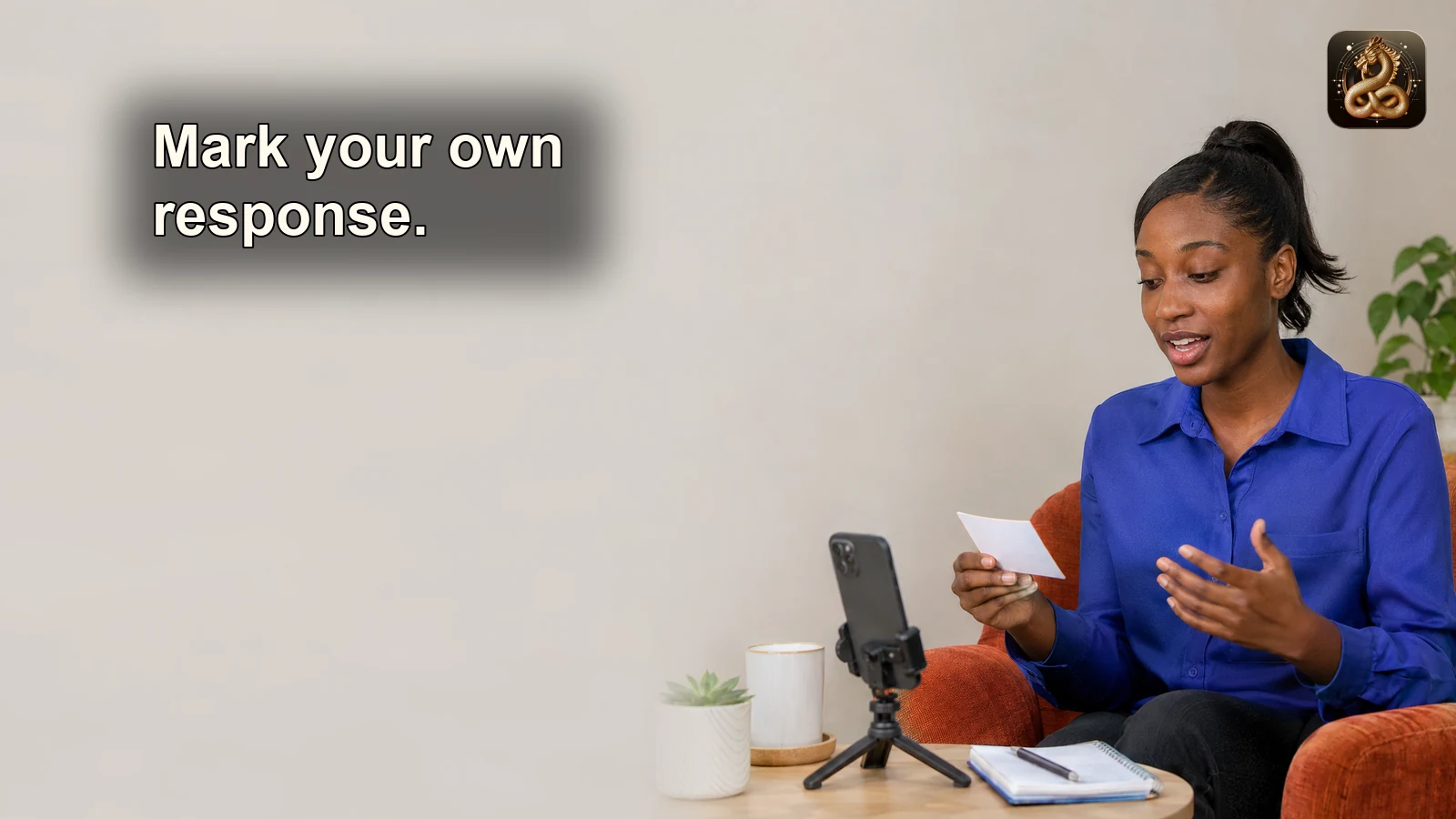
Second, give one character a place and an action. Start close to what happens: arriving, noticing, moving an object or choosing where to sit. You can leave the character's wider history unknown. Keeping the scene small gives you room to hear how a few sentences fit together without designing a complete story world.
Third, follow one manageable development. The character might look at the envelope and decide to leave it where it is. Another scene might end with a question. Keep an imagined choice inside the fiction rather than treating it as advice you have now given yourself. A scene can be interesting without producing a model answer.
Finally, announce any move into commentary. “My note after making that up” is enough to distinguish your present response from the narration. Say what you want to retain about the writing, or finish without analysis. The piece does not need an interpretation, a moral or another scene to justify the time spent speaking.
Fictional demonstration: an envelope stays closed
The following speaker, character and events are all original fiction. Imani chooses a short premise for an optional spoken entry. She begins: “This is an invented scene. I am making up an adult character named Noor, arriving at a room where an envelope is lying on a chair.” The opening makes the kind of account explicit.
She continues: “Noor places her bag by the table. The envelope has one folded corner and no visible name. She picks up her bag again, then sets it down more carefully so the strap does not cross the doorway. She is curious about the envelope, but she does not open it.” These actions supply a small sequence without requiring a dramatic discovery.
Imani pauses and adds an author comment: “I do not want to decide who left it.” She then closes the scene: “Noor chooses the other chair and waits for the person she came to meet.” The fiction does not establish what is inside the envelope or whether the meeting will happen. Those details are simply outside the scene she chose to compose.
After a natural pause, Imani says: “My note now: I liked leaving the envelope unexplained. That is a response to the writing, not something I think the object means about my life.” She ends the recording. This demonstration illustrates labelling and transitions. It is not a report of a real customer, a memory technique or an outcome from journaling.
Try a simpler version when that fits
You can make the whole entry three or four sentences. Name it as fiction, describe one action and stop. A character putting a cup on a shelf may be enough. There is no minimum plot, required duration or expectation that the scene should contain conflict. An ordinary invented moment can remain ordinary.
You can also abandon the fictional format after the opening. Say that you have changed your mind and choose whether you want another kind of entry. You do not owe the premise an ending. If a real memory arises, label it as a memory and decide whether it belongs in a separate recording rather than slipping it into the fictional scene unnoticed.
For another composition task, SoulFul GLO's two-voice journal guide uses two expressly authored viewpoints in a written exchange. This entry instead creates one fictional narrated scene. Neither exercise supplies another person's actual response or turns an imagined statement into independent evidence.
Choose whether to revisit the recording
A later listen can concern the composition itself: can you hear where fiction begins and where commentary starts? You do not need to analyse recurring symbols or find a message hidden in your own wording. The scene's details were choices you made, and a new interpretation remains an interpretation rather than a recovered fact.
If you retain a private recording, use an arrangement whose access you understand. Fiction can still reveal personal references, background speech or identifying details. There is no need to keep material you do not want, and calling a recording fictional does not make its storage private. This guide sets no sharing or publication task.
Questions readers often ask
Must I picture the scene clearly?
No detailed internal image is required. You can compose with ordinary words, a premise and one action. If that format does not appeal to you, choose a different entry or write instead. This is not a visualization assessment.
Can the character use my name?
It can, if the fictional status remains unmistakable, but an invented reference may be simpler. A familiar name can blur an account for a later listener. Consider the actual events and identifying details, not just the name you choose.
Does the scene need to teach me something?
No lesson or personal explanation is required. You can enjoy composing a few sentences or keep a response about their wording. The existence of a scene does not establish a psychological interpretation or a future outcome.
What if I accidentally describe a real event?
Pause and say what changed. Decide whether you want a separate factual entry, clearly qualified recollection or a more distinct fiction. Do not rely on a general fictional label to settle a mixed account whose actual meaning remains unclear.
Keep possibilities separate from fictional scenes
Explore SoulFul GLO's idea-list voice journal when you want to collect possible real projects without choosing them yet. An invented scene has a different purpose. Name it clearly, compose only what you want to express and let it finish without requiring it to become a plan.