
A short verse appears beside an everyday activity in a meditation book or app. It may accompany opening a window, watering a plant or sitting down. You would like to understand how the words belong with the action, rather than treating the verse as another passage to memorise or a promise about how the moment should feel.
In Plum Village practice, a gatha can be a short practice verse associated with daily life. It has a source and a context. Learning to use one does not require turning every ordinary action into a ceremony, collecting many verses or replacing the source's explanation with your own interpretation.
This guide helps you choose an existing, clearly explained resource and decide whether to try it. It offers a small plan, a practical table and fictional demonstrations. It does not reproduce a teaching curriculum, supply a traditional verse or promise that remembering words will produce calm or insight.
Quick answer
Choose one existing gatha whose source, meaning and associated activity you understand. Read its explanation before using it during an ordinary low-demand action. Keep the practical task clear, with no rush to finish the words or requirement to match a feeling. If the wording or method is unclear, ask the source's teacher or simply leave the verse aside. You can finish the activity without recitation.
Understand what this resource is asking
Plum Village's extended-practice guidance presents gathas as short verses used with everyday activities. Its app collection supplies practice poems for named occasions. These sources establish an actual example of the practice within that Buddhist tradition. They do not establish that every short wellness phrase is a gatha or that all communities use identical instructions.
A verse may invite attention to an action, connect it with a larger teaching or use language that needs explanation. Begin with the source's description rather than deciding that the words must function like an affirmation. A sentence can express a practice orientation without claiming that its content will automatically become true.
Keep the attribution with the resource. A photograph of a teacher, an unattributed quotation card or a copied passage may not provide enough context to identify the wording. When the source matters to your decision, use the actual book, community page or clearly credited recording instead of guessing who wrote it.

You can choose to learn about the practice without adopting it. Spiritual language may be meaningful within its tradition while not fitting what you want today. There is no need to claim membership, agree with every belief or rename the practice as something else in order to make a respectful choice.
Keep the action different from an attention word
A repeated word used as an attention anchor can have a different purpose from a verse associated with a daily action. Likewise, silently reading a poem for attention is not automatically the same activity. What matters is the actual instruction you selected, not whether all three arrangements happen to contain words.
For a gatha attached to an ordinary task, find out how the source relates the verse to that task. Does it invite recalling the words before beginning, during the action or at another point? Do not invent a demanding sequence merely because the resource appears brief. A short text can still need a clear explanation.
Some Plum Village resources connect lines with breathing as part of their own instruction. That is a source-specific method, not a universal direction from this article. Do not hold your breath, hurry it or force an unfamiliar pattern to finish a verse. Choose only instructions you understand and willingly want to follow, or ask an appropriate teacher.
You are not being asked to create a recording, compose a new spiritual teaching or merge several methods. An existing resource can be enough. Learning its context and making a small participation decision may be more useful than gathering instructions from several places before trying any of them.
Choose one ordinary, low-demand occasion
Start with an action whose practical requirements are already familiar. Sitting down in a comfortable chair or tending an ordinary household plant may offer a manageable occasion. Choose the actual activity first, rather than inventing a task solely because a verse has an appealing title.

Leave driving, road crossing, equipment use and actions requiring close vigilance outside this optional exercise. A source collection may contain material for many parts of life, but that does not make this article a safety assessment for each activity. Necessary attention belongs with the real task and its circumstances.
Check whether the action involves another person. A greeting, phone call or shared task includes their needs and choices, not only your private practice. Avoid delaying a response so that you can complete silent words, or assuming someone has agreed to participate because you are using a verse internally.
You do not have to transform a whole morning. One chosen occasion can stay one occasion. If the activity happens rarely, there is no need to repeat it artificially to maintain a routine. The verse is a resource you may use, not an obligation to create more chores.
A small plan before the action
First, open the actual source and read the full verse with its explanation. Identify words you do not understand, including terms that carry meaning within the tradition. Keep uncertainty visible. A familiar-sounding sentence can still mean something more specific than the interpretation you first supply.
Second, name the practical action in ordinary language. You are sitting down, opening a window or watering a plant. The description should remain true even without the verse. This helps prevent the recitation from replacing the task or turning it into a performance of spiritual significance.
Third, decide whether you want this association today. You may like the explanation but prefer to leave the activity simple. You may want to read the verse separately before trying it with an action. Both choices can preserve the resource for later without making this occasion incomplete.
Fourth, follow only the source's understandable invitation. Keep the words available in a suitable place if remembering them adds effort, but do not put a device or printed card where it interferes with the activity. If you lose the line, continue the practical task or stop the recitation without rushing to catch up.
Finally, let the occasion end. Put the resource away when you are finished with it. There is no requirement to repeat the action until the words feel natural, report a particular emotion or decide that the verse has changed the meaning of the whole day.

A table for keeping words and action clear
| Question before beginning | What to establish | An ordinary choice | Avoid adding |
|---|---|---|---|
| Where did the verse come from? | The actual source and credited context | Use the original explanation | Guessing an author from an image |
| What activity is named? | A task you already understand | Choose one suitable occasion | Inventing extra repetitions |
| How are the words used? | The source's particular invitation | Follow only clear, welcome instructions | Combining unrelated methods |
| What if I forget a line? | The practical task still exists | Continue the action without reciting | Rushing to finish the words |
| What does finishing require? | Only the activity and chosen practice | Leave the occasion complete enough | A required mood or insight |
These are preparation questions rather than a traditional sequence. You can use one question and decide not to proceed. If a resource raises a concern outside this article's scope, leave the personal practice aside while you seek appropriate clarification.
Fictional demonstration: an existing verse for a familiar task
In this invented example, Noor finds a clearly attributed practice verse associated with tending plants. She reads the source's explanation before approaching her own plant. She does not treat the verse as advice about how much water it needs; that practical question belongs with the actual plant and its care information.

Noor chooses to recall the resource at one familiar point in the activity. When she cannot remember a line, she notices the uncertainty and leaves the recitation unfinished. She completes the ordinary task without adding water merely to give herself more time with the words.
Later, she can reread the verse if she wants to understand it better. Her choice does not establish that the plant benefited from the recitation, that she became calmer or that remembering less would be a failure. This is a fictional example of separating practical care from an optional attention resource.
The simpler version is to read the verse while not doing the task, then decide whether its explanation fits an occasion you actually have. There is no need to perform both activities together immediately. Familiarity can remain a possibility, rather than something the first attempt must demonstrate.

Fictional demonstration: deciding not to use the verse
Another fictional reader, Daniel, encounters a verse whose language he interprets as a claim about how he should feel. The source's explanation is not available in the copied image he received. He does not fill in the missing context from a search for similar-looking quotations.
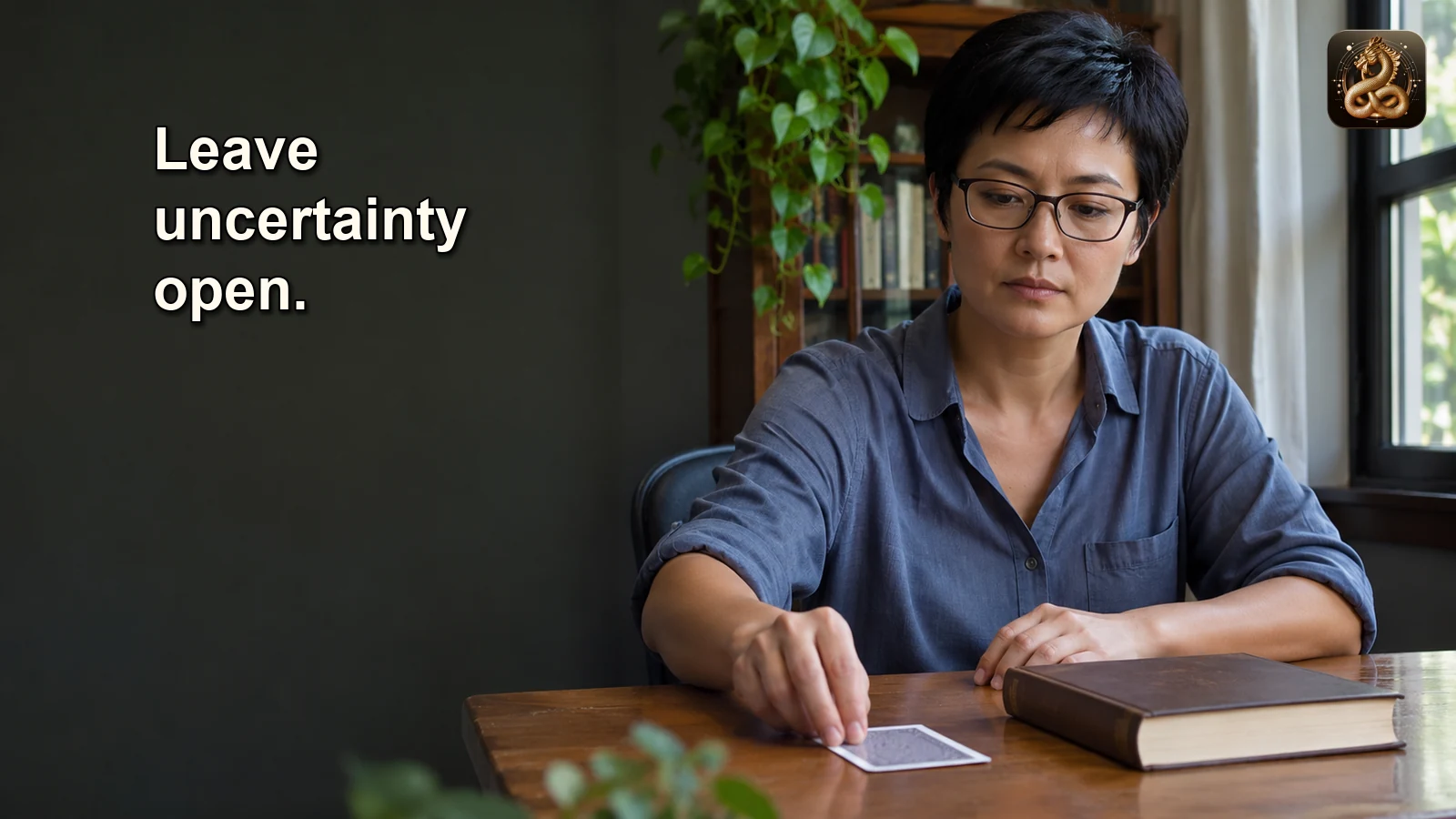
He leaves the verse aside and continues his ordinary activity. If he remains interested, he can find the actual credited resource or ask the community that teaches it. For now, declining is a complete practical response, rather than proof that he has rejected mindfulness or misunderstood every spiritual practice.
Daniel might choose a different attention activity on another occasion. He does not need to replace the words with a new verse and keep the original author's name. The example illustrates attribution and choice, not a claim that his interpretation of the copied image was correct.
Let remembering remain a practical matter
You may learn a short verse through familiarity, but memorising is not the only decision involved. Knowing the words does not establish that you understand their context or want to use them with every activity. Keep those questions separate, especially when a phrase becomes familiar enough to repeat automatically.
If you want a reminder, choose one that fits the actual setting. A book open nearby or a private note with appropriate attribution may be enough. Avoid placing private material in a shared location or using a reminder that gets in the way of a practical task.
You do not need a streak, a count of recitations or a collection of completed occasions. Those are additional arrangements, not requirements established by this guide. If a tracking system makes the activity feel compulsory, reconsider whether you want that system at all.
Keep possible value modest and source-specific
An action-linked verse can give you a clear occasion to remember a chosen practice. Reading its explanation may help you notice what a teacher is asking. These are practical possibilities about attention and understanding, not evidence that an individual verse changes mood, health or the outcome of the task.
The word mindfulness covers varied activities and teaching contexts. General research on meditation does not verify a particular verse, a copied quotation or a consumer app. Keep health concerns and appropriate support on their own routes, and stop an optional activity that becomes distressing or unwelcome.
If you prefer a plain attention word rather than an action-linked verse, SoulFul GLO's repeated-word meditation guide addresses that different choice. It does not replace the source context of a gatha or turn the two methods into interchangeable instructions.
Questions readers often ask
Is every short mindful quotation a gatha?
This guide makes no such classification. Check how the actual source identifies its text and explains its use. A quotation card may omit the author, tradition or associated activity. Leave those details uncertain until you can verify them.
Must I memorise the verse before beginning?
Use the source's guidance and a practical arrangement that fits. This article does not make a memory test a condition of participation. You can read for understanding, choose another occasion or finish an ordinary task without reciting anything.
Can I use a verse without following its spiritual context?
You can decide whether you want the resource after understanding its source and meaning. Do not invent a new interpretation and attribute it to the original teacher. If the framing does not fit, choosing another activity is an available and respectful response.
What if I do not feel different afterward?
No particular response is required here. Keep the observation honest and the task small. A completed action or remembered line does not establish a health outcome, and an unchanged feeling does not require more recitations.
Choose one resource you can understand
For a separate way of using words as an attention object, read SoulFul GLO's short-poem attention guide. Whether you read, recite or choose no word-based activity, keep the actual instruction and your willingness together. One clear occasion can remain enough.