
You try to follow a meditation but keep searching for the right thing to think about. A repeated ordinary word offers a smaller task: notice the word, let it pass and return when you remember. It can be tried without selecting a sacred phrase, coordinating breathing or believing that a particular sound has special power.
This guide describes an optional self-led attention exercise. It does not teach a named religious practice, reproduce a teacher's method or promise a health effect. A plain word is one possible anchor among others. If repetition is unpleasant or distracting, you can choose a different activity rather than trying to make this one work.
Quick answer
Choose one short, ordinary word whose meaning does not create pressure. Think it quietly at an easy pace while sitting somewhere appropriate for a brief pause. Let breathing remain natural. When attention wanders, notice and return if you want to continue. Stop at a chosen endpoint, then attend to your surroundings before moving to your next task.
The word does not need to silence thought. It gives you something simple to return to. You are not trying to pronounce it perfectly, count a specified number of repetitions or produce a particular feeling. Keeping the task small makes its boundaries easier to understand, even if your attention moves away often.
Know what this approach does and does not teach
NCCIH's overview of meditation describes focused attention that may involve a sensation, sound, image or repeated word or phrase. That broad description supplies context for choosing a verbal anchor. It does not establish that the particular exercise in this article has been clinically tested, or that a word can be selected to deliver a medical result.
Some meditation traditions use mantras with particular meanings, teaching relationships and forms of practice. An ordinary word chosen from your own vocabulary should not be presented as an equivalent substitute for every such tradition. If you want to learn a named method, seek its actual instruction and understand the commitments rather than relying on a generic article.
Here the task is deliberately modest: return attention to a familiar word. You can use it silently without claiming to chant a traditional formula. You do not need to assign a frequency, sacred origin or scientific mechanism to it. Leaving those claims out keeps the exercise within what you are actually doing.
This is also different from repeating a statement you hope to believe. A single word need not make any assertion about your confidence, safety or future. If your chosen word starts turning into a demand, change it or choose a nonverbal anchor. There is no advantage in keeping language that feels like an argument.
Pick one ordinary word
Choose a word that is familiar and easy to recognise. A simple word such as here or steady may suit one person and irritate another. These are examples, not prescribed words. Read your choice once and notice what it brings to mind. If it immediately opens a long personal story, choose something less loaded.

Avoid a word that functions as a command you are expected to obey. Calm can sound like an instruction to change your feelings; focus can become a criticism when attention moves. Neither is universally wrong, but notice your own response. You are choosing an anchor, not a slogan that has to improve your performance.
Use a language you understand in the way you intend. A word borrowed from an unfamiliar language may carry meanings or uses you do not know. There is no need to borrow one to make the exercise legitimate. If you are interested in a traditional term, learn its context separately instead of inventing a meaning for it.
You can write the word on a small card while learning the exercise, then leave the card nearby. That is an optional memory aid, not a journaling task or an object with special properties. You do not need stationery, a subscription, a particular recording or a set of approved words before trying a short pause.
Separate repetition from controlling your breath
Sit in a position that gives you ordinary support. Let your eyes stay open if that is easier. Notice where your hands can rest without effort. Choose a setting in which you can pause safely; this is not something to practise while driving, crossing a road or doing work that depends on continuous attention.

Think the word once, then allow a little space. Repeat it when you are ready. You do not need to place a word on each inhale or exhale. If you find yourself stretching or holding breathing to match a pattern, release that pattern and return to ordinary breathing. You can also end the exercise.
The pace may vary. A word can appear quickly when you are distracted and more slowly at another moment. You are not playing a metronome accurately. Notice whether you are rushing, then decide whether to leave more space. There is no required speed, pitch or number of repetitions in this optional version.
Silent repetition need not become a vivid internal voice. You might recognise the word without hearing it clearly in your mind. That is enough to understand the task. If trying to produce an inner sound becomes the main effort, use a visible word card briefly or choose a different kind of anchor altogether.
Return without starting the whole session again
At some point you may notice that you have been thinking about an errand, a conversation or the next instruction. You can return to the chosen word at that moment. There is no need to reconstruct every thought that intervened or decide exactly when attention moved. Begin from the point at which you noticed.
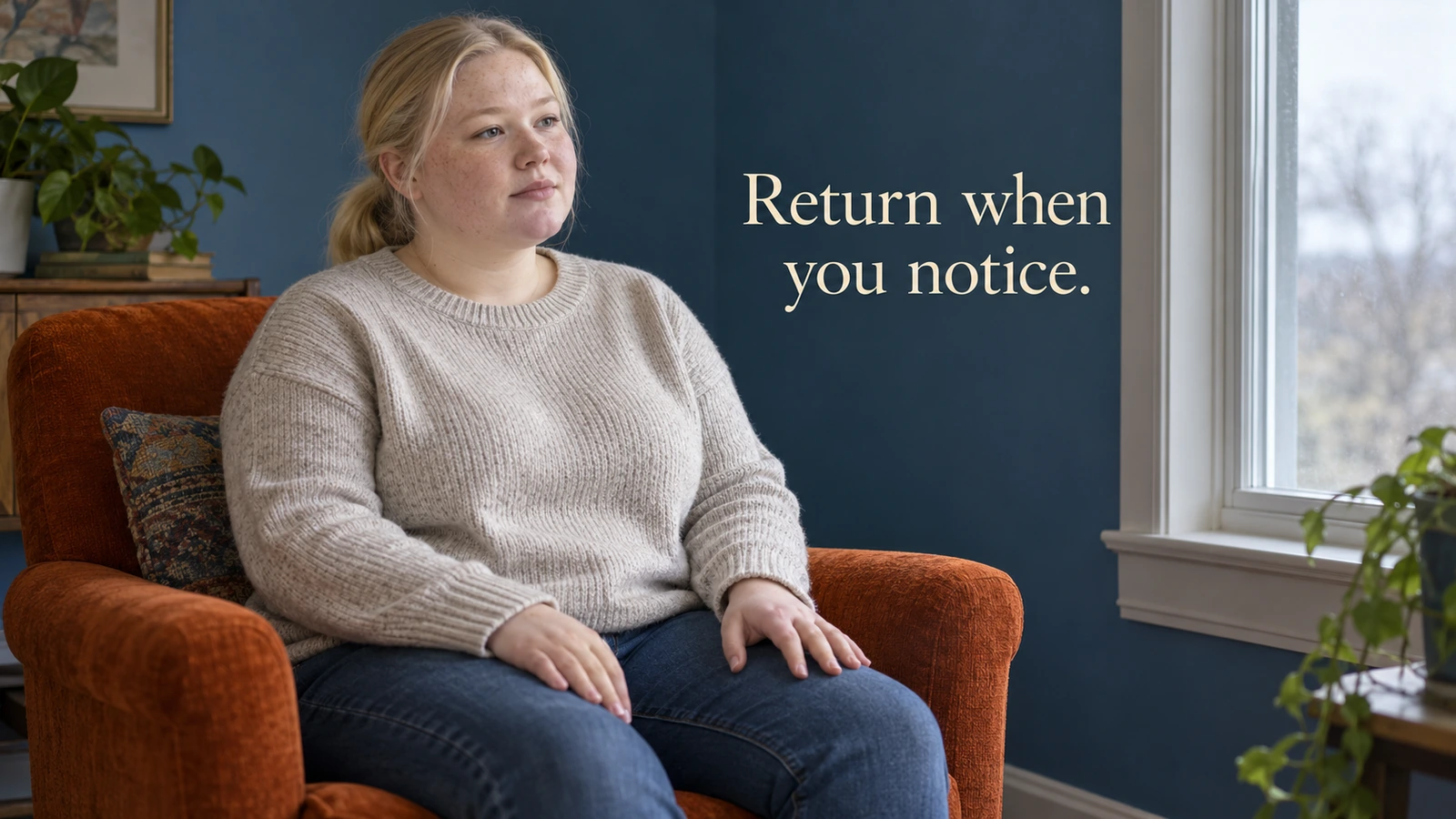
Avoid adding a second task of recording how many times you became distracted. Counting can be a different exercise, but it is not necessary here. A return is simply another return. You can let the previous interruption remain unmeasured instead of carrying it forward as evidence that the next repetition needs to be better.
If the word begins repeating automatically while you plan something else, pause the repetition. Notice the room and decide whether you want another few deliberate returns. Automatic repetition is not proof of a deeper state, and it is not an error you need to eliminate. It tells you something about what you noticed just now.
You may find that a physical or external anchor suits you better. The contact of a chair, an ordinary open gaze or a familiar sound can be alternatives when appropriate. You do not have to switch through several methods in one sitting to find a winner. Ending with a clear preference is a reasonable choice.
Keep meaning from becoming an instruction to feel differently
A word such as steady may suggest the quality you would like to bring to a task. It does not establish that you currently feel steady. You can notice the difference without trying to close it. If the word starts implying that discomfort should disappear, remind yourself of its limited role or choose different language.

Some words carry personal associations that are not obvious until repetition begins. A place name, for instance, may bring up memories rather than serve as a simple anchor. That does not make it a bad word in general. It may just be poorly suited to the small attention task you chose for this particular occasion.
Changing the word once is different from searching endlessly for a perfect word. If you keep comparing alternatives, pause and ask whether this is the activity you want. You can leave the question undecided. No published list, spiritual explanation or claim about sound can determine a universally correct personal choice for you.
If repetition causes distress, increases agitation or feels difficult to stop, discontinue it rather than intensifying the exercise. Attend to ordinary surroundings and seek appropriate support when needed. Meditation does not replace necessary care. This guide cannot explain an individual reaction or determine whether a specific meditation method is suitable for you.
Two fictional examples of a small adjustment
Ravi chooses the word clear because he wants to prepare for a meeting. After several repetitions, he notices that he is judging whether his mind is clear enough. He changes to an ordinary location word with fewer demands attached. He tries a few more repetitions, then stops at the endpoint he chose beforehand.

Ravi still has meeting preparations to finish. He checks his notes instead of treating the meditation as proof that he is ready. This fictional example shows a language adjustment and a separate practical action. It does not demonstrate an effect on concentration, work performance or anxiety, and it is not a report about a SoulFul GLO customer.
Elena chooses a word she uses in her everyday language. She notices that she is stretching her breathing so the word will fit a repeated rhythm. She lets go of that pairing and thinks the word less frequently. When the rhythm keeps drawing attention away, she ends the exercise and takes an ordinary seated break.
Elena does not replace the word with a more elaborate phrase or assume she needs training in breath control. She has learned that this arrangement was not useful today. Another time she might choose a different anchor. The example illustrates a stopping decision, rather than a claim that a particular adaptation will work for everyone.
Decide when the repetition ends
Before beginning, choose a short, realistic endpoint. You might use a few repetitions or an ordinary timer if you already have one. Neither choice is an effective-dose recommendation. The useful question is whether you can stop without turning the endpoint into another thing to monitor continuously while you are trying to practise.

When you finish, let the word stop rather than carrying it deliberately into every activity. Notice your surroundings, move at your normal pace and return to what needs attention. You do not need to repeat it while writing a message, crossing a street or having a conversation. Those activities may require a different use of attention.
You can decide later whether to try it again. Keep the decision about the actual arrangement: the word, the pace and the setting. Avoid turning one brief session into a conclusion about your ability to meditate. You may prefer words sometimes and silence, sound or another kind of practice on other occasions.
Choose guidance that fits how you practise
If you prefer to read instructions in your own time, SoulFul GLO's written-guidance article explains how to use a text without keeping up with a recorded voice. It addresses that format choice rather than requiring you to use a word anchor.
Read the written meditation guidance
If a timer makes you check repeatedly, the separate timer guide offers practical ways to arrange a clear endpoint. Keep the timing decision separate from judging the quality of the repetitions themselves.
Read the meditation timer guide
Frequently asked questions
Is an ordinary word the same as a traditional mantra?
Not necessarily. Named practices can have particular meanings and instruction. This guide offers a plain verbal attention anchor without claiming to teach or replace those traditions. Learn a specific method from an appropriate source if that is what you want.
Should I match the word to my breathing?
You do not need to in this version. Let breathing remain natural and repeat the word at an easy pace. If the two become awkwardly linked, stop coordinating them or choose another activity.
What if I forget the word?
You can look at a small reminder card or return when you remember. Forgetting does not require restarting the whole session. If remembering becomes the main task, a different anchor may be more useful.
Must I keep the same word every day?
No daily commitment is required here. You can keep a workable choice, change it deliberately or choose another practice. There is no need to maintain a streak or search for a perfect word before taking a short pause.