
A journal sentence may contain a phrase you want to spend more time with: a cup left beside a window, the sound of a gate or the way an unfinished project occupied a table. You can take words from that sentence and arrange them as a separate short poem. The new piece can remain private beside the entry that supplied it.
This guide describes an optional writing experiment using your own prose. It offers choices about selection, order and line breaks, with two original fictional examples. It is not poetry therapy, a memory exercise or a promise that making a poem will improve your mood. Choose an ordinary passage you are comfortable rereading, or write something new instead.
Quick answer
Copy a small passage of your own journal writing, keep a private reference to its source and select words you want to work with. Arrange those words into a few lines on a separate page. Read the result aloud or silently, revise the selection or line breaks, and label it as a new piece made from that entry. Leave the original unchanged.

For a first attempt, keep the selected words in their original order and add no new ones inside the poem. That is a practical constraint, not the only correct method. You can later try another order or write new connecting language, provided you describe the result accurately and distinguish the new work from an exact excerpt.
Understand the form before setting your own rule
The Academy of American Poets describes found poems as existing language reshaped into a poem. Its examples discuss outside texts. Here, the source is your own earlier prose, and the procedure is a modest personal adaptation of that literary idea. No existing published poem is supplied for you to copy.
Decide on a simple working rule: use only words already present, keep their order and choose where lines end. Stating the rule can prevent the exercise expanding into a search for impressive vocabulary. It also gives you something concrete to revise. If a word is missing, you can leave a gap in meaning or choose a different passage.
The rule serves the writing, so you may change it. You could rearrange phrases or add a title that contains new words. Make a brief note about the choice if retaining the relationship to the original matters to you. This is a creative piece rather than a record that must preserve every detail of the earlier account.
Choose a small source you actually wrote
Start with one paragraph or a few connected sentences, not every notebook you own. Choose a passage with details you can hear or picture. Ordinary material is suitable: putting dishes away, waiting for a class or moving books between shelves. You do not need a dramatic event or a complete explanation of what the day meant.
Check that the wording is yours. A journal can contain copied lyrics, a message from someone else, a book quotation or an exercise supplied by another writer. Those words are different source material. For this experiment, select your own prose and leave borrowed language aside rather than assuming everything in your notebook has the same authorship.
You can also decline to use a passage that feels too personal. A poem does not require a difficult experience to justify its length. If rereading becomes uncomfortable, close the notebook or choose another activity. This tutorial concerns voluntary ordinary writing; it does not advise working through distress or replacing appropriate support with a literary exercise.
Copy the passage without marking up the original
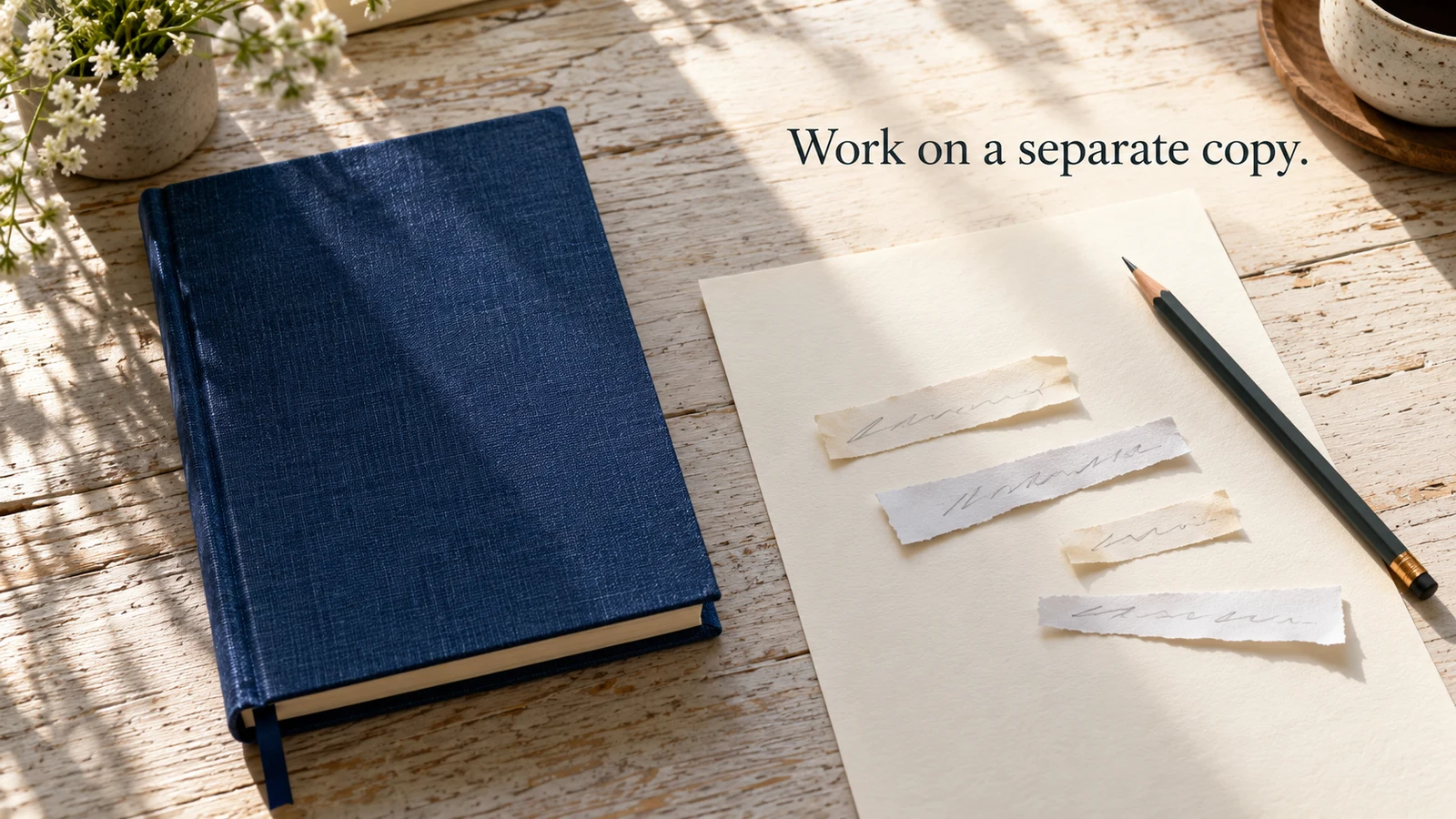
Put the chosen prose on a separate sheet or in a separate working document. Add a source pointer you can understand, such as the entry date and page number, without unnecessarily duplicating sensitive details. The copy becomes a surface for circling phrases, crossing out options or trying different line breaks while the original stays as it was.
If the entry contains earlier corrections or uncertain wording, keep that context available privately. You can choose a phrase for its sound without claiming it is a complete factual account. The poem and the source may come to emphasise different things. Label the new piece separately so a later reader does not mistake it for the whole original entry.
For older material, SoulFul GLO's guide to reviewing journal entries offers a separate way to consider context. Use it when that is what you want to do; a found-poem experiment does not require a review of your personal history.
Select phrases before arranging lines
Read the copy once and mark a few words or short phrases you want to retain. You might choose a concrete noun, an action and a small detail that changes the picture. Try “the blue cup,” “waited” and “beside the open window” rather than beginning with a demand that the poem explain your entire afternoon.
Keep the selection small enough to see at once. Read only those phrases, ignoring the rest for a moment. What relation do they create? If the sequence is difficult to follow, return a useful word from the source or remove a phrase that requires too much missing context. You do not need to preserve everything that first caught your attention.
Watch for an accidental claim. Removing “I imagined” before a sentence can make an invented scene sound like an observation. A poem may deliberately depart from literal reporting, but notice that change and label the work accordingly. Selecting words does not turn the result into evidence about another person's motives or an event you did not witness.
Let line breaks change how the words are read
Write the selected phrases on separate lines and read the sequence. A line ending creates a place where a reader may pause or briefly hold an expectation. Try moving one break rather than replacing every word. Compare the versions and keep the arrangement you prefer; you do not need to call one objectively better.
For example, “the cup waited / beside the window” gives “waited” a little space before the location appears. “The cup / waited beside the window” first isolates the object. Both versions can use the same words while directing attention differently. These are original illustrative phrases, not claims about what a particular reader will feel.
Punctuation can stay simple. A full stop can close the piece; a comma may keep a phrase moving. If your working rule allows punctuation changes, make them where they help the reading. Rhyme and a fixed metre are optional. There is no requirement to make ordinary journal language resemble a style you do not enjoy.
If you would rather begin a new entry, explore SoulFul GLO's prompt-adaptation guide. It offers a different writing task: changing a question so it fits the account you want to make.
Original fictional example: a table after lunch
Consider this invented source passage, written for this guide: “After lunch I moved the blue cup to the windowsill. The table still held a folded cloth and three crumbs. I left the cloth where it was and opened the window.” It concerns an ordinary scene and contains no borrowed literary quotation.
One possible selection, preserving word order, is: “the blue cup / the table still held / a folded cloth / three crumbs / I left / and opened the window”. The slashes show possible line breaks in this printed example. On your own page, you could write each phrase on a separate line and omit the slash marks.
That selection is not a complete summary of lunch. It moves attention through objects and actions while leaving most of the account out. Another version might keep only the cup and the open window. The writer can compare both without treating a shorter poem as a more honest account or a longer one as a deeper reflection.
Notice the phrase “I left.” In isolation it can suggest leaving the room, although the original says the cloth was left in place. If that ambiguity is unwanted, keep “the cloth” after it or remove the phrase. This small revision tests the actual wording rather than adding a general lesson about letting things go.
Original fictional example: a project left unfinished
A second invented source passage reads: “The cardboard model was still on the desk when I returned. One corner had lifted from the base. I put a book beside it, checked the glue label and decided to leave the next attempt until Saturday.” The writer can work with material details without giving the model a symbolic meaning.
An initial selection could be “the cardboard model / still on the desk / one corner / lifted / a book beside it / until Saturday”. Keeping the source order leaves the objects and time reference in sequence. Read it once and ask whether the final line belongs with the piece you want, not whether it proves patience or personal growth.
If the rule changes to allow reordering, a second arrangement might begin “until Saturday” and then return to the model on the desk. That is a new compositional choice, not the chronology of the original entry. Keep a note such as “phrases reordered” if you want the source relationship to remain clear when you revisit the page.
You can title either version with a phrase from the source or leave it untitled. A title such as “One corner” focuses attention differently from “Until Saturday.” Try reading the poem with and without a title. There is no obligation to explain the object, complete the project or turn the poem into an action plan.
Keep the new piece distinct from the old entry
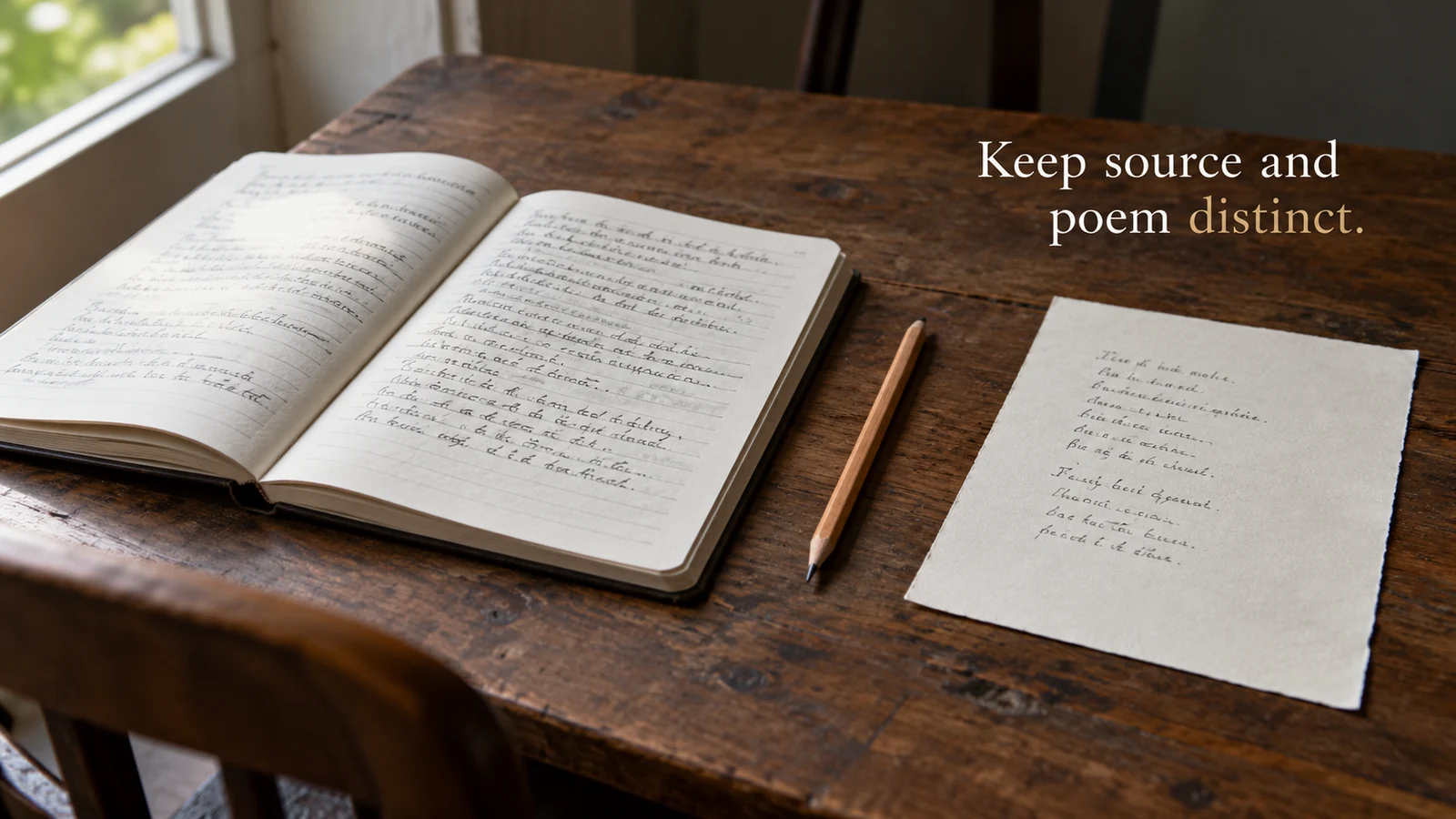
Give the poem its own date if you date your writing. A note can say “Made from my entry dated 12 April; words kept in source order,” using dates that are true for your own material. You do not have to publish the source pointer or make a catalogue of every draft. Keep only the context that is useful to you.
If you want to share the poem, consider the words that remain rather than assuming shortness makes them impersonal. A place, unusual phrase or account of another person can still carry private information. Sharing the poem and showing the full source are separate choices. This tutorial makes no promises about anonymity, secure storage or the behaviour of a recipient.
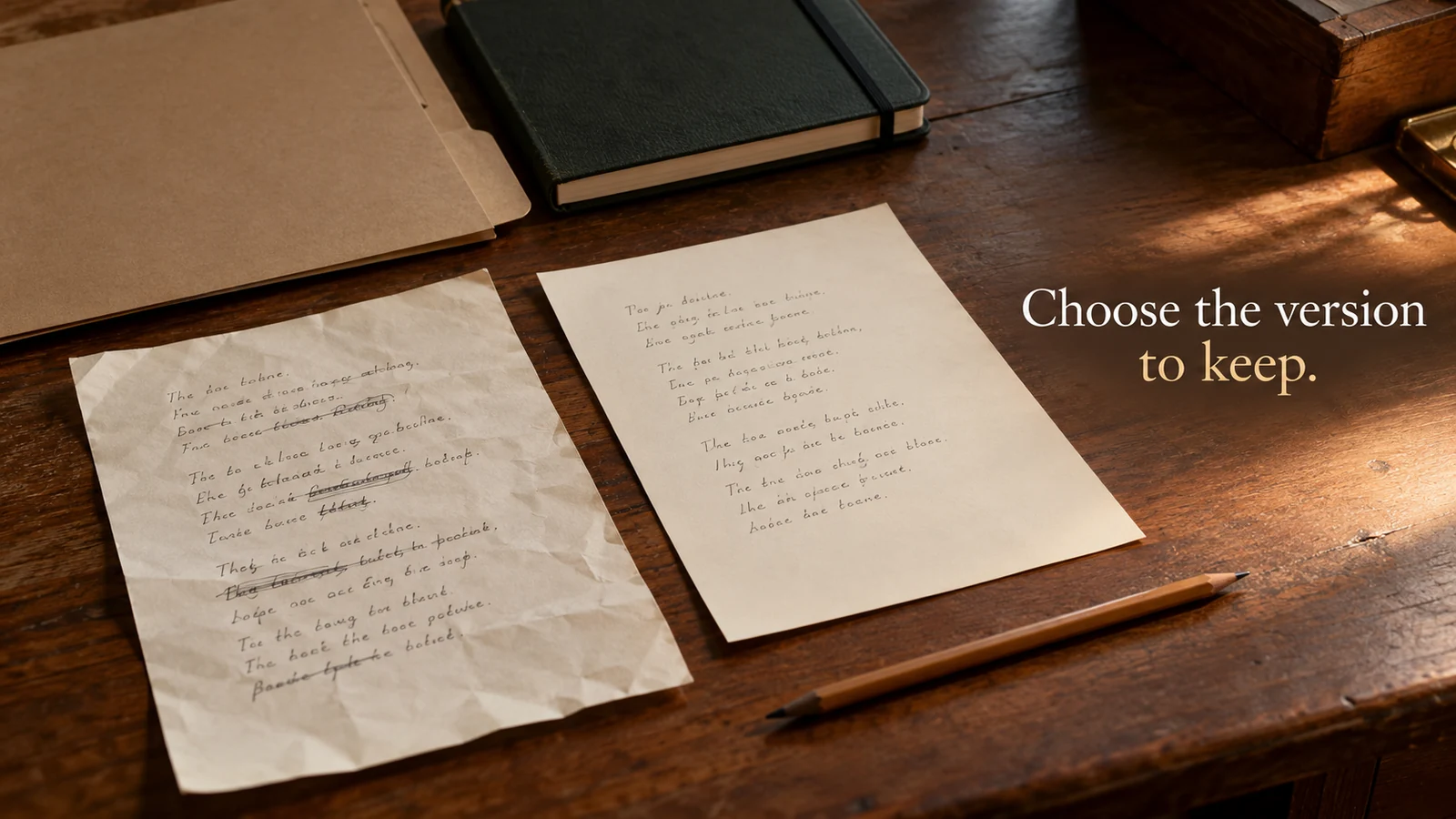
Finish by deciding which version, if any, you want to keep. You can retain a rough attempt, keep two alternatives or stop without a finished poem. The procedure offers a way to work with language already on your page. It does not establish a daily requirement, a score for your writing or an obligation to produce something worth showing.
Frequently asked questions
Must the poem rhyme?
No. For this experiment, phrase selection and line breaks are enough to explore. You may hear a rhythm you like, but you do not need to force rhyme by adding words that were absent from the source. Choose a rule suited to the piece you want to make.
Can I use words from more than one entry?
You can, after a small first attempt if that suits you. Keep source references separately and notice how combining dates changes context. The result is a new composition rather than a continuous quotation from one occasion. Avoid treating the sequence as proof that events happened together.
Can I add words that are missing?
Yes, if you change the working rule and describe the result accurately. A piece with new connecting language may be a poem adapted from the entry rather than a strict selection. There is no need to hide the revision to make the exercise count.
Should I black out words on the original page?
This guide uses a separate copy so the original remains available. You can cross out options on that working copy without changing the earlier entry. Whether you later alter a personal notebook is your choice, but permanent changes are unnecessary for this method.
Is this a mental-health practice?
It is presented here as optional creative writing. No clinical outcome, memory improvement or emotional benefit is established by completing it. Choose material you are willing to read, stop when you wish and use appropriate support for concerns that exceed a writing tutorial.
For the separate question of where the source page lives, explore SoulFul GLO's shared-household journaling guide. Keep the arrangement suited to your circumstances, then decide whether you want to return to this writing experiment.