
An optional wellness quiz asks how often you discuss concerns with a partner, but you do not have a partner. The available answers range from always to never. Choosing never might let you advance, yet it would describe a relationship you are not answering about. The difficulty is in the question and its options, not in finding a more flattering response.
Before selecting an answer, establish what the question actually asks and whether the form offers a suitable way to respond. You can leave an optional activity unfinished when its choices do not represent your situation. This guide concerns informal adult self-reflection quizzes. Clinical, research, employment and other formal assessments need their provider's instructions and relevant professional guidance.
Quick answer
Read the whole question, its stated time frame and every available answer. Look for an actual not-applicable, unsure or skip option, and use it only when its meaning fits. If no offered response is accurate, pause rather than inventing an experience. Ask the provider a bounded question or leave the quiz. Do not rewrite a formal question and treat the resulting score as equivalent.
A missing answer can mean several things. The subject may not apply, the wording may be unclear, or you may lack enough information to choose. Keep those situations separate. You can explain the mismatch in ordinary language without supplying private answers or trying to correct the provider's scoring system yourself.
Identify the assumption that creates the mismatch
Read for a person, activity or arrangement the question takes for granted. Does it assume you have a partner, work with colleagues, keep a particular routine or use a certain service? A response frequency does not necessarily give you a way to say that the underlying situation is absent. Locate that assumption before trying to choose between the frequency options.
For example, “How often do you review your weekly practice plan?” assumes that there is a plan to review. If you have no such plan, never might mean you have a plan and do not review it, or it might be the answer the provider intends for your circumstances. You cannot establish that intention from the word alone. Read any explanation attached to the item.
Keep a short note if it helps: “This asks about a plan I do not have.” The note identifies the reading problem. It does not establish that the whole quiz is invalid, and it is not a reason to construct an imaginary plan so the question becomes answerable. You are deciding how to handle this item in the actual form.
Check the period and subject before answering
A question about the last week differs from one about your usual experience. If you recognise the situation but it did not occur during the stated period, reread the available instructions. They may explain how to answer that case. Avoid silently changing the period to a month or a remembered year because it supplies an easier example.
Also check whose experience is being requested. A question about your own routine is not asking you to describe someone else's routine. You may know what a friend does without having that experience yourself. Similarly, a general statement about what people ought to do is different from a request to describe what you actually did.
If the wording contains two questions, such as enjoying an activity and doing it regularly, an answer may fit only one part. Name the difficulty when asking for clarification. “I enjoy it but did not do it during the stated week; how does this item handle that?” is more precise than choosing an average that the form never defined.
Read each available response as an answer
Look through the entire list before selecting. A suitable option may appear after the frequency choices, or the form may explain an item elsewhere on the page. Use only controls that actually exist. This article does not establish that SoulFul GLO or another provider offers a skip button, an optional field or a not-applicable response.

Keep the meanings distinct. Not applicable can describe a subject outside your circumstances. Unsure can describe uncertainty about a subject that does apply. Prefer not to answer can express a choice not to disclose. They are not automatically interchangeable, even when more than one would move the form forward.
Read any provider explanation of those labels. The meaning in this particular quiz may be more specific than your ordinary use of the phrase. If an explanation is missing and the distinction affects your choice, leave that point unresolved. Selecting the label that looks least negative would still leave the underlying question unanswered.
If personal information requests are part of your concern, use SoulFul GLO's guide to checking a wellness quiz before entering personal details. That guide addresses disclosure and account context. A form can explain its information use clearly and still leave you with an answer choice that does not fit.
Use a supported skip without making assumptions about the result
If the quiz supplies a skip option for this item, read what it says about skipping. It may allow you to continue, leave an incomplete result or require another step. Use its actual explanation rather than assuming that an unanswered item is ignored, receives a neutral value or makes no difference to the score.
A control being present tells you what you can select. It does not explain every consequence of that selection. If a result depends on how missing answers are handled, look for the provider's description or ask. This guide cannot reconstruct a scoring rule from the appearance of a button.
You can decide not to continue after skipping. Reaching the next screen does not oblige you to finish or accept an interpretation. If you keep a result for personal reference, retain any relevant explanation that some questions were unanswered. Avoid presenting it to yourself or someone else as a complete assessment when the form describes it differently.
Ask about the item without sending your whole response
A useful question identifies the quiz, the item wording and the particular answer problem. For example: “In the question about discussing plans with a partner, which provided option is intended for someone without a partner?” You can ask about the design without giving the provider an account of your relationships.
Use the provider's legitimate support route and omit identifying details that are unnecessary to the question. If you share a screenshot, inspect the actual image for earlier answers, account details or another person's information. Quoting the short item and its response labels may be enough, depending on the support arrangement.
Read the reply for what it resolves. An explanation of where the skip control sits may answer a navigation question without explaining how missing responses affect the result. Ask a focused follow-up if that distinction matters. You can also leave the activity while waiting; a request for clarification is not a commitment to submit later.
Three fictional answer decisions
The subject is absent
In this invented example, Noor opens a personal reflection quiz and reaches a question about a weekly group activity. Noor does not attend such a group. The form includes not applicable, with a note explaining that it is intended when the activity is absent. Noor reads that note and chooses the option for the stated reason.
Noor has not learned how any other service handles missing group experience. The example depends on the fictional form's explicit explanation. If the option or explanation were absent, the same answer decision would not be available. A friendly title or familiar subject would not supply it.
The time frame is unclear
Another fictional reader, Elias, sees a question asking about regular practice, followed by an instruction referring to the previous seven days. His routine has changed recently. He could answer about the period stated in the instruction, but he wants to know whether regular refers to that period or a longer usual pattern.
He asks the provider which period governs the item, using the wording of the question rather than sending his practice history. Until the answer is clear, he leaves it unsubmitted. This example concerns a reading ambiguity. It does not claim that Elias should receive a particular score or that a recent change represents progress.
The available labels do not match
A third fictional reader, Amira, finds a yes-or-no item joining two separate activities. She does one and has never tried the other. The quiz gives no explanation for that combination and no alternative response. She decides that neither available answer describes the situation she wants to report.
Amira leaves the optional quiz and writes a private sentence about the activity she actually does. That is a different reflection activity, not a way to obtain an equivalent quiz result. These people and forms are invented illustrations. They do not describe a current app interface, real customer experiences or a validated method of interpreting scores.
Keep an unfinished quiz separate from a judgment about yourself
An incomplete form can record an unresolved interaction with a particular set of questions. It does not establish that you are unwilling to reflect or that another person's circumstances are the right model for yours. You can be interested in the topic and still decline to answer through an unsuitable set of options.
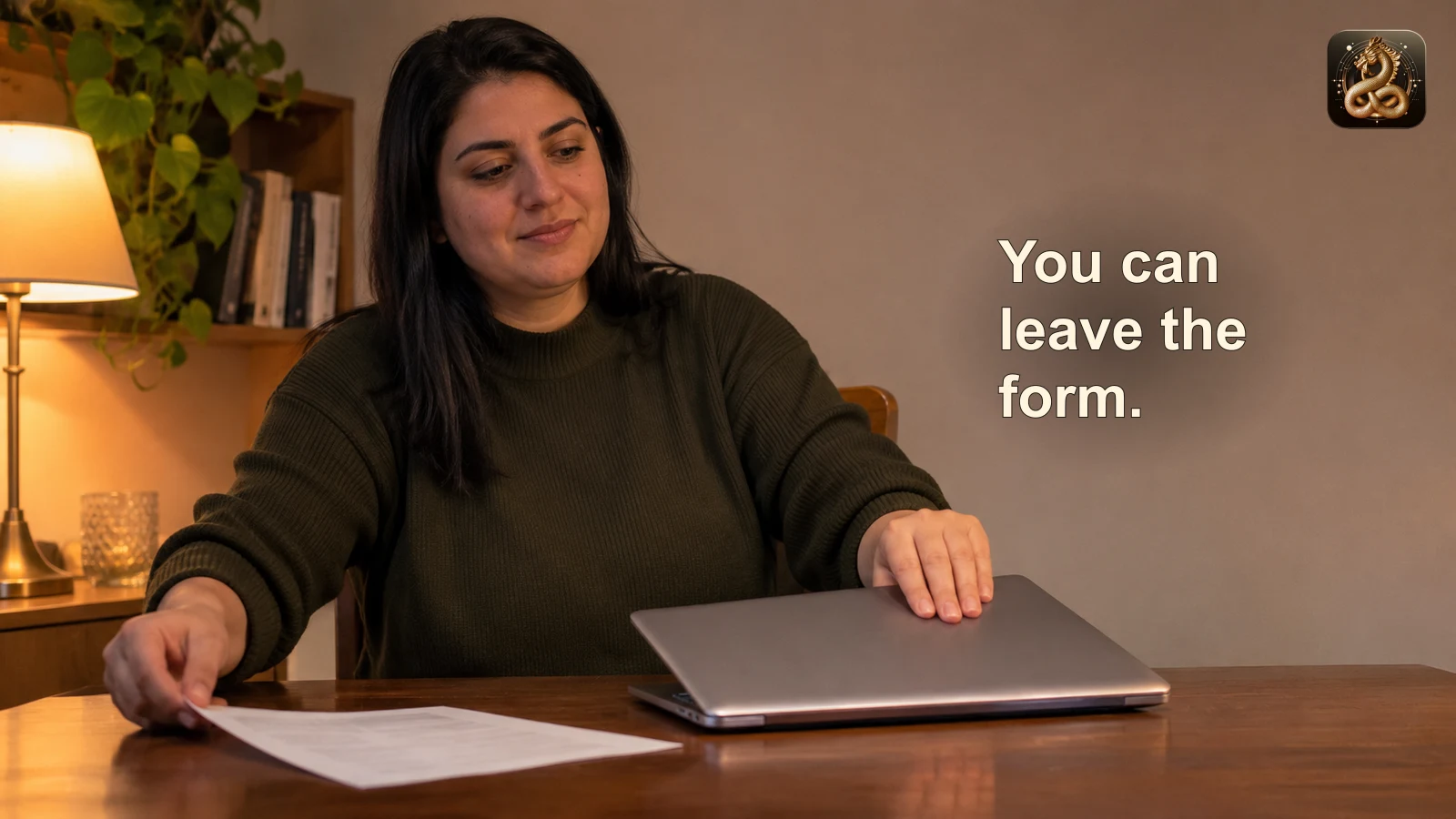
If you want to keep something from the occasion, note the practical question rather than inventing a score. “I wanted to understand the period this item covers” is a usable reminder. Keep any personal writing somewhere appropriate to its content and actual access arrangements. The form's title does not determine how private your own notes are.
Choose another resource on its actual purpose. A journal question, a meditation and another quiz are different activities, with different instructions and limits. You do not need to call them equivalent to decide that another option suits this moment. For concerns requiring care or a formal assessment, use appropriate support rather than trying to make an informal quiz fulfil that role.
Frequently asked questions
Can I choose the middle answer when nothing fits?
A middle option has the meaning supplied by the form. It is not automatically an unspecified or not-applicable response. Read the instructions and available labels. If no choice accurately expresses your answer, ask the provider or leave the optional activity rather than assigning a new meaning yourself.
Does skipping a question leave the score unchanged?
That depends on the actual scoring and missing-response rules. Check the provider's explanation. A visible skip control is not evidence that the result will be calculated in a particular way, and this guide does not certify the result of any individual quiz.
May I rewrite the question to make it apply?
You can use different wording for your own separate journal reflection. Do not treat an answer to your revised wording as an equivalent response in a structured or formal assessment. Ask the provider how an unsuitable item should be handled under that assessment's instructions.
Must I finish a quiz I started?
For the optional personal activity discussed here, you can leave it. Use the relevant provider instructions for an activity with another purpose or obligation. An unfinished reflection quiz does not have to produce a score or a conclusion about your wellbeing.
Choose a separate question when you want personal writing
SoulFul GLO's prompt-adaptation guide offers a method for revising an optional journal question. Use it for a new piece of private writing if that is what you want. Keep that choice separate from answering, rescoring or completing the quiz you left.