
You know a short guided meditation well enough to recognise its instructions before the speaker finishes. One day you wonder whether you would like to practise without a voice throughout the session. That question can stay practical. You are choosing a different arrangement for your attention, rather than taking an examination or leaving guided meditation behind.
An unguided session removes the ongoing spoken prompts. It does not remove the need for an understandable practice, a workable ending or the choice to stop. Start with something you already understand from appropriate guidance. If you cannot describe what you intend to do, more explanation may be useful before experimenting with a quieter format.
Quick answer
Choose a short, familiar and understandable practice whose instructions make sense without continuous narration. Check the complete sequence and ending first, keep the original guidance available, and use a duration that fits your actual time. During the session, distinguish ordinary distraction from forgetting what the practice asks. Return to the understood task when you want to, consult the source when meaning is missing, and use guided audio again whenever it suits you.
There is no requirement to become comfortable with unguided meditation. A familiar recording may remain your preferred way to practise. A session with fewer words may suit another occasion. Neither arrangement supplies a guarantee about mood, concentration or health, and switching formats creates no obligation to continue a practice that feels unwelcome.
Decide what you want to change
Name the feature of guided audio you would like to change. You may want to choose when to finish, avoid a narrator's pace or spend a short period with an instruction you already know. These are different reasons. An unguided session may address one while leaving another problem untouched.
For example, if the voice returns too frequently, a recording with longer gaps may provide enough space. If you do not understand the invitation, removing the voice will not explain it. If the room is uncomfortable, silence will not change the seating. Identify the actual issue before assuming that fewer prompts are the answer.
SoulFul GLO's guide to long pauses between spoken cues describes remaining with an understood invitation while guidance continues. That is a separate option. You can compare it with a deliberately unguided session without treating either as the stage you ought to reach next.
Begin with a complete practice you understand
Revisit the actual source rather than relying on a pleasant memory of its opening. Check what the practice asks you to attend to, what it says about distraction, whether its instructions change and how it finishes. A recording may contain important qualifications after the part you happen to remember.
Choose material intended to be usable in the way you propose. Some guidance belongs to a course or depends on a teacher's explanation. An excerpt does not automatically become a standalone practice when you stop the audio. If you cannot establish that the sequence is complete, use the original arrangement or seek clarification.
Keep a cue separate from an improvised technique. A reminder to attend to an ordinary sound is different from inventing a breathing pattern because a recording once mentioned breathing. Do not reconstruct unfamiliar physical instructions, imagery sequences or breath exercises from fragments. The quieter format should leave the original meaning intact.
You need not memorise a script word for word. The useful question is whether you understand the task well enough to state it plainly. If your explanation changes every time you try, return to the source. Familiarity with a speaker's voice is not the same thing as understanding the whole practice.
This format guide cannot adapt a clinical programme for independent practice; ask the responsible provider about that arrangement.
Make guidance available without keeping it playing
Leave an easy route back to the original material. A bookmark, readable page or recording paused before its instructions can be enough, depending on what the provider actually supplies. Check the arrangement before beginning. Do not assume that an app includes transcripts, section markers or offline access merely because another service does.
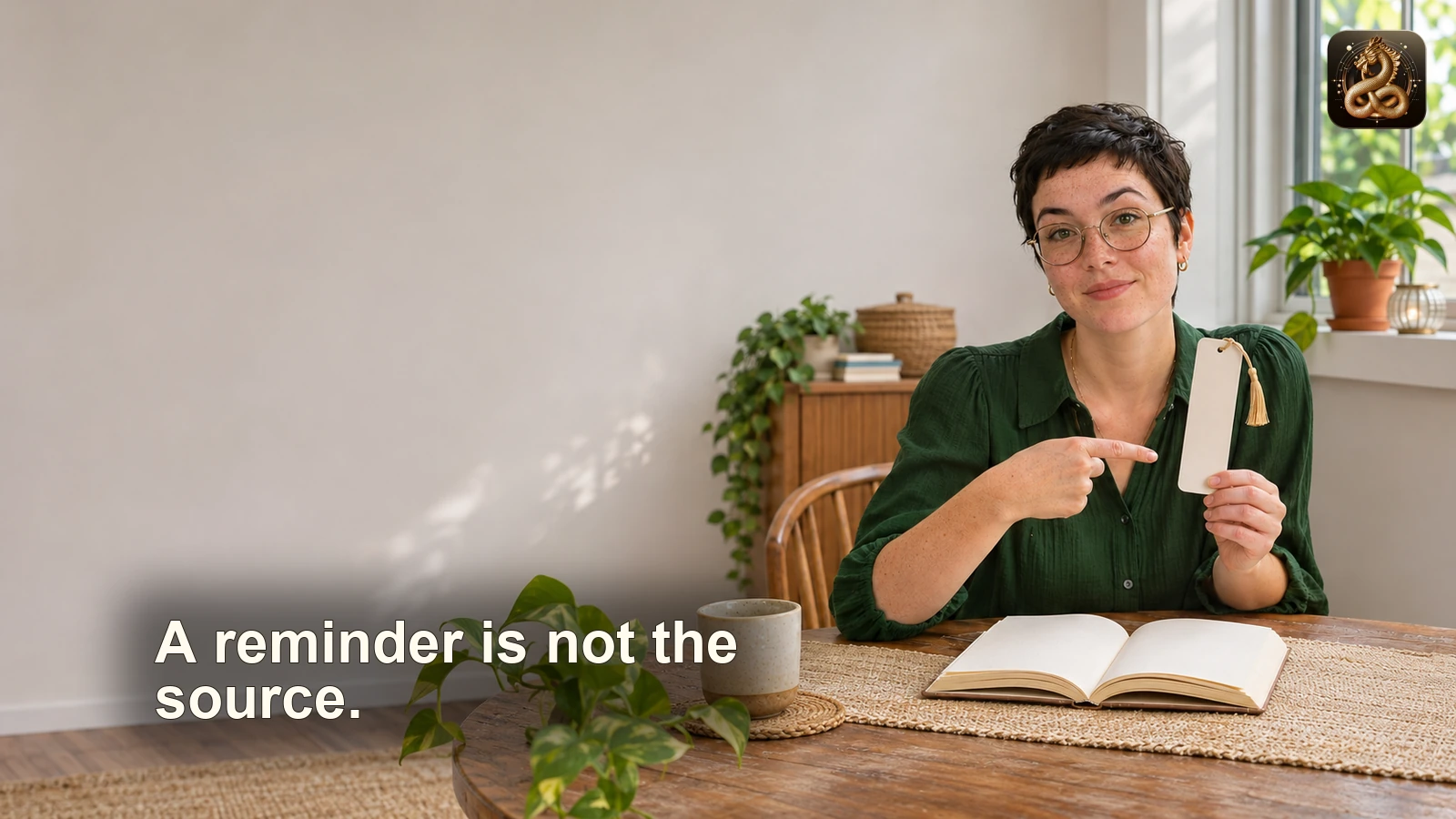
If you make a private reminder, keep it short and clearly distinguish it from the source. Include only an instruction you have understood. A note should help you locate the original explanation when needed, rather than replace a qualification you omitted to make the wording fit on a small card.
Reading and practising can remain separate activities. You can consult the page, try an understood instruction and consult it again. SoulFul GLO's written-guidance article covers that arrangement in more detail. Returning to a source is ordinary use of guidance, not evidence that the unguided attempt has failed.
Choose an ending before you begin
Decide how this particular pause will end. You might use a tested timer, another familiar signal or an untimed moment when responsibilities allow. Pick an arrangement you can actually use. A larger duration is not inherently more worthwhile, and a missing ending should not become a reason to remain longer than you intended.
Leave room for returning to the day. If you have an appointment soon, the practice needs to fit before the time required to prepare for it. Do not ask meditation to suspend an ordinary deadline. You can choose a shorter pause or keep the familiar recording whose length and closing you already know.
Try the change on an occasion when you would ordinarily choose a familiar recording. Keep the room, chair and understood practice much the same, so the missing voice is the main change you are considering. Afterwards, note one practical difference if you want: you wanted a reminder, preferred choosing the pace or needed the instructions nearby. Avoid changing the duration, attention task and surroundings all at once merely to make the unguided attempt feel different. This modest comparison can inform your next choice without becoming an experiment that proves a benefit.
Read the meditation-timer setup guide if a timer would help. It explains checking the actual ending signal and placing the display without making the countdown your focus. Equipment readiness remains separate from understanding the meditation itself.
Distinguish distraction from a missing instruction
During practice, a thought about an ordinary task may take your attention elsewhere. If you still understand your intended focus, you can choose to return to it. There is no need to replay every missed moment, restart the whole session or calculate how much of the duration counted.
A different situation occurs when you no longer know what the practice asks. Perhaps you recall a phrase but not the action it described, or remember that the sequence changed without remembering how. Consult the available guidance, use the recording again or finish. Guessing is unnecessary when the missing information can stay explicit.
You can ask a simple question: do I know the task, or am I trying to recover it? The answer helps choose a response. This is an original practical distinction for handling the format. It is not a test of memory, a diagnostic tool or a claim that you should monitor every shift in attention.
If you consult the source, take the time the consultation actually needs. You may decide that the remaining gap is better spent reading than practising. That is a usable decision. An optional session does not leave a debt to repay with extra minutes, and the original recording remains available for another occasion.
Let the room remain an ordinary room
Removing a voice does not require removing every sound around you. Use a setting appropriate to the practice and your responsibilities. Keep anything that genuinely needs attention available. A doorbell, another person's request or an uncomfortable position can call for an ordinary response without being turned into a lesson about commitment.
You can keep your eyes open if that fits the actual guidance and setting. You can also change position when needed rather than hold still to demonstrate that the session is unguided. If a resource prescribes a physical action you are unsure about, seek an appropriate explanation instead of using this format guide as a substitute.
Avoid making the room an equipment project. You do not need to purchase a cushion, redesign a corner or find an ideal silence before deciding whether fewer spoken prompts suit you. Change the part that makes the session workable, and leave the rest alone when it already serves your purpose.
Two fictional trials
Mira knows a short sound-attention practice from a teacher's complete standalone instructions. In this invented example, she reviews the directions and keeps the page nearby. She chooses a brief gap with a familiar ending signal. Her aim is to see whether she likes using the known task without ongoing narration.
Partway through, she notices that she has been thinking about lunch. She still knows the practice's focus and chooses to return. Later, she wonders whether its closing instruction included another step. She checks the page rather than supplying one. Reading takes the remaining time, so she finishes after reviewing the actual ending.
Mira's useful observation is about the arrangement: the page was easy to consult, and she wanted its closing explanation available. The story does not establish improved attention or a particular emotional effect. She can choose audio next time without treating that choice as a reversal of progress.
In another fictional situation, Alex wants fewer spoken reminders but finds an entirely unguided pause unappealing. He chooses a familiar recording with longer spaces instead. The voice still supplies the sequence and closing. He has learned which format he wants today, without deciding that one type of meditation is universally easier or better.
Keep benefits separate from the format
You may appreciate choosing your pace or hearing the room without narration. Those are practical preferences you can notice directly. They do not establish that unguided meditation produces stronger benefits, works faster or is more authentic than guidance. A pleasant session is a personal report, not a comparison study.
NCCIH's meditation overview discusses varied approaches, evidence limitations and possible negative experiences. It advises against replacing conventional care with meditation. Those boundaries apply whether a voice is present or absent; an audio-format choice is not an individual assessment of suitability.
Stop a practice that becomes unwelcome and seek appropriate qualified support for concerning difficulties. You do not have to remain alone with an instruction because you called the session unguided. Questions, assistance and another activity remain available. The practical experiment can end without a conclusion about meditation as a whole.
Frequently asked questions
Do I have to stop using guided recordings eventually?
No progression requirement is established here. Use guidance when its instructions and arrangement suit you. Trying a different format can remain an occasional choice. You do not need to remove a useful voice to demonstrate commitment or repeat a format you dislike until it feels acceptable.
What if I forget what to do?
Return to the actual source, use the recording again or finish. Keep forgetting an instruction separate from knowing it and becoming distracted. If the practice requires explanation you have not received, seek that explanation or choose a simpler resource rather than inventing missing steps.
Can a short cue card be enough?
It can help locate a familiar instruction, but check what it omits. A private reminder should not replace essential context, qualifications or an ending you do not understand. Keep the original material available and distinguish your own shorthand from the provider's complete guidance.
Does an ordinary or distracted session mean this format is unsuitable?
One experience need not decide a permanent preference. You can observe what was inconvenient and choose another arrangement next time. There is no requirement to score concentration, reproduce a feeling or continue practising until you obtain a result that justifies the experiment.
Choose the amount of guidance you want today
Explore SoulFul GLO's meditation overview when considering a guided option. For an unguided pause, keep the understood practice, source and ending available. Choose the arrangement you want to use today, with room to ask a question, return to a voice or stop.