
You set aside a few minutes to meditate, start a timer and put the phone beside your chair. Then you look at it. Has a minute passed? Is the timer still running? Will you hear the ending? The countdown becomes the thing you keep returning to, even though you meant to attend to something else.
A timer can handle a practical question: when will this pause end? It cannot decide whether the session was worthwhile or make you stay until the sound. A useful setup gives you reasonable confidence in the ending signal, leaves the controls accessible and lets the screen sit outside your immediate view.
Quick answer
Before an unguided meditation, choose an available duration and test the actual timer with the device and audio arrangement you will use. Confirm that it starts, produces a noticeable ending and can be stopped. Start your chosen duration once, check that it is running, then place the display where you can reach it without continuously watching. If its state becomes uncertain, check it directly rather than starting another timer blindly.

This is an everyday equipment and attention guide, not a prescribed meditation technique. You can finish early, use a recording with its own ending or choose an untimed pause. Keep responsibilities that need your attention available. A personal timer should not replace an essential reminder, safety procedure or another person's supervision.
Decide what job the timer has
For this session, the timer marks an ending. Choose a duration that fits the time actually available, including an ordinary margin before your next responsibility. There is no special number that makes this setup valid. If you have only a small gap, you do not need to spend most of it configuring a device.
Separate the time you can spend from the feeling you hope for. Setting a timer for longer because you have not become calm gives it a different job: measuring whether you have achieved a state. You can notice how you feel without making the alert conditional on feeling better. The session remains optional throughout.
Decide whether you need a timer at all. An audio guide may already contain a clear closing instruction. Adding a second ending could leave you wondering which one to follow. Read the recording's description and choose an arrangement you understand; do not assume that a player includes a timer, background playback or a particular closing sound.
Test the ending before you settle
Use a short test that does not consume the time intended for practice. Stay with the device while it runs. Check the displayed state, listen for the ending and try the stop control. This is a practical equipment check, rather than a meditation attempt you need to count.
Test the arrangement you will actually use. If you plan to have headphones connected, include them. If you will put the phone on a nearby surface, test there. A sound heard through one arrangement does not establish what will happen after you connect a different speaker, change an output or switch applications.
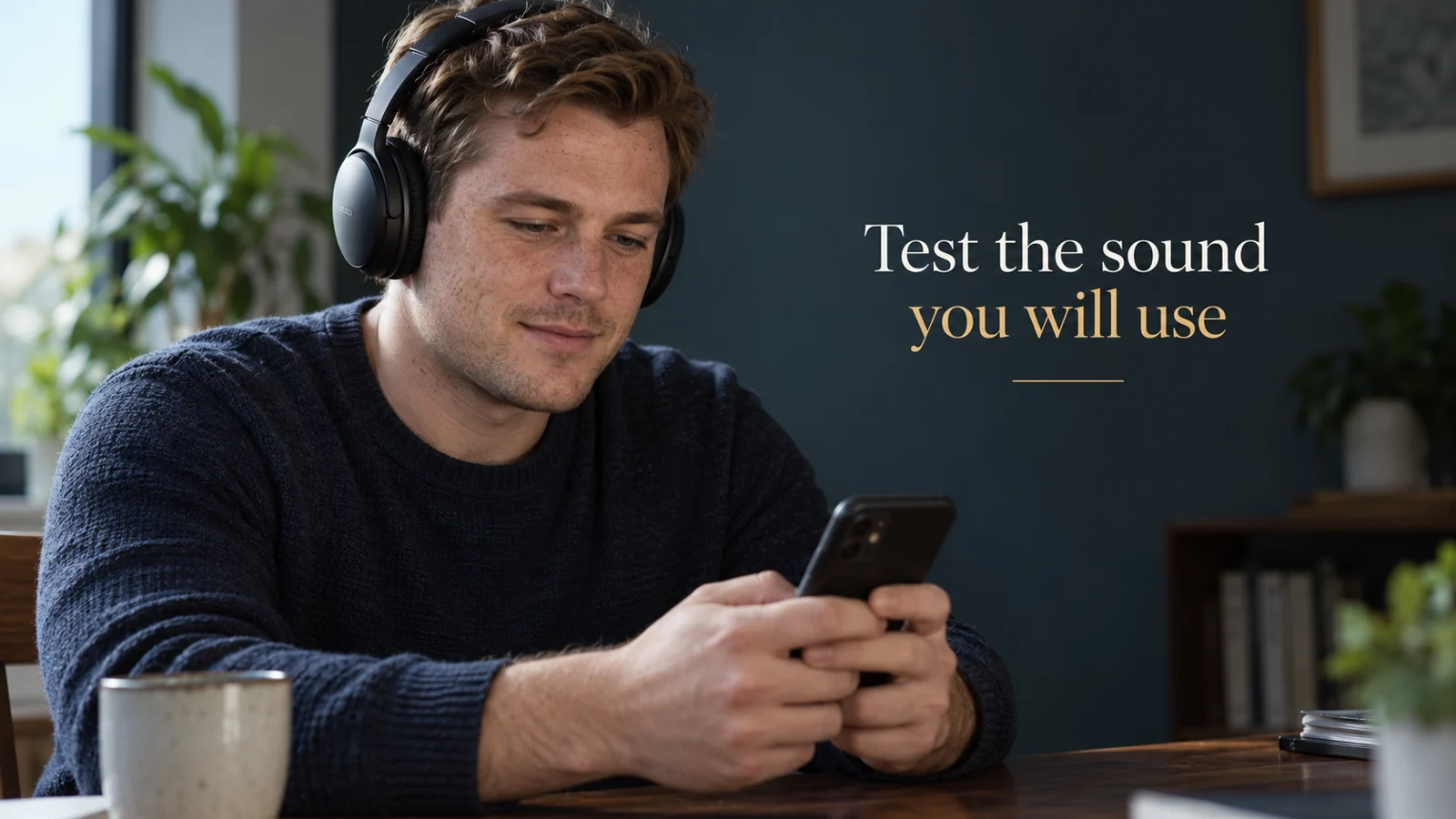
Device instructions matter because settings differ. Apple's official Clock guide, for example, explains its own timer controls and sounds. Use documentation for your actual device and software when you need exact steps. Do not transfer a statement about one manufacturer's alarm to every timer or assume that silencing messages also silences, or preserves, the ending you selected.
Choose an ending you can notice without making it unnecessarily loud. Listen while making the choice rather than judging a sound from its name. Consider other people in the room. A long repeating alert may be awkward in a shared space, while an ending too quiet to notice will not perform the job you gave it.
If the test fails, keep that as equipment information. Check the visible settings and the provider's instructions, or use a simpler option you already understand. You do not need to complete an unguided practice while wondering whether the alert works. Avoid trying unfamiliar downloads or granting extra permissions solely to rescue this session.
Start once and give the screen a place
After the test, set the duration you chose for the actual pause. Clear or distinguish any test timer that remains, using the controls your device provides. Press start once and look for its visible running state. Putting the phone down before confirming this can turn a forgotten tap into repeated uncertainty.
Place the screen outside your direct line of sight while keeping the device stable and reachable. Turning a display away may be enough. You do not have to hide it across the room or arrange a difficult reach. Keep your ordinary access needs and any important communication in mind.
For an eyes-open practice, choose a view that does not include the changing numbers. You can still look around and respond normally to the room. The aim is a practical display position, not a rule that forbids you from checking a device when necessary. Eyes-closed practice is not required to make a timer useful.

If you want to compare comfortable viewing options, explore SoulFul GLO's eyes-open meditation guide. It offers ordinary home examples for placing your gaze without turning the pause into a staring task. Choose an option that fits you; the timer does not determine where you must look.
Tell a time question from a device question
When you want to check the countdown, ask what you need to know. A device question is concrete: did I press start, did the sound stop or did the application close? A time question may simply be curiosity about how much is left. These questions can lead to different choices.
If you have a concrete reason to doubt the timer, look at it. Read the actual state and decide what to do. Checking is more useful than repeatedly assuring yourself that it must be working. Once you have the answer, you may return to the practice or finish. There is no requirement to conceal a genuine equipment problem.

If the question is only how long remains, you can let it be unanswered and return to the attention anchor you selected. That might be an ordinary sound or another comfortable focus from your chosen guidance. You are making a fresh choice about attention, not trying to remove curiosity permanently.
A check that already happened does not erase the session. Put the display back if you want to continue. Avoid adding time as a penalty or restarting until you achieve an uninterrupted attempt. The timer can mark the pause you actually had, including the moment you looked at it.
Recover an uncertain timer without doubling the session
An interruption can make the device state unclear. Perhaps you picked up the phone to answer something important and can no longer remember whether you paused the timer. Look for the current timer before pressing start elsewhere. A second timer can produce two endings and leave the original question unresolved.
Read what the controls actually show: running, paused, finished or no timer present. If the meaning is unclear, consult the device's instructions or end the attempt. Do not infer elapsed meditation time from a vague memory of when you sat down. A missing record is simply missing information.
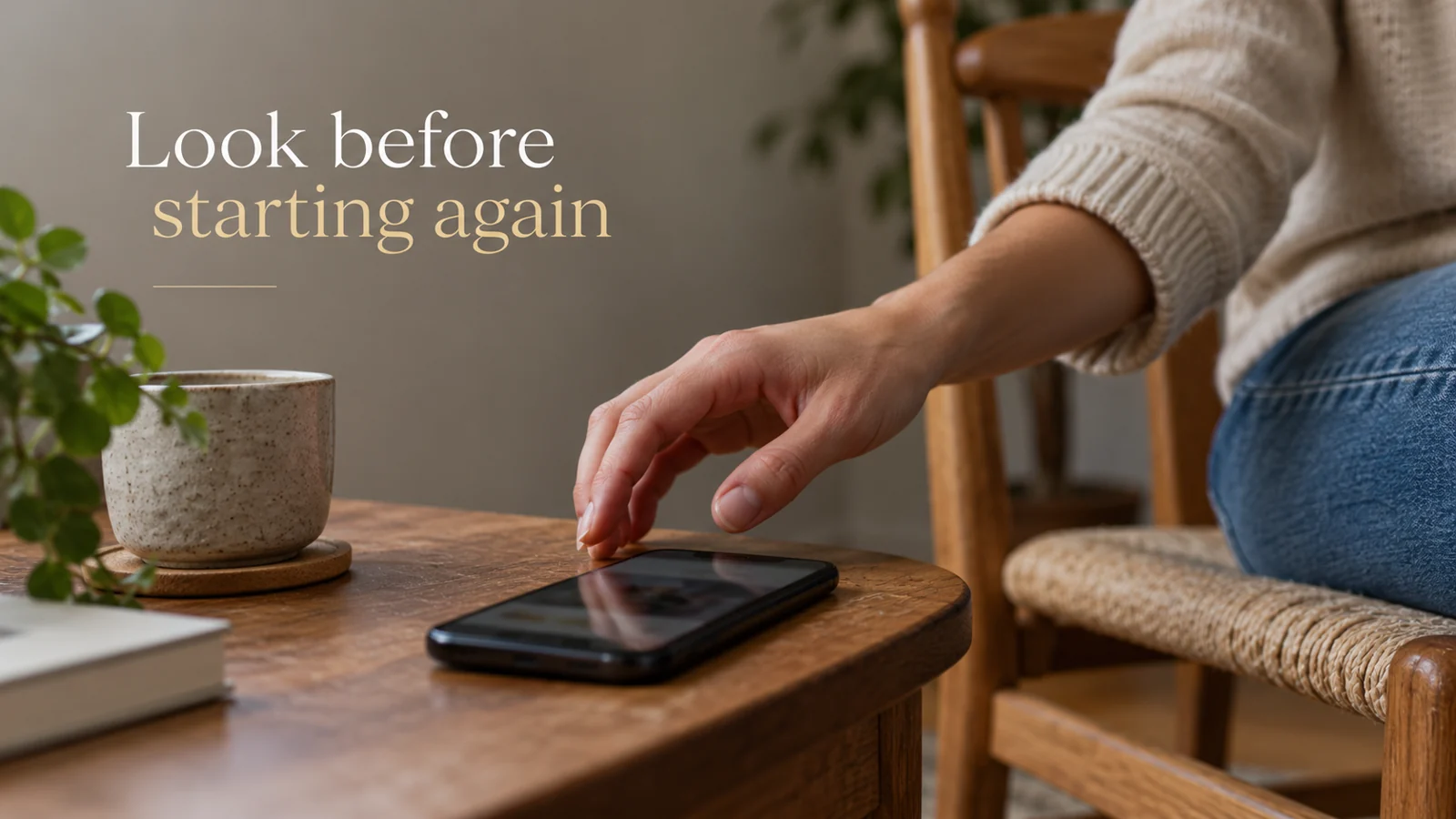
Choose what happens next based on the situation now. You might resume a paused timer, finish because the available gap has ended or choose a new short pause later. None requires recovering an exact total. Avoid creating a catch-up duration to compensate for minutes you cannot account for.
After a failed or confusing attempt, change one identifiable part before testing again. For example, use the same device without the accessory that made its output uncertain, provided that is suitable for you. Keep a note about the actual observation rather than diagnosing a fault you have not established.
Two fictional setups with different problems
A visible countdown beside a chair
In this fictional example, Mira has already tested a timer on the shelf beside her chair. The ending is noticeable, the stop control is familiar and no other alert is needed for the gap she has chosen. During the pause, the bright changing numbers keep attracting her eyes.
She rotates the display away while leaving it within reach. When she later wonders how much is left, she recognises that she has no new evidence of a device problem. She chooses to return to the ordinary room sound she was attending to. If she wants to look again, that choice remains available.
Mira's adjustment concerns the display position. It does not establish that her concentration improved or that checking time has disappeared. After the ending sounds, she stops it and moves on. She can retain the same arrangement next time if it remains convenient.
An output change after the test
In a second fictional example, Arun tests his phone timer, then connects a speaker to listen to something before beginning. He realises that he has changed the arrangement after the test. Rather than assuming where the ending will play, he checks it again before starting his chosen pause.
The point is not that a speaker always redirects an alert. Device behaviour varies. Arun has a specific uncertainty because the configuration changed, so a direct test answers his practical question. He keeps the practice optional if resolving the equipment takes longer than the gap available.
The examples solve different problems. Moving a display addresses a visible distraction; testing the actual output addresses uncertainty about the ending. Copying the first response into the second situation would leave the equipment question unanswered. Use the distinction to identify your own next action.
Let the ending remain an ending
When the timer ends, stop it using the control you tested. Look around and change position when comfortable. You do not need to squeeze in another technique or assess your whole practice history before getting on with the day. If you want a note, keep it tied to the setup: alert too quiet, screen distracting or controls easy to reach.
Meditation experiences vary. NCCIH notes that the evidence about possible harms is limited and advises against replacing conventional care with meditation. If a practice becomes distressing, stop and seek appropriate support when needed. A reliable timer is an equipment result; it is not evidence that a practice is suitable for an individual.
Frequently asked questions
Should I turn the phone completely off?
Only choose an arrangement that still does the job you need. A powered-off phone is not the same setup as the running timer you tested. If you want no phone involved, choose another familiar timing method or an untimed pause. Keep essential responsibilities separate from the experiment.
Do I have to close my eyes to stop checking?
No. You can move the countdown outside your direct view and leave your eyes comfortably open. Choose an ordinary part of the room to look toward. If you need to check a genuine device issue, do so; the exercise does not depend on preventing every glance.
What if I finish before the alert?
You can stop early. Cancel the timer if you no longer need it, so it does not sound unexpectedly later. An available ending signal does not create an obligation to remain seated or to make up the unused minutes in another session.
What if I want a recording instead?
Choose guidance whose length, instructions and ending you can check. A recording can provide a different structure from an unguided timed pause. Do not assume a library contains a specific timer feature or promise a particular emotional result from changing the format.
For help choosing among optional approaches, explore SoulFul GLO's practice chooser. Read the available guidance and choose what suits the time and attention you have today. Keep the timer as a practical aid wherever it is useful, and leave it aside when another structure fits better.