
A handwritten entry may be clear enough when you first write it and awkward to read months later. Perhaps you want a typed copy you can enlarge, search or revisit without handling the notebook each time. Copying the words is a different task from improving the entry. Decide which one you want before a spelling correction or a remembered detail becomes part of the apparent original.
This guide concerns an optional personal transcription of your own ordinary writing. It offers no promise about a tool's recognition accuracy, privacy or preservation. Keep formal records under their applicable rules. For a personal notebook, the useful result is a readable copy whose relationship to the source you can still explain.
Quick answer
Choose one entry, identify its notebook and pages, and label the typed document as a transcription with today's copying date. Type the words you can actually read. Mark uncertain or missing text consistently, keep later explanations separate, and compare the finished copy against the original from beginning to end. Leave the source available rather than treating a smooth-looking document as proof of an accurate copy.
Use four checks: source, wording, uncertainty and readback. The source tells you what you copied. Wording distinguishes transcription from editing. Uncertainty keeps guesses visible. Readback tests whether text was omitted, duplicated or changed during transfer. You can finish one page without committing to digitising a whole collection.
Choose the source and a manageable boundary
Start with one entry you are willing to work with. Find its beginning and ending before opening a blank document. A date written at the top might apply to several pages, while a new paragraph might belong to a later addition. Note what the page actually establishes and leave an unclear boundary unresolved until you can inspect it.
Give the copy a practical source pointer: notebook identifier, page numbers where present, and the entry's written date. If the notebook has no page numbers, describe a reference you can use again without pretending it was part of the original. A temporary paper marker can help while you work, but it should not become your only way of finding the source.
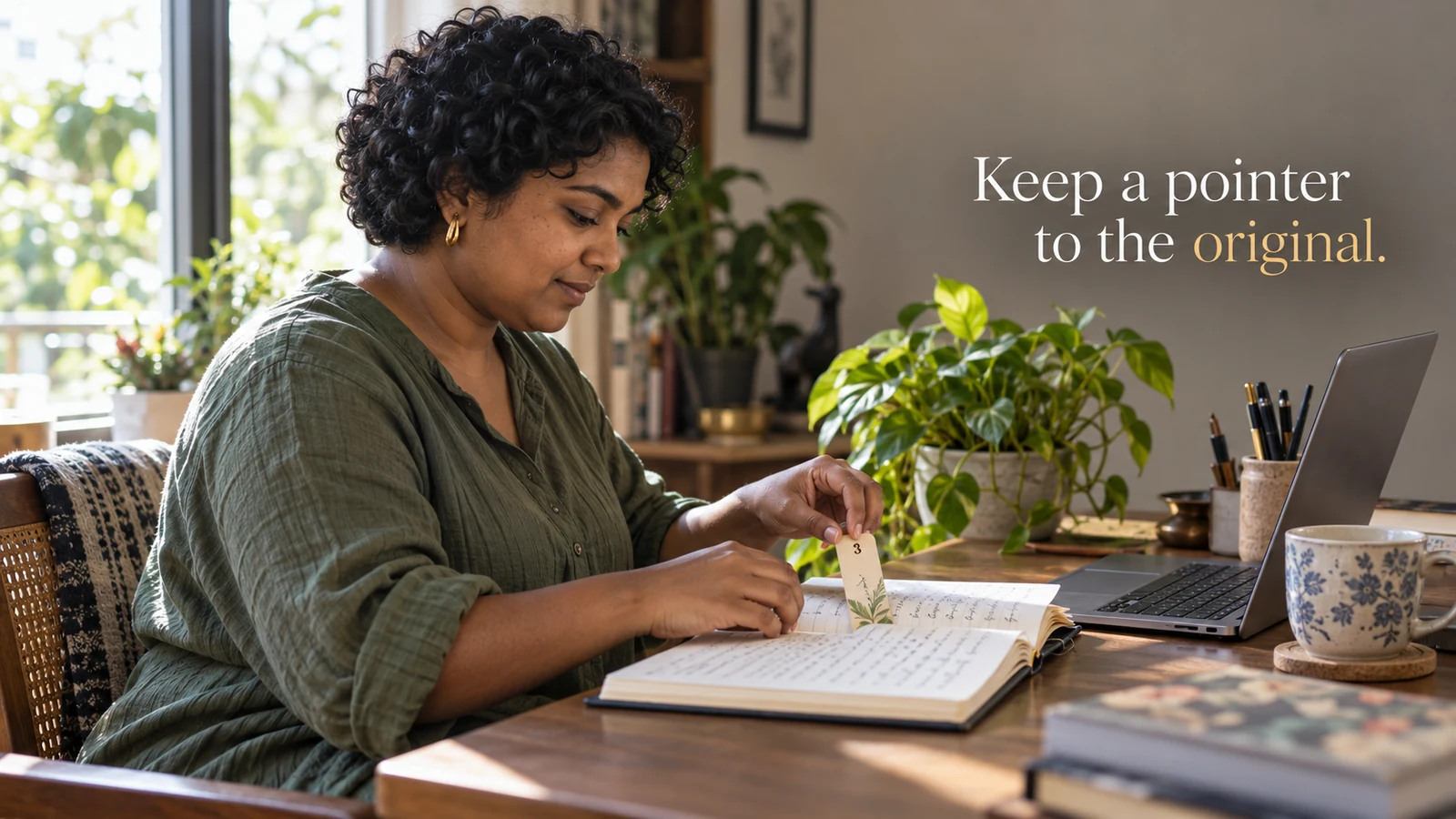
Distinguish an entry date from a copying date. A heading such as "Transcription made 8 November; source entry dated 3 May, notebook B, pages 12 and 13" preserves both. These dates describe different actions. A typed copy created today should not appear to have been created on the day described in the notebook.
Decide what kind of copy you are making
A transcription follows the written account. An edited version changes wording for a present purpose. A summary selects the main points. All three can be useful, but the labels should match the work. If you want only a short reminder, make a summary openly instead of calling it a complete transcription.
For a faithful personal copy, retain the original word choices, spelling and grammar where you can read them. A sentence that sounds awkward now can remain awkward. You can explain a term or correct a factual statement in a separately dated note without making today's interpretation appear to have been on the earlier page.
The Smithsonian Transcription Center's instructions ask its volunteers to preserve original spelling and grammar. That is institutional guidance for its collections, not certification of this personal workflow. The source offers a useful distinction between copying and correcting; your notebook does not need to adopt every convention used by a public transcription project.
Write a short copying note before beginning. For example: "Original wording retained; unclear text marked [unreadable]; my later comments appear under a separate heading." This is an original suggested convention for personal use. Explain any marker you choose so that brackets do not later look like words written in the notebook.

Arrange the page and copy in small sections
Place the source where you can read it comfortably and keep your place. If you use a photograph you already made, check that it includes the edges and relevant margins. A cropped line can look like an unfinished sentence. An unreadable image is a reason to inspect the original, not a reason to supply the missing ending.
Type a short paragraph, then locate the next passage in the source before continuing. Use a removable marker or another simple reference if helpful. Avoid editing the original notebook while also typing the copy: those are two separate operations, and combining them can make it harder to tell which wording you meant to preserve.

Keep a sensible reading order. If a sentence continues on the next page, identify that transition where it matters. A marginal addition may belong beside a particular phrase rather than at the end of the entry. When the relationship is uncertain, describe the location separately instead of quietly choosing the order that makes the best story.
You can preserve useful paragraph breaks without reproducing the exact width of every handwritten line. If layout carries meaning, such as a list beside a sketch, record that relationship. A typed text copy cannot automatically preserve every visual feature of the original page. Keep the source for details the transcription does not represent.
Mark uncertainty instead of completing the story
When a word is hard to read, first inspect the letters that are actually visible. Compare similar letters elsewhere in the same entry if that helps. Context can suggest a reading, but a plausible sentence does not prove the word. Keep a tentative reading visibly tentative rather than promoting it to certainty.
Your personal convention could distinguish "[unreadable word]" from "[possibly: window]". The first records a gap; the second records a proposed reading. Neither belongs in the source quotation without explanation. Use a marker only for the relevant span so that one uncertain word does not make an otherwise readable paragraph appear wholly missing.

Numbers and names deserve deliberate checking because a small character change can alter the account. Compare the written date, amount or page reference carefully. If the source remains unclear, retain that limitation. Looking up what you now believe happened is a different task from identifying what the earlier handwriting says.
If navigation is making the work cumbersome, SoulFul GLO's paper journal index guide offers a separate way to organise page references. Use it for retrieval while keeping this document's copying conventions attached to the actual transcription.
Keep tools from becoming unreviewed authors
If you use an available text-recognition tool, treat its output as a draft to compare with the source. It may omit a line, combine unrelated marks or turn an unusual word into a familiar one. A fluent result still needs checking. This guide does not establish the capability or error rate of any particular service.
Before providing a page to a service, review its actual access and storage arrangements. A journal image may include neighbouring entries or another person's details. You can choose manual typing or a less sensitive practice page instead. Renaming a file, keeping a link to yourself or using an automated feature does not by itself establish confidentiality.
Likewise, an editing assistant may improve grammar because that is what its task usually calls for. State your copying purpose clearly and inspect any returned changes. If the result substantially rewrites the page, keep it as an adapted version if you want it; do not substitute it for the source-faithful copy without changing its label.
Fictional example: a word that remains uncertain
The following writer and entry are original fiction. Lina is copying an old note about rearranging a worktable. She can read "I left the blue folder beside the" but the last noun is unclear. She remembers having a window shelf at that time and initially types "window" because the sentence sounds natural.
During readback, Lina notices that the visible letters do not establish that reading. She changes her typed line to "I left the blue folder beside the [unreadable word]". Under a separate heading she writes, "Copying note: I wondered whether this was window, but could not read it confidently." The guess remains available without becoming the original wording.
Lina also notices that the notebook spells "separate" incorrectly. She retains that spelling in the transcription under her chosen convention. She does not need to draw a conclusion about her past writing ability. Her task concerns the text on this page, and the separate copying note supplies enough context for later use.
Fictional example: a later addition in the margin
Another fictional writer, Dev, finds a small addition beside a paragraph about a craft class. A mark points from the margin to the sentence about materials. He can see the connection, so his copy places the added phrase at that point and notes that it was written in the margin.
A second marginal sentence has no clear attachment. Dev puts it in a labelled source note with its location instead of inserting it into the main paragraph. He cannot establish when either addition was made, so he does not assign them the entry's date automatically. The copy records the distinction without trying to reconstruct the whole writing occasion.
Read the whole copy against the source
After typing, compare from the first line to the last. Follow the source in order rather than rereading only the polished document. Check skipped lines, repeated phrases, negatives, names and numbers. A missing "not" can change a sentence more than a misspelled adjective. Check that your opening and ending match the boundary you selected.
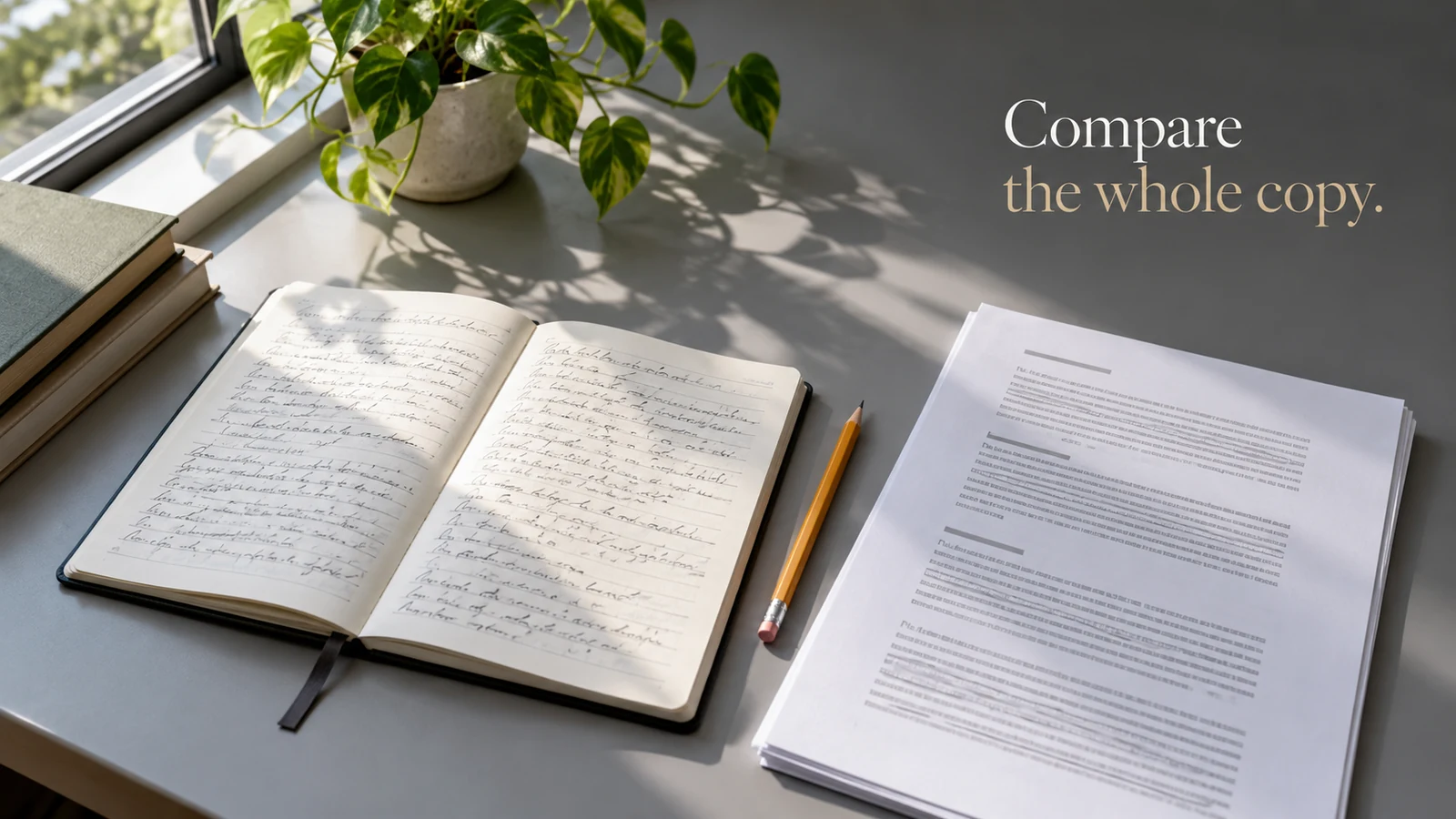
Then inspect your labels and notes. Can you distinguish source wording, uncertainty markers and today's comments? Can you find each page again? A useful completion note might say "Compared with pages 12 and 13; one word remains unreadable." It describes the check you performed without claiming that every ambiguity has disappeared.
Save and reopen the transcription
Save the copy in an arrangement you understand and reopen it once. Confirm that the text, markers and source pointer are still present. If you later revise the transcription, date the change and explain whether you corrected a copying error or added new commentary. The notebook and typed copy can remain related without becoming interchangeable.
Frequently asked questions
Should I fix spelling while typing?
For a source-faithful transcription, retain readable original wording under the convention you chose. Put an explanation or edited version elsewhere. If easier reading is your main purpose, label a revised copy as edited so its relationship to the source stays clear.
Must I transcribe the whole notebook?
No. One selected entry can be a complete copying task. Identify what is included and avoid describing a partial page as the whole entry. You can stop with a clear progress note and return later without assigning the rest of the notebook to yourself.
Can a transcription replace the original?
A text copy represents words and selected relationships, not every physical or visual detail. This guide does not establish preservation quality or advise discarding a source. Keep the original available when its details matter, and seek appropriate guidance for fragile or formal material.
What if the typed copy contains a mistake?
Correct the copying error after checking the source, and date a note when the distinction matters. A correction to the transcript does not mean the notebook itself changed. Keep later factual reinterpretations separate from repairs to the copying process.
For the separate question of who can access a notebook or digital copy, read SoulFul GLO's private journaling guide. Decide what you want to retain and where before turning one private page into several files.