
You return to a journal entry and recognise the day, but the thought you want is somewhere inside several pages. A short summary can give that entry a second way in. It can describe what the pages cover while leaving the original account available, including the details the short version cannot carry.
This is an optional editing task for your own private writing. The aim is a useful description you can read beside the source, rather than a verdict about the day or a polished substitute for what you wrote. You can summarise a single paragraph, a whole entry or nothing at all.
Quick answer
Choose the exact passage you want to summarise. Read it through, then write a short description of its main event or question in fresh words. Compare the description with the source for changed certainty, missing qualifications and added explanations. Label it as a summary, give it a source pointer and record when you wrote it. Keep the original separate and intact.
A single sentence is a useful starting size, not a requirement. If it cannot carry an important qualification, add another sentence or narrow the passage. The summary can say that the entry contains several subjects. It does not have to reduce an untidy day to one message.
Choose the passage before choosing its meaning
Open the entry you actually want to describe. Mark its beginning and ending for this task, perhaps with a page reference or a selection in your own document. A heading such as “Summary of pages 12 and 13” tells you what was included. It also keeps a description of one section from appearing to cover a whole notebook.
Read the chosen passage once before drafting. Look for what the writing spends time on, including any question it leaves unresolved. You might find a sequence of errands, a description of a room or several attempts to explain a disagreement. Name the subject at that scale instead of looking immediately for a life lesson.
If the passage is too broad, choose a smaller part. An entry about travel, a meal and a conversation may need separate short descriptions, or one plain sentence naming all three. You can decide how much work is useful for finding the entry later. A summary is optional extra writing, not a condition of keeping a journal.
Draft a description in your own words
Set the source beside you and try one sentence beginning “This entry describes…” or “In this passage I wrote about…” You can remove that opening later if it is cumbersome. Starting this way keeps attention on the text you have, rather than on what you now wish you had said.

For a fictional entry about rearranging a kitchen, a first attempt could be: “I described moving the tea things to another shelf and trying the new arrangement that evening.” That sentence identifies the action and time. It does not claim that the arrangement worked permanently or explain why the writer prefers change.
Use a subject you can locate in the original. A sentence such as “I finally learned to make room for myself” may be your present interpretation, but it is a poor description of pages that only record moving cups. You can keep that interpretation separately if you want it. The source summary has a narrower job.
Keep uncertainty when making the account shorter
Compression can change meaning by removing small words. Suppose the source says, “I think I left the notebook in the reading room, though I did not check my bag.” A summary saying “I lost my notebook in the reading room” adds an outcome and drops the uncertainty. A closer version is “I wrote about not finding the notebook and wondering whether it was in the reading room.”
Check words such as perhaps, seemed, expected and remembered. You do not have to repeat every one, but preserve any qualification that affects the claim. A prediction in the original remains a prediction in the summary, even if you now know what happened. A later outcome belongs in a separately identified addition.
Keep other people's motives at the same level too. “We did not settle a time” is different from “They refused to make time.” If the source records your impression, say that it records an impression. Shorter wording should not make an uncertain account sound like an established explanation.
For the separate task of changing a question before writing a new entry, read SoulFul GLO's guide to adapting a journal prompt. Here, the source already exists. Your job is to describe that source fairly while deciding what a shorter note needs to retain.
Compare the summary with the actual sentences
Put the draft summary next to the source and identify a passage supporting each part. If you cannot find the support, decide whether the phrase is an inference, a new memory or simply too broad. Remove it from the summary or label it separately. You can do this without treating the notebook as a formal evidence file.
Check the main actor, sequence and scope. Did you change something you hoped to do into something you did? Did a sentence about one afternoon become a claim about the whole week? Did an event involving two people become a statement about a group? These are ordinary editing questions with answers in the selected passage.
Next ask what the short version leaves out. Omission is part of summarising, but it matters when the removed material would alter how you understand the retained statement. You can add a qualification, choose a more limited description or use two sentences. A summary that points accurately to a complicated entry is more useful than an elegant line that misrepresents it.
Three original examples of narrowing a summary
An observation with an unresolved cause
Fictional source: “The plant near the door had a bent stem when I came home. I had moved it that morning. I don't know whether it caught on the bag or was bent earlier.” An overconfident summary would say, “I damaged the plant with my bag.” The source does not establish that cause.
A closer summary is: “I noticed a bent stem after moving the plant and left the cause uncertain.” It retains the observation, relevant earlier action and limit of knowledge. The writer can find the entry without the summary supplying an explanation the original did not have.
Several subjects in one entry
Fictional source: “I tried a different route to the library. The side street was quieter while I walked through. I also wrote down the title of a book I wanted to borrow and the repair needed on my umbrella.” These notes need not share a deeper theme.
A workable summary could be: “This entry includes a library route, a book to look for and an umbrella repair note.” If the route is what interests you, narrow the scope instead: “Summary of the opening paragraph: I described the side-street walk to the library.” The label explains why the remaining subjects are absent.
A changing opinion within the passage
Fictional source: “At first I wanted to move the table back. After lunch I liked having the extra space by the window, though I still had not found a place for the lamp.” A summary saying “I liked the new arrangement” loses both the change and the unresolved part.
Try: “My view of the table arrangement changed during the day, with the lamp's place still undecided.” That sentence does not pretend the entry reached a complete conclusion. These examples illustrate editing choices; they are invented passages, not reports from customers or evidence of a wellbeing effect.
Label the addition so it cannot replace the source by accident
Use a small heading such as “Summary, written 11 November” and a reference to the original date or page. If you write the summary later, use the date you actually make it. A date keeps today's wording from appearing to be part of the earlier account.
On paper, use an adjoining margin with enough room, another page or a separate card you can pair with the notebook. Avoid writing over the original lines. In a digital document, a clearly separate section can work if you know how the actual tool displays it. This article makes no claim about a particular app's summary or linking features.
Keep the pointer specific enough to use: notebook label and page, entry date and heading, or another reference you recognise. If two entries have the same date, add the distinguishing part. You need only enough organisation for your purpose; a full index is a different project.
Leave present-day responses in their own place
You may read an entry and now disagree with it. Write that response separately from the summary. “The entry describes my plan to move the table” identifies the source. “I now prefer its old position” records your current view. Both can be kept without making one stand in for the other.
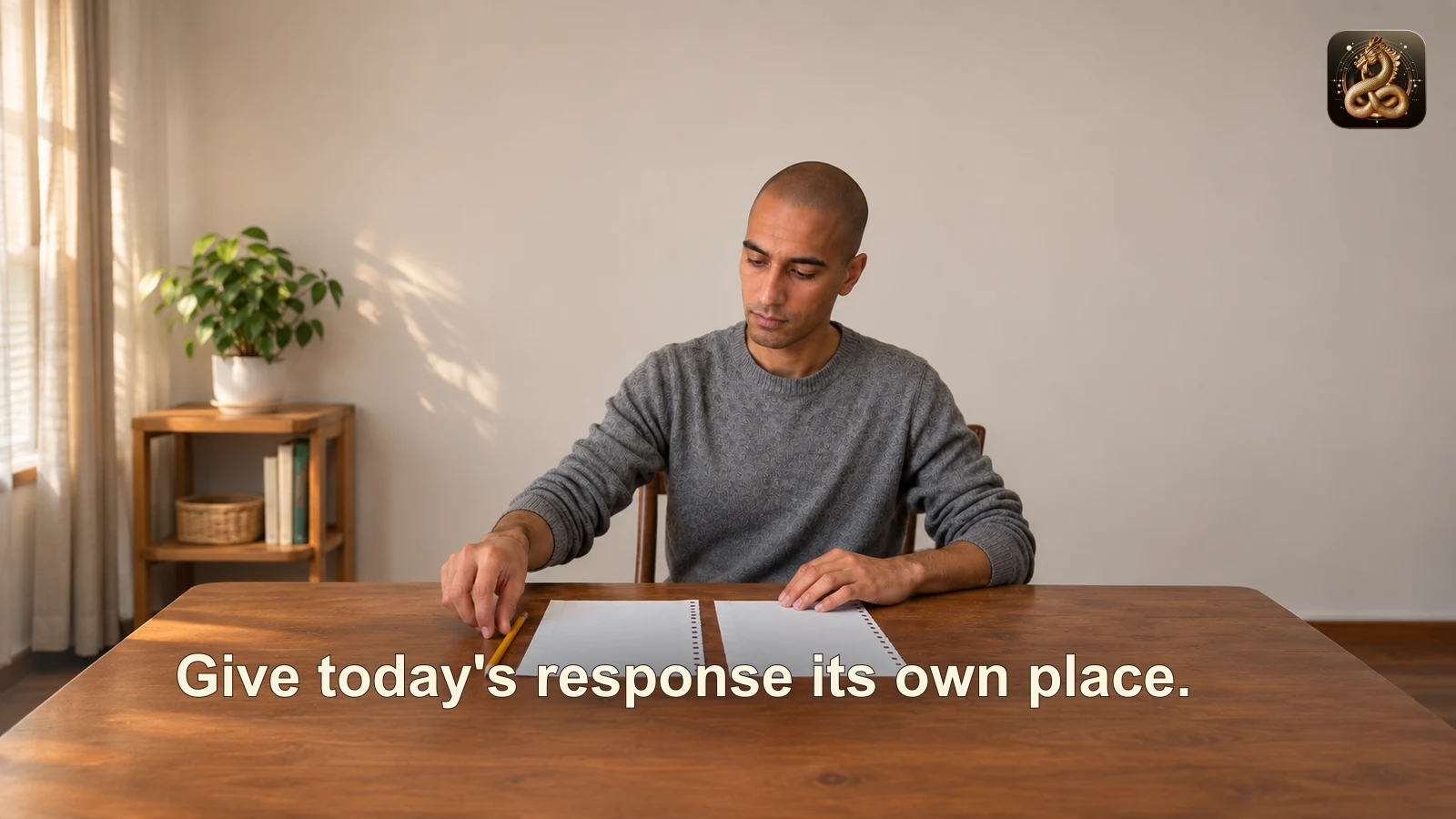
If you discover a factual mistake, give a retained correction its own label and date where the distinction matters. Summarising is not an instruction to conceal or rewrite the earlier wording. Formal records have their own requirements; this method concerns ordinary optional personal writing.
A summary can also remain unfinished. You may realise you are not sure what the passage is about, or that returning to it is unwelcome. Leave the task and choose another activity. This is an editorial exercise, not treatment, and continuing through distress is not part of the method.
Set the source aside and read the short version once as a stand-alone note. Check references such as “it,” “there” and “that conversation.” If the subject disappears without the original beside it, name the ordinary event or object once. You can keep identifying details general when a broader description still points you to the right passage.
For example, “I changed it after that” may be too vague to distinguish two entries. “I described changing the desk arrangement after lunch” gives a subject and sequence without adding a reason. Restore a qualification if the source only says you considered the change. The short note should help you recognise the passage, then send you back to its actual detail.
Frequently asked questions
Must the summary be one sentence?
No. Start with one if it helps you choose the subject, then use the space needed for an accurate short description. Add a qualification or narrow the passage when compression would change its meaning. You can leave a complex entry without a summary.
Can I copy a sentence from the original?
You can keep a quotation, clearly labelled as one. A summary uses fresh wording to describe the selected passage. The two can sit beside each other, but quoting one sentence does not necessarily describe everything covered by a longer entry.
Can the summary include what happened afterward?
Keep a later outcome in a separately labelled note. If you want a combined account, make its different dates and sources clear. A summary of the earlier entry should not make later knowledge appear to have been available when you wrote it.
Will summarising help me understand my feelings?
It may give you a shorter description of what you wrote, but this guide promises no emotional result. Choose it for an ordinary editing or retrieval purpose. A personal journal is not a diagnosis or a substitute for support suited to your circumstances.
Return to the source when the detail matters
Keep SoulFul GLO's guide to reviewing old journal entries nearby if you want to explore a separate task: reading earlier writing in its original context. A summary can take you to an entry; return to the entry itself when you need its detail.