
A sentence in a book can stay with you long after you have forgotten its surroundings. You remember agreeing, feeling puzzled or thinking about an ordinary afternoon of your own. When you open a notebook later, the author's words and your response may arrive together. A small reading entry can give each a clear place.
Choose a passage you want to think about, identify where it came from and describe your response in your own words. Your entry might keep a disagreement, a question or a memory prompted by the reading.

Quick answer
Record the title, author and a useful page or section reference. Add a short, accurately marked quotation or a paraphrase labelled as yours. Write your response separately, then leave an optional question. Stop when the note contains enough for your purpose. One passage can be enough, and no lesson or next action is required.
This is an ordinary reading and writing method. It does not assess you, treat a health condition or establish that a book will change your wellbeing. The fictional passages below were written solely for this guide; they are not quotations from published books or accounts of real readers.
Choose what you want to keep from the reading
Begin with a specific detail rather than a demand to understand everything. A narrator's description, an unusual comparison or an argument you disagree with can all provide a starting point. You might want to remember the wording, consider an idea or record the memory it brought to mind. Those purposes can lead to different entries.
If the language itself matters, a brief quotation may be useful. If you are interested in the idea, a labelled paraphrase may be enough. If the passage mainly reminded you of a place, your personal response can take more space than the source note. Choose the proportion according to what you actually want to preserve.
If note-taking interrupts the reading you wanted, finish the chapter, use a removable bookmark where appropriate or leave the thought unrecorded. Choose whether a note serves this reading occasion.
Give the source a clear place
Write enough information to recognise the material later. For a book, that usually means the author, title and page or chapter. Include the edition when it matters to finding the passage, since page numbers can differ. For an online essay, the title, author where supplied and link may serve the same practical purpose.

Do not spend the session reconstructing a reference you cannot establish. You can write that the source is uncertain and leave space to check it. A confident-looking author name is less useful than an honest note that you have not verified it. Keep a remembered idea separate from an attributed quotation until you have the wording in front of you.
If you listen to a book, note a chapter and approximate playback point when those are available and useful. A timestamp from one version may not locate the same passage in another. The aim is a usable pointer for your own return, rather than a formal citation system imposed on every personal note.
Keep three kinds of writing distinct
An exact quotation reproduces the source's words. Check it against the text and mark it clearly. Keep the selected extract brief enough for the purpose of your entry. You do not need to copy a whole page to remember why a line caught your attention. A source reference can direct you back to its wider context.
A paraphrase restates an idea in your own wording. Label it as your summary rather than surrounding it with quotation marks. If you are unsure whether the summary represents the argument fairly, leave that uncertainty visible. You can reread the surrounding paragraph before deciding what the passage is claiming.
A response describes what you think, remember or wonder. It might agree with the passage, challenge it or move toward an association the author did not mention. That association belongs to you. A sentence about your own memory does not establish what the author intended, and a fictional narrator's statement is not automatically the author's personal belief.
A four-part entry you can try
Use four short headings: Source, Passage or idea, My response, and Open question. The last part is optional. Two columns can keep source material beside your response, but a narrow notebook or phone note may work better with the headings one after another. Choose a layout you can comfortably read again.
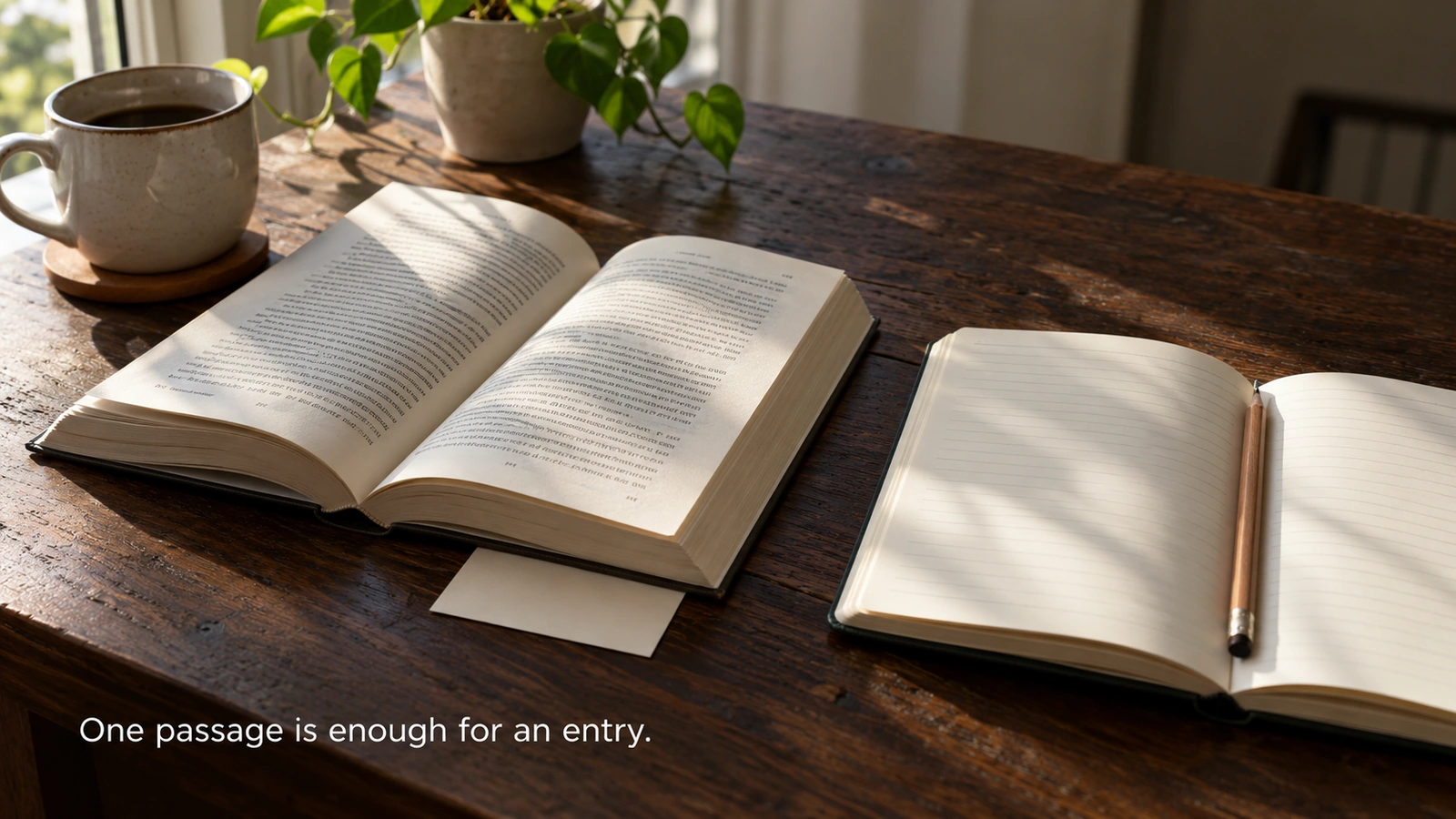
Colorado State University's Writing@CSU describes a double-entry journal that puts material from a text alongside questions and reactions. The shorter personal format here draws on that established separation. It does not reproduce the course assignment or claim its educational goals as measured benefits of this article's exercise.
For the source field, add the pointer that will let you find the passage. For the second field, identify whether you are quoting, paraphrasing or recording a tentative recollection. In the response field, use your own voice. The question field can hold something you would like to think about without requiring an answer today.
Before closing the entry, read the source and idea fields together: could you find the passage and tell which words belong to its writer? Then read your response on its own. Does it contain something you thought, noticed or questioned, or does it simply repeat the summary? If it repeats, keep the useful summary and add one specific response, such as 'This reminds me of where I put my reading lamp; my reason was different.' That is an illustrative reader response, not a quotation from a book. Leave the question blank if no question arose.
Fictional example: a detail that brings back a place
Here is Lina's completed entry, using an original fictional passage written for this guide and an invented personal memory.
Source: Original fictional passage in this guide, under Fictional example: a detail that brings back a place.
Passage, exact quotation: "The chair by the shop window was usually empty at four, when the light reached the corner of the table."
My response: "This brings back a cafe where I waited for a friend. I remember choosing a seat near a window, but I do not remember the time or exactly where the table stood. The chair in the passage belongs to the fictional scene; it is not evidence about the cafe I visited."
Open question: "Which part of my own memory is clearest: the light, the seat or the waiting?"
Lina's source field points to this guide because the passage was created here. For an actual reading entry, she would replace that reference with the book or essay details she can establish.
Fictional example: disagreeing with an idea
Original fictional passage written for this guide: "Keeping a room's arrangement unchanged for a while can help you notice which parts already work. I leave comfortable arrangements alone for a week and make a note of how I use them. Anything that makes the room difficult to use is a reason to change it sooner."
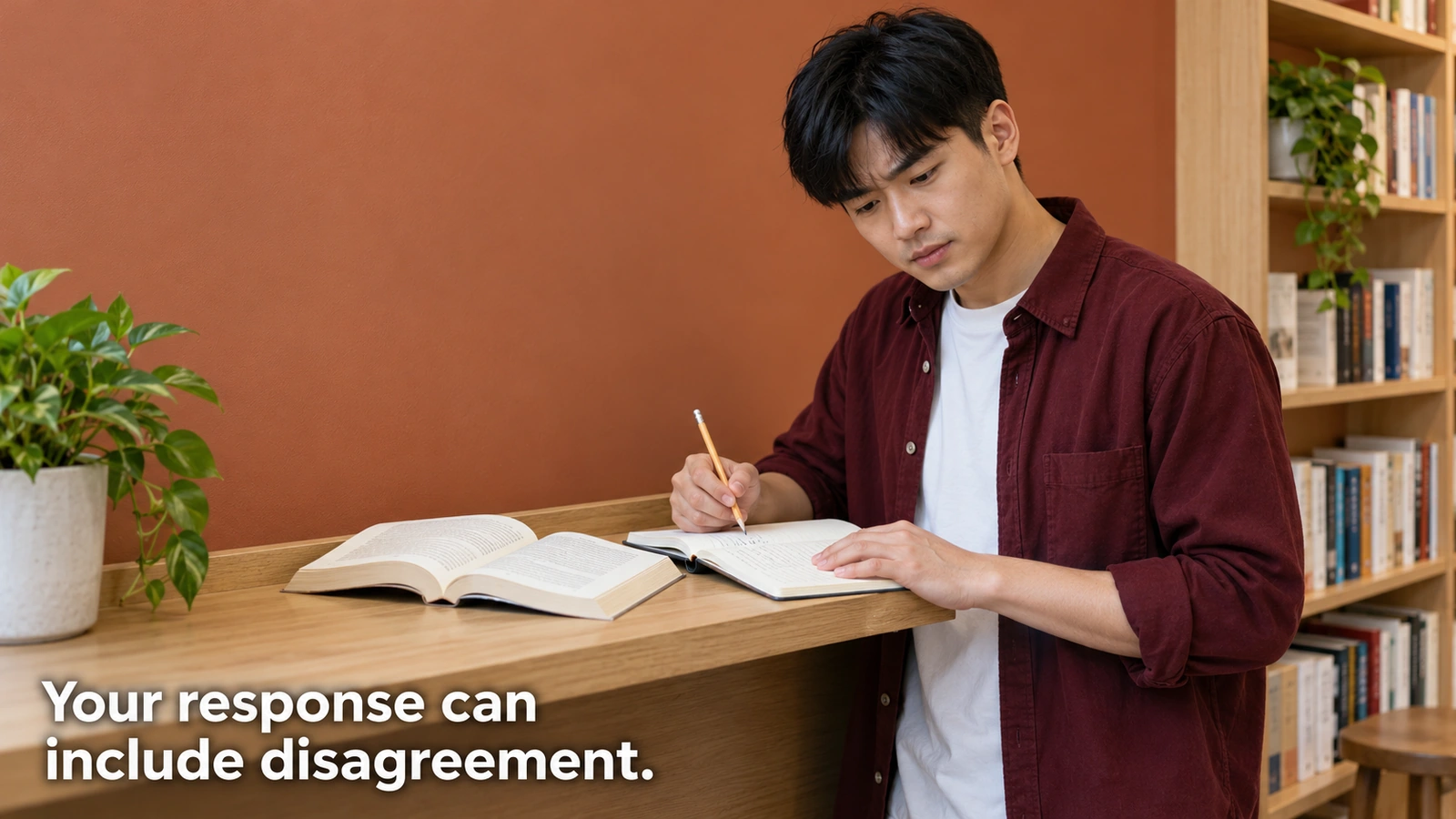
Mateo first drafts this paraphrase: "The narrator says to leave rooms unchanged." Checking it against the passage, he notices that it loses the comfortable-arrangement condition, the week of observation and the practical exception. He revises it: "The narrator prefers a week of observation before changing a comfortable arrangement, with an exception for practical difficulties." His response can now address that specific preference.
His response reads: "I agree with noticing how I use the room. For my reading lamp, I preferred comparing two comfortable positions on the same afternoon instead of waiting a week. The direct comparison made the difference easier for me to notice. I would choose the timing according to what I wanted to compare."
Mateo disagrees about the timing of a comparison while sharing the narrator's interest in observing the room. His example concerns two comfortable positions, so it addresses the week-long preference rather than arguing against the exception for practical difficulties.
His open question reads: "Which arrangement would I like to observe in place, and which would I rather compare on the same occasion?"
Leave room for context and uncertainty
A striking sentence may work differently in its surrounding paragraph. Before treating it as advice, check who is speaking and what the text is doing. A character may be mistaken, a passage may be ironic or an essay may later qualify its opening claim. You can note the immediate response while postponing an interpretation of the whole work.

If you later understand the passage differently, add a dated response rather than silently replacing the first one. Your original entry can remain an account of that reading occasion. A later note can identify the context you missed without making the earlier response dishonest or requiring you to defend it forever.
Mateo could return to his entry after trying the lamp positions again. A dated addition might read: "18 May, later response: I compared the positions during daylight the first time. Tonight one position leaves a reflection on the page. My earlier comparison still describes that afternoon, but I would now include evening light when choosing between them." This adds a condition to his own response; it does not alter the fictional passage or make the narrator responsible for his first comparison.
He can keep the addition beneath My response and refer back to the earlier note. The source reference stays the same because he is reconsidering his experience, rather than citing a different passage. Anyone rereading the entry can follow what changed: the observation time and his preference, not the source wording.
For another optional reflection exercise, explore SoulFul GLO's guide to adapting a journal prompt that does not fit. It considers changing a question you choose to answer; keep an author's passage attributable when you respond to reading.
Finish before the note becomes another assignment
Ask whether you have kept what you wanted: a source pointer, a passage or idea, and your response. If so, close the notebook. You do not need a rating, a list of takeaways or a commitment to put the book's ideas into practice. A question can remain a question when you finish reading.

If you want to find selected entries again, explore SoulFul GLO's paper journal index guide. It offers a separate method for locating notebook pages, which you can use selectively without cataloguing every book or every thought.
Frequently asked questions
Does every entry need a quotation?
No. A labelled paraphrase and a clear source pointer can be enough. Quote when the exact language matters and you can check it. If you only remember an idea, describe it as a recollection until you verify the text. Quotation marks should not make an uncertain memory appear exact.
Can I use fiction for personal reflection?
Yes. You can respond to a scene, image or character without treating it as instruction for your life. Distinguish the character's situation from your own. A response can concern the writing itself, and it does not have to disclose a personal experience or uncover a lesson.
What if my response seems unrelated?
Record the connection as your association if you want to keep it. You do not have to prove that the author intended it. If understanding the text is your main purpose, return to its wording and context separately. Personal association and interpretation can sit beside each other without becoming the same claim.
Do I need to finish the book first?
No. Identify where you are in the reading when that context matters. Your response to an opening chapter may change after the ending, and you can add a later note. You can also leave a book unfinished without producing a final assessment of it or of yourself as a reader.
Can the entry be only a few lines?
Yes. Keep the source identifiable and the response recognisably yours. Length is a practical choice, not evidence of depth. If you have nothing you want to add, return to reading or put the book down. The notebook is available when it serves the reading you chose.