
A journal entry does not have to begin with a paragraph. Sometimes a small drawing is the most direct way to record what caught your attention: the chair you kept returning to, a crowded tabletop or the route you took through a familiar room. You can make that record with a pencil and a few marks, even if drawing is not a skill you practise.
The useful question is whether the page says enough for your purpose. A detailed illustration may take more work than you want. An unlabeled symbol may become impossible to understand next week. This guide offers a practical middle option: one ordinary detail, a simple mark and enough context to recognise it later.
This is an optional personal-record method, not art therapy, a drawing lesson or an assessment of mental health. You can use words, sketches or neither. Choose another activity if looking closely at an experience becomes uncomfortable.
Quick answer
Choose one thing you want to record. Sketch its basic shape, add a short label if needed and write what the mark means to you. Keep observation separate from interpretation: a drawing of a closed door might describe the room, while the note beside it explains why you noticed it. Finish when the page preserves what you wanted to keep.

You need no special notebook or set of colours. An ordinary pencil and a small usable space on paper are enough for the examples below. The method can remain entirely offline; this article does not claim that SoulFul GLO has a drawing canvas or sketch-upload feature.
Decide what this page should preserve
Begin with a specific purpose rather than a demand to draw your whole day. Perhaps you want to remember the arrangement of a room, a detail from a walk or the difference between two places you sat. Complete the sentence, “I want this page to remind me of...” A modest answer gives the sketch a clear job.
You might draw three cups on a table because you want to remember a shared breakfast. You might sketch the outline of a window because the afternoon light caught your attention. Neither image needs to summarise the relationship, explain an emotion or represent an entire period of your life.
Consider whether a drawing is actually useful. A time, name or exact quotation may be clearer in words. If the detail matters precisely, write it rather than asking a rough picture to carry information it cannot reliably preserve. Mixing formats is an ordinary choice.
Use shapes before detail
Start with the outer shape of the object or arrangement. A rectangle can stand for a desk; a curved line can suggest the edge of a cup. Add another line only when it helps you distinguish this object from something else. You are making a private reference, so recognisability for you can be sufficient.
Leave room around the marks. A crowded page can make it difficult to add a date or explanation later. You do not need to fill the blank area simply because it is available. The empty space can separate this entry from the next one.
If you start judging the drawing, return to its purpose. Does the outline help you remember the thing you chose? If so, polishing the perspective is optional. If it does not, add a plain label or use a sentence instead. A journal need not become a portfolio.
Give personal marks a small key
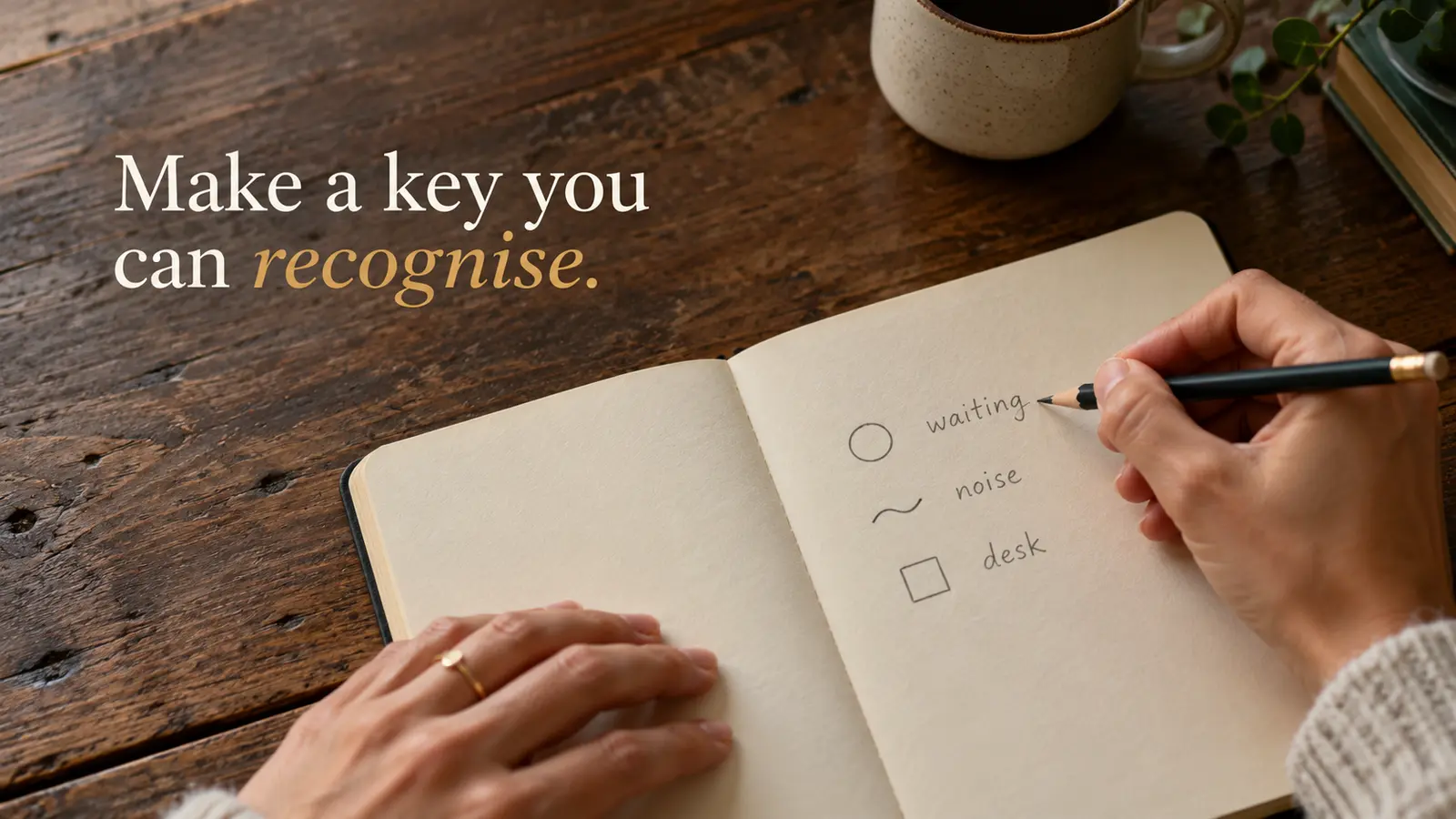
A sketch can show a literal object, but you may also want a mark for something less visible, such as waiting or repeated noise. Choose the meaning yourself and write it beside the mark. For example, a small circle could mean “waiting for a reply” on this page.

Keep the key local at first. The same circle can have another meaning in a different context, and you do not need to create a permanent visual language. A label beside the entry prevents you from relying on memory alone.
No shape has a universal psychological meaning in this method. A dark line does not diagnose sadness, and an open shape does not prove progress. Avoid interpreting another person's marks through your own key. Their page belongs to them and may serve a different purpose.
A three-part entry you can try
Put a date at the top if it will help you find the entry. Draw one ordinary detail in the middle. Under it, add a short line beginning “I noticed...” or “This reminds me of...” Use whichever wording fits the distinction you want to retain.
For example, sketch a crowded shelf and write, “I noticed I kept moving the same book to reach the lamp.” That entry preserves an observation. You can leave it there without converting the page into a plan to reorganise the room.
A different entry might show two simple squares and the note, “Two places I considered sitting; the one near the window had more light.” The drawing compares an arrangement. It does not have to describe how you felt unless that is something you choose to add.
Keep observation and meaning separate
A picture can be accurate enough about an object while leaving its significance uncertain. You may draw an empty seat and later wonder whether it represented rest, absence or simply where you placed your bag. A short note can preserve what you meant at the time.
Try separate labels: “What I saw” and “What I made of it.” Under the first, describe the ordinary detail. Under the second, record your interpretation as an interpretation. For example, “The desk was covered with papers” and “I thought I would have trouble choosing where to begin.”
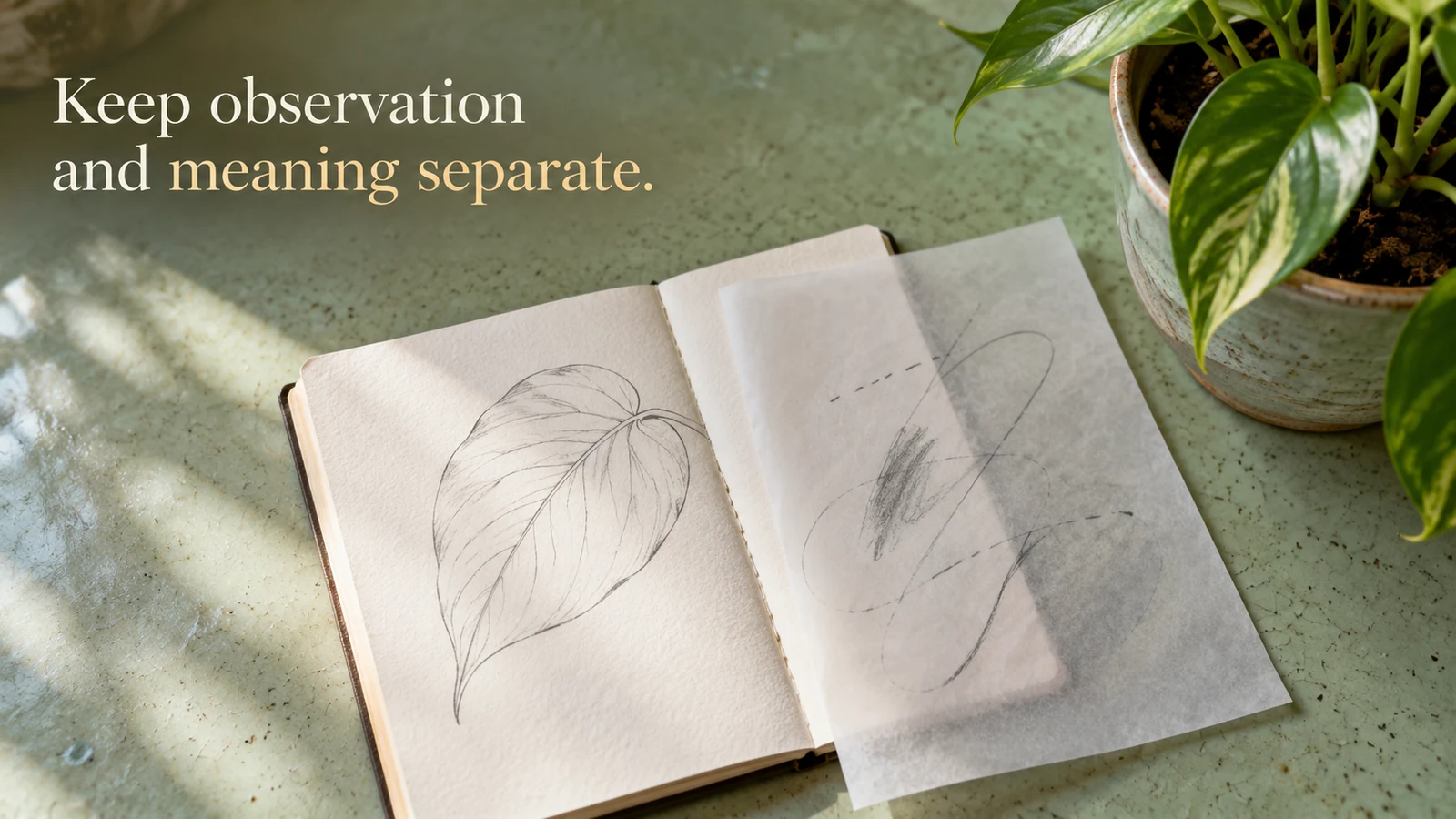
Those statements do different jobs. Keeping them distinct leaves room for a later change of view without erasing the original page. You can add a dated note rather than redraw the scene to match what you now think.
You can also leave meaning open. “I noticed this but do not know why it mattered” is a usable entry. There is no requirement to uncover a deeper explanation, identify a hidden symbol or arrive at a lesson before closing the notebook.
Choose a format you can actually use
A whole page may be unnecessary. Try a small box in an existing notebook, a corner of a loose sheet you will keep or a short entry beside some writing. Think about where the record will live before spreading it across several surfaces.
If you use separate paper, choose a practical way to keep the pieces together. An envelope or ordinary folder may suit your arrangement. For a paper notebook with entries you expect to revisit, SoulFul GLO's paper journal index guide explains simple page references. You can index the subject without describing private details in the label.
A digital tool is another option only if you understand its actual features and storage. Check whether it supports drawing, where files are saved and who can access them. An app offering text journaling does not automatically offer sketching. This guide makes no promise about export, handwriting recognition or private cloud storage.
For a broader view of the available reflection formats, explore SoulFul GLO's journaling overview. The website describes voice and text journaling; you can keep a separate paper sketch beside those practices if that arrangement suits you.
Add words where they prevent confusion
Use words for details that the picture cannot carry clearly. A date, location or short phrase may be enough. If you drew a bus stop to remember a change to your usual route, add which journey you mean rather than expecting the sketch to preserve the timetable.

You can write directly beside the relevant mark. A small arrow may connect a label to the right object when there are several. Keep the page understandable without turning it into an elaborate diagram.
Exact wording and paraphrase should remain distinct. If you include something another person said, avoid presenting an uncertain recollection as a quotation. A phrase such as “my impression of the conversation” can describe your own note more accurately.
Private names and sensitive details are optional. A useful page can focus on your observation without making another person identifiable. Consider who might see the notebook, including anyone with whom you share the room. Sketches alone are not a privacy safeguard.
Two fictional examples
Recording a place without writing a long description
A fictional reader, Leila, wants to remember a corner of her rented flat where she enjoyed reading. She draws the chair as a square, the window as a rectangle and a short line for the lamp. Beside it she writes, “Sunday afternoon; chair angled away from the doorway.”
The sketch preserves an arrangement she could try again. It is not evidence that the room changed her wellbeing. If she later moves the chair, she can create another small entry rather than editing the first picture into a record of a different day.
Using a mark when the exact feeling is unclear
A fictional reader, Arun, does not want to choose an emotion word for an uneventful but busy afternoon. He draws several short parallel lines and labels them “many small interruptions.” He adds one concrete example, then decides the entry contains enough.
The lines are his own shorthand for that occasion. They do not form a score or establish a pattern on their own. If the symbol is unclear when he returns to it, the written key gives him the original context.
Both examples are invented illustrations of the method, not customer stories. Your entry can use another format entirely, including a literal drawing with no emotional interpretation.
Finish without adding another assignment
Decide whether the record serves the purpose you chose at the start. If it does, put the pencil down. An incomplete-looking outline can be a complete entry when it preserves the detail you wanted.
Avoid adding a compulsory reflection, action list or gratitude section after every sketch. You can include those things when useful, but they are separate choices. The page does not need to justify the time you spent on it.
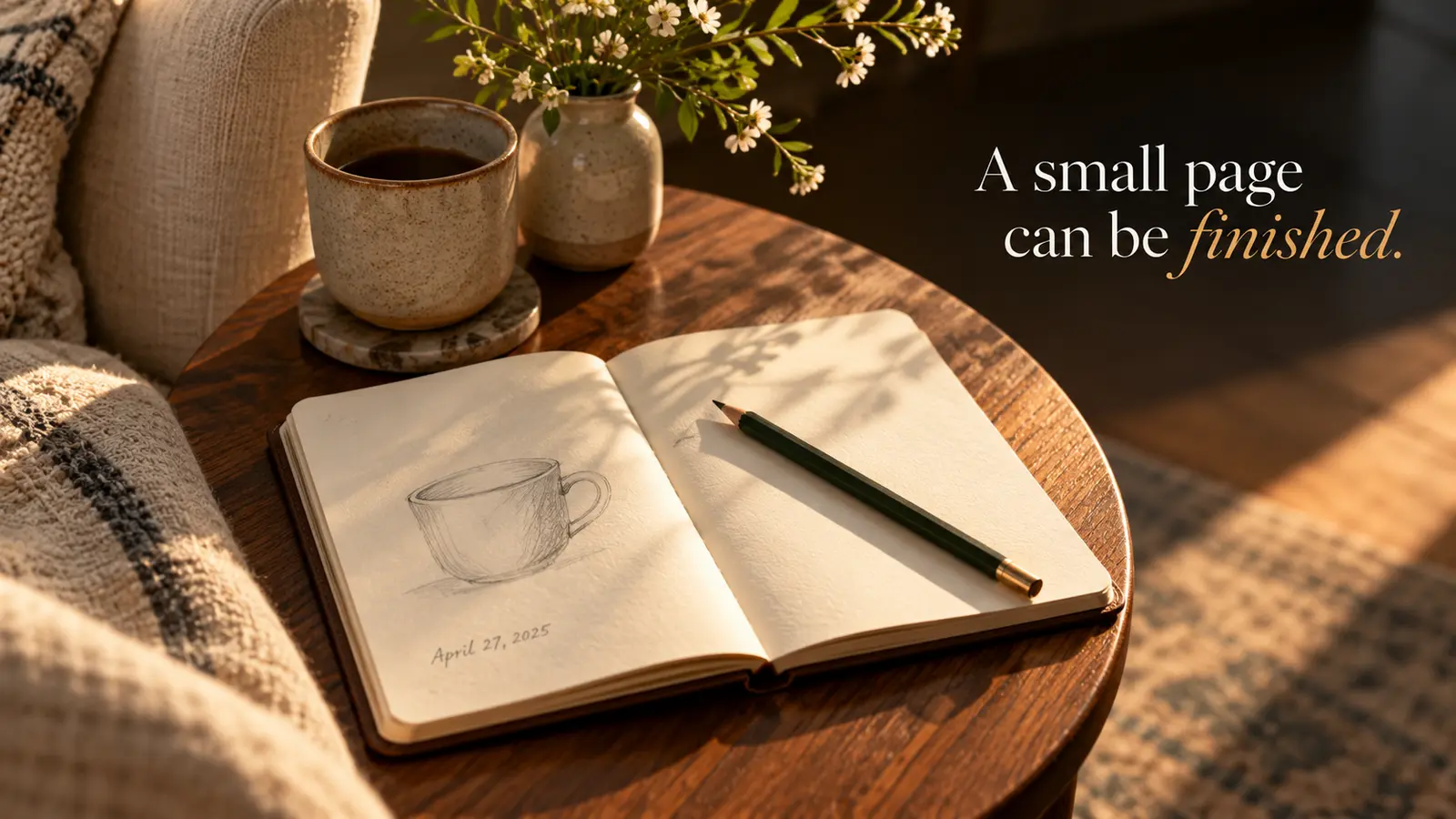
If you want to return later, leave a simple cue such as “look again after moving the lamp.” If you do not, close the book without one. Repeatedly reviewing an upsetting experience is not required by this method; stop or seek appropriate support when the subject needs more than ordinary self-reflection.
FAQs
Can I use sketches if I cannot draw realistically?
Yes. Use a literal outline, a few basic shapes or a personal mark with a written key. The practical question is whether you can understand the record, rather than whether another person would admire the drawing.
Do I need to describe my feelings?
No. You may record an object, arrangement or ordinary detail without assigning it emotional meaning. If you choose to add a feeling, use your own words and leave uncertainty visible.
Should I use the same symbols every day?
Only if that helps. A small repeated key can be convenient, but changing a mark is allowed. Date the change if you want to compare entries, and avoid treating symbol choices as a psychological test.
Can I combine drawing and a written prompt?
Yes. Select one part of the prompt that you actually want to explore. You could draw the place it brings to mind and add a short explanation. SoulFul GLO's guide to adapting a journal prompt covers changing wording when the question itself does not fit.
Is this art therapy?
This guide describes an everyday personal-record exercise. It is not an art-therapy service, clinical assessment or replacement for professional care. A simple sketch can support reflection without carrying a treatment claim.
If you want a written or spoken companion to your paper practice, revisit SoulFul GLO's journaling overview and check the features available to you. Keep the sketch method small enough to serve the record you want to make, with no obligation to turn it into a daily project.