
You open a meditation resource and see a person sitting with thumb and finger touching. The image suggests a recognisable practice, but it leaves several questions unanswered. Which gesture is it? What does the teacher mean by it? Is the position part of the instruction, an option or simply the way the photograph was arranged?
A useful introduction starts with those questions. This guide explains how to approach a named hand mudra without assuming that its appearance establishes a health effect. It includes a small reading plan, a fictional demonstration and ways to ask for an alternative. It supplies no treatment protocol or universal hand position.
Quick answer
Find the name and source of the hand gesture, then read what the actual instruction asks the hands to do and how that gesture is understood in its teaching context. Keep a symbolic or traditional explanation separate from a claim about health. If a hand position is uncomfortable or unclear, leave it out and ask for a suitable alternative. Copying a photograph is optional and cannot replace an explanation.
Begin with a named gesture and an identifiable source
Mudra is used in yoga teaching for gestures or positions, including hand gestures. Different practices have their own contexts. This article concerns understanding a hand instruction in a meditation resource; it does not present an account of every religious, artistic or yogic use of the term.
Yoga Vidya's mudra article gives an example in which thumb and index finger meet and distinguishes chin and jnana forms through the orientation of the hands. That describes the convention in that resource. Keep its names and explanation attached to its source rather than announcing a universal naming rule.
The same page includes traditional interpretations and claims about physical effects. This guide does not adopt its claims about memory, circulation, brain activity or healing. Describing where fingers are placed requires far less evidence than saying that the placement changes a medical condition.
A name can make your next question more specific. Instead of “Am I doing meditation hands correctly?”, you can ask, “Which gesture is this resource teaching, and what role does it have here?” You may discover that the gesture is optional, part of a larger practice or not explained well enough to try.
Read the hand action separately from its meaning
An instruction can contain several kinds of information. It may describe contact between fingers, the direction of the palm, where the hands rest and a traditional interpretation. Read each part at its own level. A physical description tells you what is pictured; an interpretation describes how a source understands it.
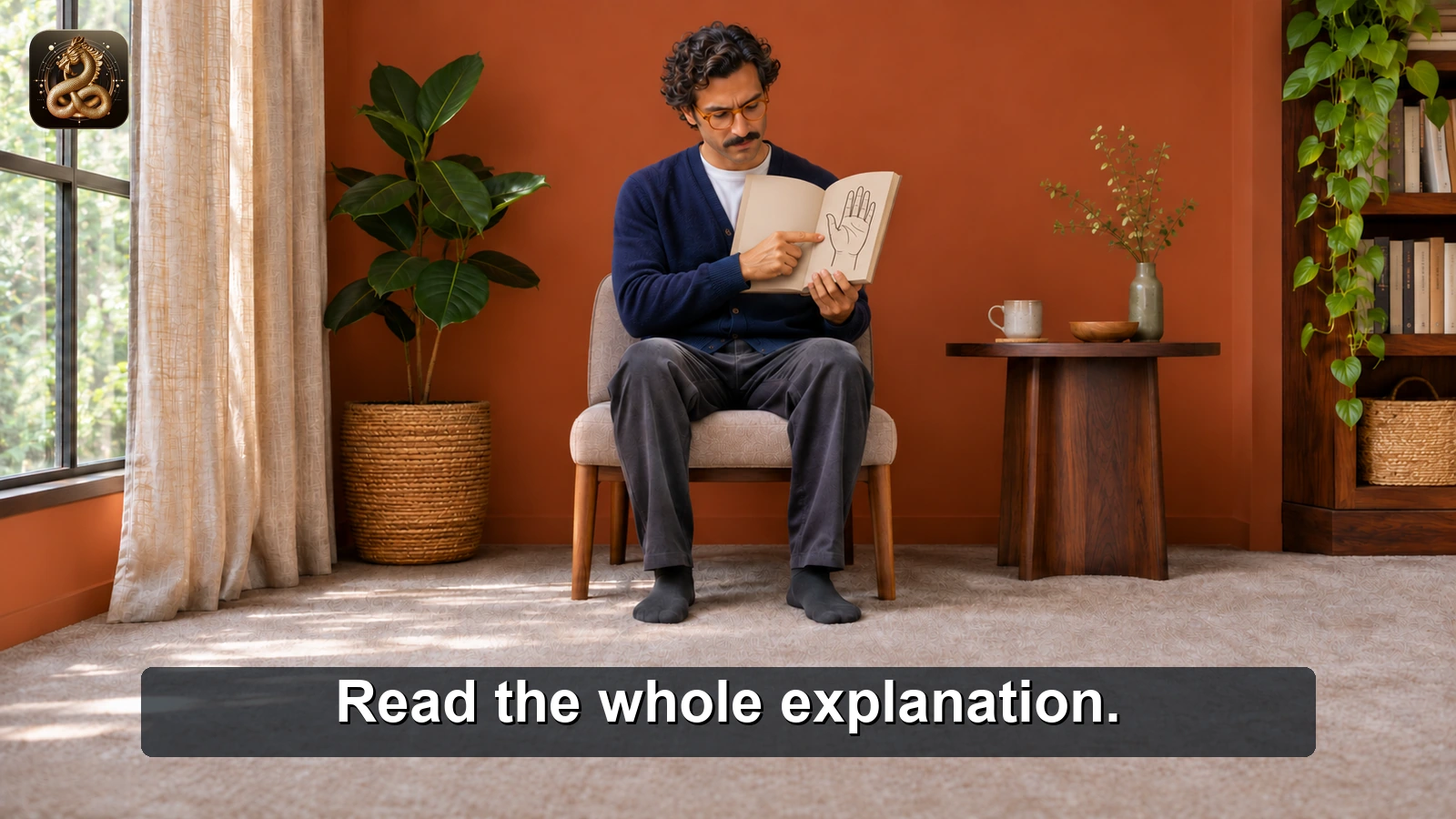
You can respect a tradition without claiming that its symbolism has been established as a biological mechanism. Attribute an interpretation to the named teaching. Avoid extending it to every person using a similar hand shape, especially when you have only seen an image without an explanation.
If a resource describes thumb and finger contact, check whether it also explains the rest of the hand and the support. Do not invent extra pressure, a required stretch or a compulsory duration. An attractive photograph can hide those ordinary practical details.
You may decide that learning the meaning is enough for now. Reading a source and recognising which questions remain is a complete educational activity. There is no need to turn every interesting term into a daily routine or demonstrate it physically to prove respect.
A useful table for reading a mudra instruction
The table separates four questions that can otherwise become mixed together. Use the row relevant to the resource in front of you. Its examples describe what to clarify; they are not an instruction to adopt a particular gesture.
| Part of the instruction | What to establish | Question to keep open |
|---|---|---|
| Name | The term this source uses | Does another source mean the same version? |
| Physical description | Contact, orientation and support as explained | Is an important detail missing? |
| Meaning | The interpretation within this teaching | What claim has actually been supported? |
| Choice | What is optional or adaptable | Can I leave the gesture out? |
Make a small plan before trying anything
Choose one actual resource rather than collecting several images with similar hands. Read the surrounding explanation and identify the author or teacher. If the image has no source or the text makes claims you cannot assess, you can leave it aside and choose a clearer introduction.
Next, decide what you want to learn. You might want to understand a term in a meditation class, recognise why a teacher offers a hand position or ask whether an alternative is available. Those are manageable learning aims. A promised cure or guaranteed emotional state is not a sound basis for choosing a gesture.
Identify the instruction you can genuinely understand. Does it explain the gesture itself, or does it only name it? Does it require another activity that has not been introduced? A hand image accompanying unfamiliar breath or posture instructions should not be treated as a complete practice guide.
Keep your own situation in view. This article cannot assess pain, altered sensation, joint movement or suitability for an individual hand position. Use appropriate professional advice for health concerns. Ask the actual teacher about an alternative when a taught position is unsuitable or unclear.
For a simpler plan, read the source without trying the gesture and save one question for the teacher. You can leave the physical attempt for another occasion, a suitable introduction or no occasion at all. The plan should make the next choice clearer without creating an obligation.
A fictional demonstration: Mira reads the whole instruction
Mira is an invented adult using a meditation resource that names a hand gesture. She has seen similar photographs before but does not know whether they show the same teaching. This demonstration concerns reading and asking questions, not a claimed result from a mudra.
First, she finds the name in the current resource and reads the nearby explanation. She separates a sentence about finger contact from a sentence describing a traditional meaning. She can repeat what each sentence says without concluding that one proves a health benefit.
Second, she checks what else the activity includes. In this fictional example, the gesture appears within a longer seated practice. Mira realises that the hand image does not explain the rest of that practice, so she leaves the larger exercise for a proper introduction.
Third, she identifies a practical uncertainty: the resource does not make clear where the hands are supported. She asks its teacher, “For the version you are teaching, where do the hands rest, and what alternative can I use if the position is uncomfortable?”
Fourth, she waits for an actual answer. This invented example does not supply a physical alternative on the teacher's behalf. The point is to ask the person teaching the practice, rather than inventing a new arrangement and attributing it to them.
Finally, Mira decides whether to proceed after the explanation. She may accept an appropriate option, ask again or leave the hand gesture out. She keeps any description of its meaning attributed to that resource and makes no claim about an emotional or medical effect.
The simpler version is to learn the name and stop there. You can adapt the questions to a live class, a written lesson or a recording with a genuine support route. If clarification is unavailable, choose another resource rather than treating uncertainty as a test of persistence.
Keep ordinary comfort separate from correctness
A hand shape may look easy in a photograph while feeling awkward in your own hands. That observation matters. Do not increase pressure or stretch the fingers simply to resemble the image more closely. Pause and ask how the practice can be adapted, or choose another activity.
A teacher can explain the convention they are teaching. That does not require you to ignore discomfort or continue an activity you would rather leave. The word traditional does not settle individual suitability, and a beginner label cannot evaluate your hands.
Sometimes the difficulty is ordinary support: you are trying to hold the whole arm in place while concentrating on the fingers. Describe the actual problem to the teacher rather than guessing at a corrective pose. This guide offers no universal arm, wrist or finger arrangement.
If a concern involves pain, numbness or another worrying symptom, stop using the exercise as an experiment and seek appropriate advice. A change in sensation is not evidence of energy moving or proof that a gesture is working. Keep health assessment separate from interpreting a meditation image.
Find an attention practice with instructions you understand
Explore SoulFul GLO's practice chooser if you want another starting point for meditation, movement or listening. Choose by the activity described and the explanation available. A particular hand gesture is not a prerequisite for exploring every practice in those categories.
Distinguish a gesture from another hand-based task
Hands can be involved in different activities. Holding a simple object for attention concerns present contact. Advancing a bead can keep a place in a repetition. A named mudra may have a defined form and an interpretation in its teaching tradition. Similar-looking hands do not make those tasks interchangeable.
If your interest is ordinary contact, SoulFul GLO's touch-based meditation guide addresses that separate attention task. It does not identify a universal mudra or assign a traditional meaning to an ordinary object. Check the actual source and practice instead of merging the instructions.
Consider a cropped photograph showing thumb and index finger touching but hiding the palms and the rest of the sitting arrangement. You can describe the visible contact. You cannot use that contact alone to choose between the two orientations described in the cited Yoga Vidya resource. The useful next information is the full caption and surrounding teaching, rather than a closer attempt to reproduce the cropped shape.
You can also choose an ordinary comfortable hand arrangement within a practice that explicitly offers it. Describe that choice plainly rather than borrowing a traditional name you have not learned. Accurate language makes room for both everyday adaptations and source-specific teaching.
Handle conflicting names without inventing a universal rule
The cited Yoga Vidya page distinguishes its chin and jnana descriptions through upward-facing and downward-facing palms. Suppose two saved images show similar finger contact but only one reveals the palm orientation. Record that difference before comparing their names. The incomplete image leaves part of the identification unanswered; it does not establish that the sources disagree. This is a source-reading example, not an instruction to turn your hands to either position.
A comparison note can keep three pieces together: the name used, the orientation described and the source. For example, record that this Yoga Vidya page uses chin for its upward-facing version and jnana for its downward-facing version. If another teaching uses different terminology, preserve its own description alongside it. That makes the difference inspectable without treating either brief label as a universal rule or borrowing a health claim from the accompanying text.
Avoid assembling a new exercise from unrelated claims. A hand shape from one resource, a breathing pattern from another and an outcome promised by a third do not become an established practice merely because they appear compatible. Choose a complete, understandable introduction where appropriate.
You do not have to resolve the vocabulary for everyone. Your present decision may be only whether one explanation is clear enough to follow. Leaving a comparison unresolved is preferable to supplying certainty that the sources do not provide.
Frequently asked questions
Does a mudra have a guaranteed effect on mood or health?
No guarantee is established here. A traditional interpretation should be attributed to its source. Claims about treating a condition or producing a specific physical effect require evidence that a hand photograph or symbolic explanation cannot provide.
Do I need to use a mudra to meditate?
This guide sets no such requirement. Follow the actual practice you choose and ask what is optional. Other meditation resources can use listening, ordinary sensory attention or another clearly described task without the named gesture you have encountered.
What if I cannot comfortably make the pictured shape?
Leave it out and ask the teacher for a suitable alternative. Do not force the fingers or continue an uncomfortable position to match a photograph. Seek appropriate professional advice for symptoms or an individual health concern.
Is the same finger contact always called the same thing?
This article does not establish a universal naming system. Read the full description and source context, including palm orientation and the role of the gesture. Keep a name attached to the teaching that uses it.
Keep the source and the choice clear
Return to SoulFul GLO's meditation articles when you want another practical attention activity to compare. Read the actual instruction, ask about an unclear element and choose a form you are willing to learn. A useful next step may be a question, a suitable alternative or simply leaving the gesture for another time.