
A number can look firmer on a page than it felt when you wrote it. “I waited twenty minutes” might mean you checked a clock, made a rough guess afterward or used twenty to mean a long time. When you reread the entry, those different beginnings can disappear behind the same confident sentence.
You do not need to measure every part of an ordinary day. You can make the number's meaning clearer with a few words about what you counted, estimated or did not know. The aim is a readable personal account, not a system for scoring your life.
Quick answer: say what kind of number it is
When a quantity matters to an entry, identify what it describes and whether you counted it, read it from a source or estimated it. Keep a rough quantity visibly rough. State what was included when the boundary could be unclear. If you do not know, write that rather than supplying a plausible number. Add later corrections as later notes instead of silently rewriting the earlier account.
This is an original editorial convention for ordinary text journaling. It is not a method for scientific measurement, health monitoring, official records or financial decisions. Those purposes require their own appropriate processes. A journal label cannot make an uncertain quantity accurate.
Decide whether the quantity serves the entry
Before recording a number, ask what you want it to explain. “I carried three bags upstairs” may describe a practical detail of moving into a room. “There were about a dozen people at the table” may help describe a gathering. Neither requires you to build a daily count of bags or people.
Sometimes ordinary words do the job better. “I spent part of the afternoon arranging the shelf” may be all the account needs. An invented duration would add apparent precision without adding reliable information. You can leave a number out when it does not help you say what happened.

Avoid treating every number as a target. A note that you read several pages yesterday does not require more pages today. The entry can describe an occasion without becoming a performance comparison. Decide separately if you actually want a record for some other purpose.
Distinguish counting, reading and estimating
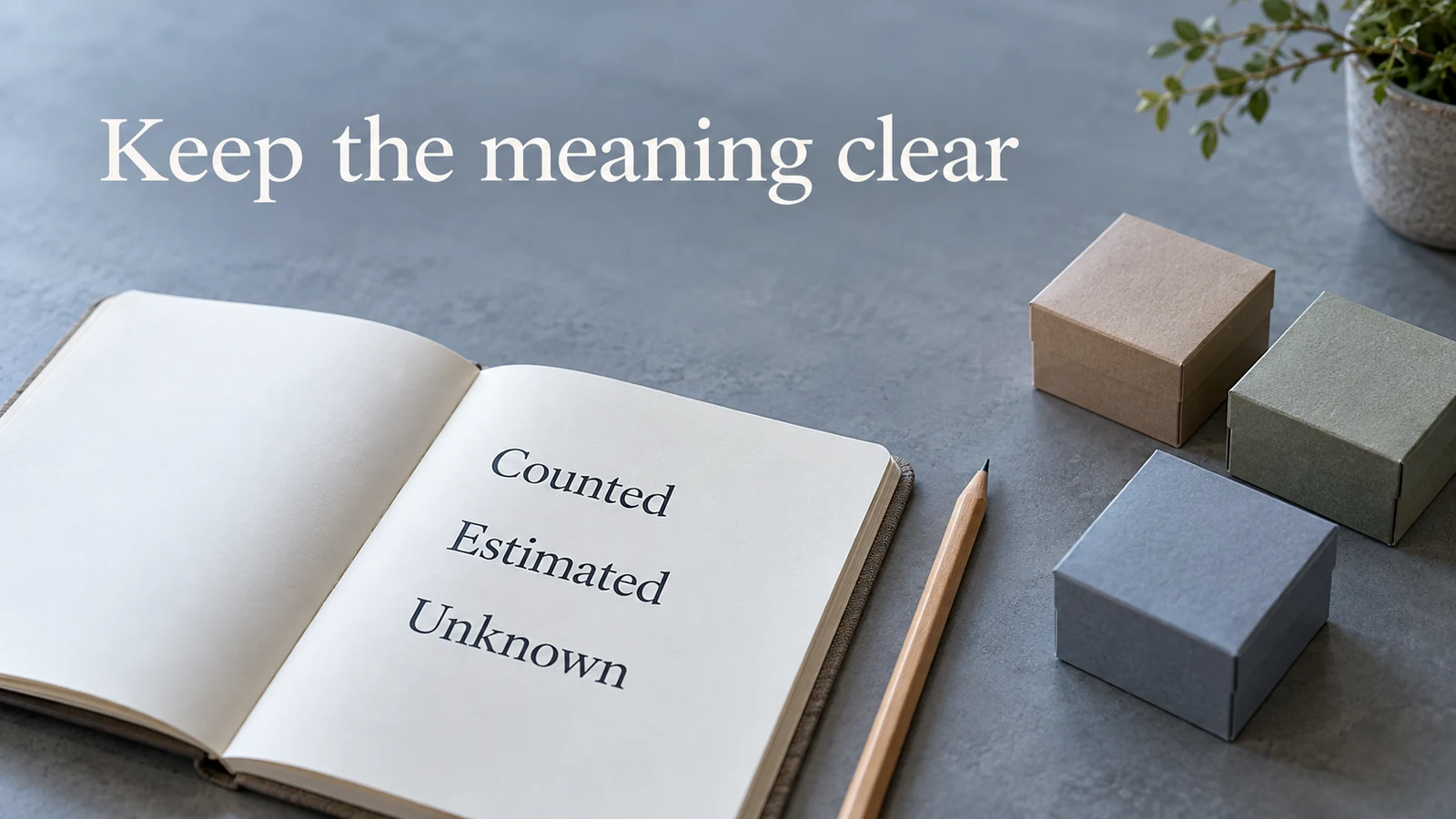
A count means you deliberately counted the things you are describing. A number read from a ticket or timetable comes from that source. An estimate expresses an approximate judgment. Those descriptions tell a later reader something about how the quantity entered the account.
A count still needs a clear subject. “Five” does not tell you whether you counted five people present, five people invited or five chairs around a table. Writing the noun and relevant boundary can matter more than adding another digit.
Likewise, a source supplies a particular number for a particular purpose. A ticket's printed start time describes the scheduled start, not necessarily the moment an event began. If that distinction matters to the entry, keep the source's meaning attached to the number rather than turning it into a different fact.
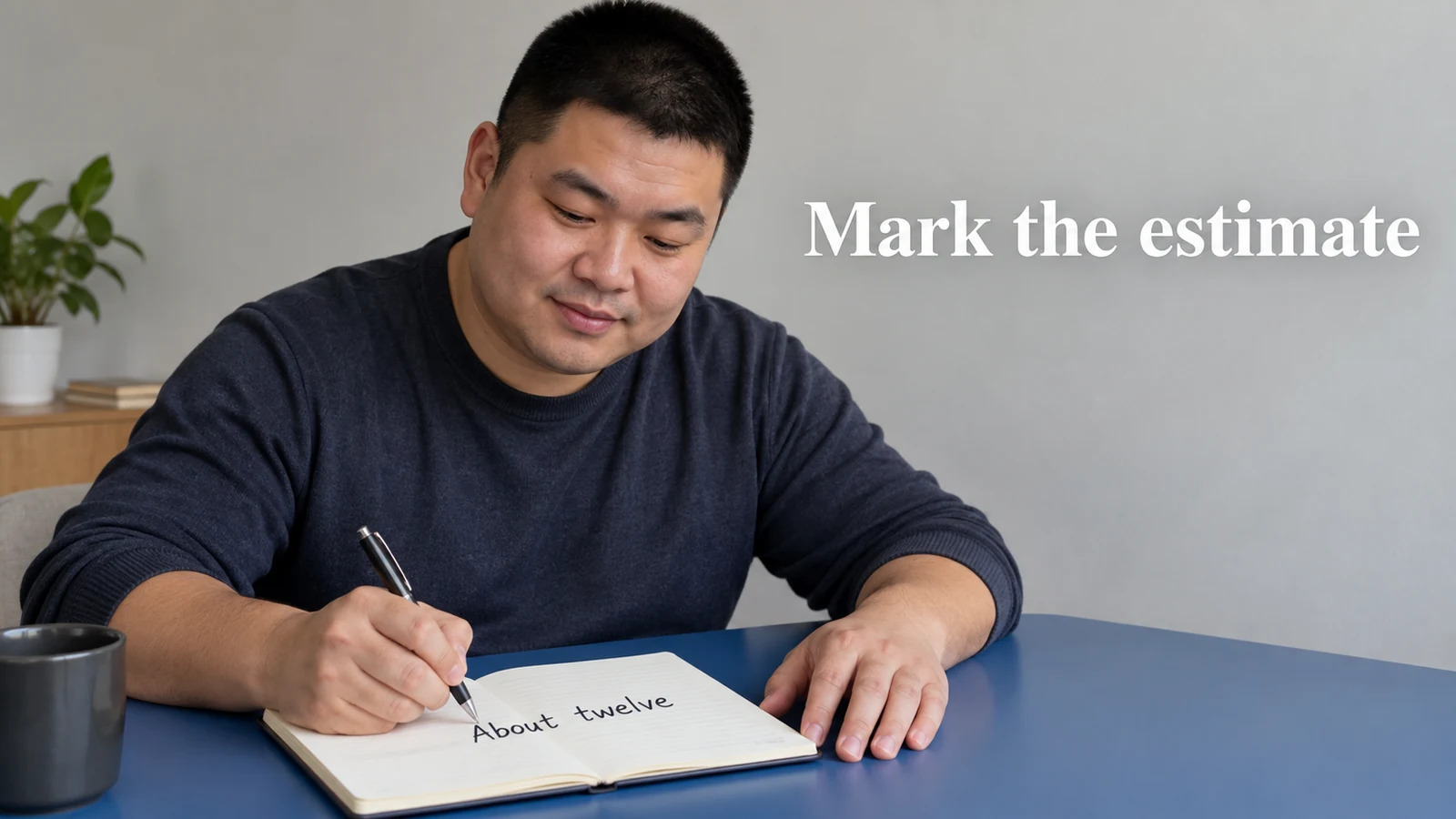
For an estimate, use ordinary wording such as “about,” “roughly” or “I think.” These are not decorative hedges to remove during polishing. They can carry the important information that you did not establish an exact amount.
Define the boundary before trusting a total
Suppose you write that you sorted twelve books. Did you include books placed aside for another shelf, or only books already put away? Either description might fit what you meant. State the boundary when a later reading could reasonably produce a different interpretation.
The same issue arises with groups. “Six people came” might include the writer, the host or only visitors. If the number matters, a short clarification can settle the meaning: “Six visitors, not counting me.” You do not need that detail when the quantity is incidental and the exact boundary serves no purpose.

A time description also has a beginning and an ending. You might be describing travel, waiting or the whole outing. If you did not note the endpoints, avoid making the account sound as though you timed a particular interval precisely.
This does not require a formal definition beneath every sentence. Use a brief explanation where it changes the meaning. The entry should remain something you can read, not a form that demands information you never wanted to collect.
Keep a rough estimate rough
If you remember roughly ten minutes, writing 10.0 minutes does not make the recollection more exact. Extra digits can imply a method you did not use. Keep the amount at the level you can support and identify that it is an estimate.
A range can be useful when it honestly describes your uncertainty, but do not invent endpoints to make uncertainty look calculated. “Perhaps ten to fifteen people” is a personal estimate if that is what you recall. It is not automatically a statistically established interval.
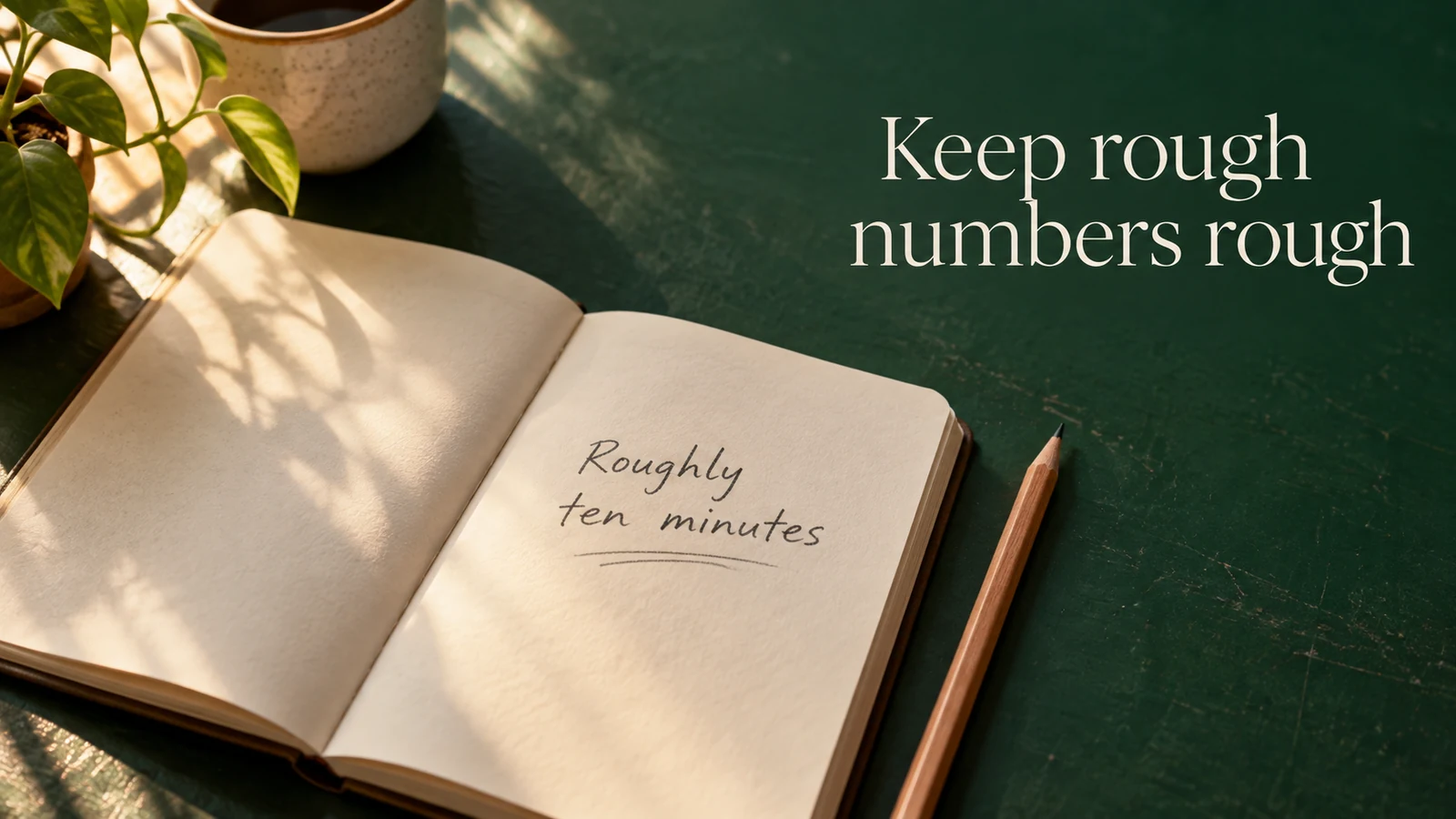
You can also describe a limit you actually know. “I stopped counting after eight” means something different from “There were eight.” The first sentence preserves the boundary of your observation. It avoids making an unfinished count appear to cover the whole scene.
If you have no reasonable basis for an amount, leave it unknown. An entry can say that the room felt crowded without claiming a headcount. Your impression and an established quantity can coexist without being treated as the same kind of statement.
Use a small notation only if it helps
You might write “counted,” “from timetable” or “rough estimate” beside a quantity. A short key at the top of a page can explain a repeated abbreviation. Choose plain words if symbols would create another thing to remember.
Keep the label close to the number. If a note at the bottom says that some quantities are estimates, it may be unclear which ones it covers. A sentence such as “About twelve people, estimated from where I sat” makes the relationship visible without requiring a separate legend.
For a source-based quantity, keep a practical pointer when it matters. You might identify the relevant ticket or note without copying personal booking details into the journal. A reference helps you find the source; it does not establish that the source answered every question about the event.
CTA: If your quantities appear alongside uncertain dates, our personal timeline guide addresses the separate task of ordering selected events: https://soulfulglo.com/blog/personal-timeline-from-journal-entries. Keep the quantity's meaning distinct from the event's date and its source.
Fictional example: chairs and visitors
The following writer and entry are invented. Nia writes about setting up a small craft gathering. She counts eight chairs around the table before anyone arrives. Later she writes, “Eight people came,” using the chair count as a shortcut.
When rereading the entry that evening, she notices that the chairs did not establish attendance. She changes her current draft to “I set out eight chairs. I think six visitors came, but I did not count them.” The first quantity is counted; the second remains an estimate.
If the entry had already been saved as an earlier account, she could add a dated clarification rather than quietly changing what it originally said. The relevant distinction is between the arrangement she counted and the attendance she recalls.
The example does not show that every gathering needs a count. It shows how two numbers can have different subjects even when they refer to the same afternoon. Nia can leave the visitors' number out if it does not serve her entry.
Fictional example: an afternoon at a worktable
Omar, another fictional writer, notes that he spent “exactly forty minutes” arranging a worktable. He later remembers that he never checked the time. Forty was his rough impression of how long the task took.
He adds a note: “Duration was a rough estimate; I did not time the task.” He does not replace forty with a more precise-looking number drawn from how much he accomplished. The finished arrangement cannot establish a duration by itself.

He also records that he put nine small containers on the shelf, a quantity he actually counted while arranging them. The same entry can contain a counted quantity and an estimated duration without forcing them into one level of certainty.
Nothing in the example requires Omar to time the next arrangement. He can write about what changed in the room instead. Clarifying an earlier estimate does not create an obligation to collect more detailed information in the future.
Add a correction without erasing its timing
If you discover a mistake, describe what changed and why. For example: “Note added Friday: the earlier total included two containers I later put elsewhere.” That tells you the difference between the original description and the later clarification.
Avoid turning a present recollection into something the earlier entry appeared to know. A dated addition can preserve a useful new detail while showing when you supplied it. If you no longer have a basis for choosing between two quantities, retain the disagreement rather than selecting the tidier number.
You do not need an elaborate revision history for every casual sentence. Use enough explanation for a future reading to distinguish an original account, a copying error and a later interpretation. Keep the work proportionate to an ordinary personal page.
Do not confuse this convention with measurement science
NIST's Technical Note 1297 discusses reporting measurement results with an account of how uncertainty was evaluated. That is technical measurement guidance, not a journaling exercise or evidence of a wellbeing benefit. The linked page also states that it is no longer being updated.
This guide does not borrow its formulas, confidence levels or certification language. The personal writing choice here is narrower: avoid presenting a guess as an established quantity. A word such as “roughly” is not a substitute for professional uncertainty analysis where that is actually required.
Questions readers often ask
Should I count more things to make entries accurate?
Only if you want the count for your purpose. You can write an ordinary reflection without collecting quantities. Removing an unnecessary number may represent the occasion better than adding a new monitoring task.
Is a counted number always beyond doubt?
No. A count can omit or repeat things, and its boundary may be unclear. Describe what you did and avoid claiming more certainty than the account supports. This guide does not establish a count's accuracy.
Can I use a range instead of one number?
Yes, when it honestly expresses a rough recollection. Label it as an estimate unless you have another basis. Do not present guessed endpoints as a calculated statistical interval.
What if two entries give different totals?
Keep their contexts and dates visible. They may describe different boundaries or contain an unresolved error. Check an available relevant source if you want to, but do not assume one total is correct merely because it is more recent.
Finish with the meaning you can support
Read the quantities in one selected entry. Can you tell what each describes and how you arrived at it? Add a short label only where it clarifies the account. Leave unknown quantities unknown, and keep the writing's purpose in view.
CTA: For a different use of a page, our everyday decision journaling guide separates facts, preferences and guesses while comparing available choices: https://soulfulglo.com/blog/journaling-before-an-everyday-decision. A clearer quantity can inform a description without becoming a rule for your next choice.