
Several journal entries can describe the same month without presenting it in order. You might write about a visit a week afterward, mention an earlier plan halfway through another entry or return to the same event on several pages. A short personal timeline can bring selected events together while keeping a route back to the original writing.
The purpose is chronological: show what the selected pages say happened and when. A timeline can cover an ordinary period, such as trying a class, changing a room arrangement or settling into a new neighbourhood.
Quick answer
Choose a specific period and a small set of entries. For each selected event, record its date or date range, a brief description and the notebook page or other source pointer. Keep the event date separate from the entry date. Sort what you can, retain uncertain or conflicting dates and combine duplicate mentions without losing their references.
Add the date on which you compiled the timeline. If you later correct a row, identify what changed and the source for the correction. This personal organisation exercise is not a clinical history, official record or measure of psychological progress.
Choose a period and a question
Begin with something you can answer through a limited selection. You might want to know the order of your first visits to a local class or which household changes happened before a guest arrived. A question about one month is often easier to organise than a request to reconstruct every important turning point.

Write the period at the top of a new page. Add a short description of the material you intend to use, such as selected entries from one notebook. That description makes the timeline's limits visible. It also helps distinguish a small compilation from a complete account of everything that happened during those dates.
Choose material you are willing to read and leave out details beyond your question. If you need a record for a professional, legal or medical purpose, use the appropriate process separately.
Separate when something happened from when you wrote
An entry dated 18 April may describe an event on 12 April. Those are two useful dates with different jobs. The event date determines where the event belongs in the chronology. The entry date identifies when that account was written. If the event date is unclear, do not silently substitute the date printed above the entry.

Use four headings: Event date, Event, Source, and Uncertainty. Include the entry date in the source field when useful. A source might be the blue notebook, page 24, entry dated 18 April. That reference lets you return to the account without copying the entire entry.
Sometimes a page describes something planned rather than completed. Keep that distinction in the event description. A note about booking a class establishes that the writer recorded a booking, not that they later attended. You can include plans if they serve your question, but label them as plans instead of converting them into completed events.
Record one event and a usable source pointer
Write a short description at the scale the selected page supports. Visiting a studio, moving a desk or receiving a timetable can be enough. Avoid adding motives or consequences unless you have chosen to record them separately as interpretations. The timeline row can remain a factual summary of what the source reports.
If the account is uncertain, preserve that in the description. You can record that the entry mentions a possible visit rather than asserting that the visit definitely happened. A source pointer does not make the underlying account infallible. It shows where the information came from and lets you check it again if needed.
Use a notebook identifier as well as a page number when several volumes are involved. For a digital entry, use an identifier or location you can reopen. Test the reference by returning to the entry before putting the source material away.
Keep approximate, unknown and conflicting dates visible
A month, a range or an ordinary relative description may be all you know. Keep that level of precision. An entry saying an event occurred earlier in May does not supply a particular day. You can place it in a May group without pretending to know its position among events that have exact dates.

Relative dates need a clear anchor before you convert them. If an entry has a reliable date and plainly refers to the previous day, you may be able to derive the event date. Note that you derived it from that wording. If the entry itself is undated or its meaning ambiguous, keep the uncertainty.
When two pages give different dates, retain both source references. Keep one row with a note that the sources disagree, or use a separate Uncertain date group. The disagreement should remain visible wherever you place the row.
Sort events and combine repeated mentions carefully
Put securely dated events in order first. Keep uncertain events beside that list until you can place them without inventing precision. In Daniel's fictional example below, either disputed shelf date precedes the use recorded on 22 May, but the lamp's date does not establish whether it came before or after either event. You can write 'shelf move precedes recorded use; lamp position in sequence unknown.' That preserves the supported relationship without assigning the lamp an arbitrary day or using its position on the page as a hidden claim about order.

Check whether repeated mentions describe one event or several. Two entries about a first visit may refer to the same occasion; two mentions of visiting a place may concern different days. Compare the actual details before merging. Similar wording alone is not enough to establish that the pages describe one event.
When you combine mentions, retain every useful source pointer and any conflicting detail in the row. Shorten the description only after checking that the references still lead to each account.
Fictional compilation: the first month of a class
Elena compiles selected April entries. The writer, dates, page references and following source snippets are all original fiction written for this example.
Source entry, page 8, dated 4 April: "Booked my place in the class today."
Source entry, page 15, dated 13 April: "Went to my first session yesterday."
Source entry, page 19, dated 20 April: "Remembering that first session again: I kept the small test piece we made."
She derives an attendance date from the second entry. The third explicitly recalls the first session, so she links it to that event rather than inventing another visit. It adds a source for the event, not another basis for its date.
Elena's finished chronology reads:
Event date: 4 April. Event: class booking recorded. Source: notebook page 8, entry dated 4 April. Uncertainty: none stated.
Event date: 12 April. Event: first attendance reported. Source: page 15, entry dated 13 April; page 19, entry dated 20 April. Uncertainty: 12 April is derived from the earlier entry's reference to the previous day; page 19 adds a mention, not independent date confirmation.
She adds: Compiled 30 April from these selected entries.
When copying the finished attendance row, Elena accidentally writes page 14 instead of page 15. Her later note reads: "Correction added 2 May: attendance source pointer changed from page 14 to page 15 after checking the notebook. Event date remains 12 April, derived from the entry dated 13 April." The source entry itself stays unchanged.
Fictional compilation: changes to a reading corner
Daniel wants to organise selected notes from May. One undated page describes moving a lamp sometime in May. An entry written on 11 May says he moved a shelf on 9 May. Another written on 14 May gives 10 May for what appears to be the same shelf move.
Daniel leaves the lamp date approximate. He provisionally combines the two shelf accounts because their details appear to concern one move, while retaining both conflicting dates and both references. If the details suggested two moves, he would keep separate rows.
An entry dated 22 May describes using the rearranged corner that afternoon. The disputed shelf range precedes that use. The lamp could fall before, between or after those events, so it stays outside strict daily order.
Daniel's partly sorted result reads:
Event date: 9 or 10 May. Event: shelf moved. Source: entries dated 11 and 14 May. Uncertainty: sources disagree; neither event date is established as correct.
Event date: 22 May. Event: rearranged corner used. Source: entry dated 22 May. Uncertainty: none stated in this account.
Outside strict day-by-day order: Event date: May, exact date unknown. Event: lamp moved. Source: undated lamp entry. Uncertainty: its position relative to the other events is unknown.
He adds: Compiled 31 May. These source descriptions distinguish the fictional entries; add page references in your own notebook where needed. The shelf conflict remains unresolved.
Leave gaps and explanations separate
A period with no selected events may mean that you did not write, did not select those pages or did not record the subject you are tracing. The timeline alone cannot decide which explanation applies. Leave a gap rather than inventing an event to make the month look complete.

Carleton College's SERC hosts Personal Timeline, a geoscience teaching activity by Rebecca Teed and Carrie Wright. Students place selected life events on a timeline before considering Earth history. Its educational context offers an example of selecting and ordering events; it does not validate this journal-compilation method or establish a wellbeing benefit.
Keep explanations beside the chronology as separate notes. For example, a class visit preceding a new hobby may prompt a question about a connection, but the order alone cannot establish that the visit caused the hobby.
For a separate reading exercise, explore SoulFul GLO's guide to reviewing old journal entries. It considers context and present-day interpretation; use that when your question concerns what an entry means rather than where an event belongs in time.
Date later corrections and choose an ending
If you correct the timeline, note the correction date, the previous description when relevant and the source for the change. You can keep a brief correction note beside the row. Leave the original journal entry intact so the later compilation does not make it appear that the original account always contained the new information.
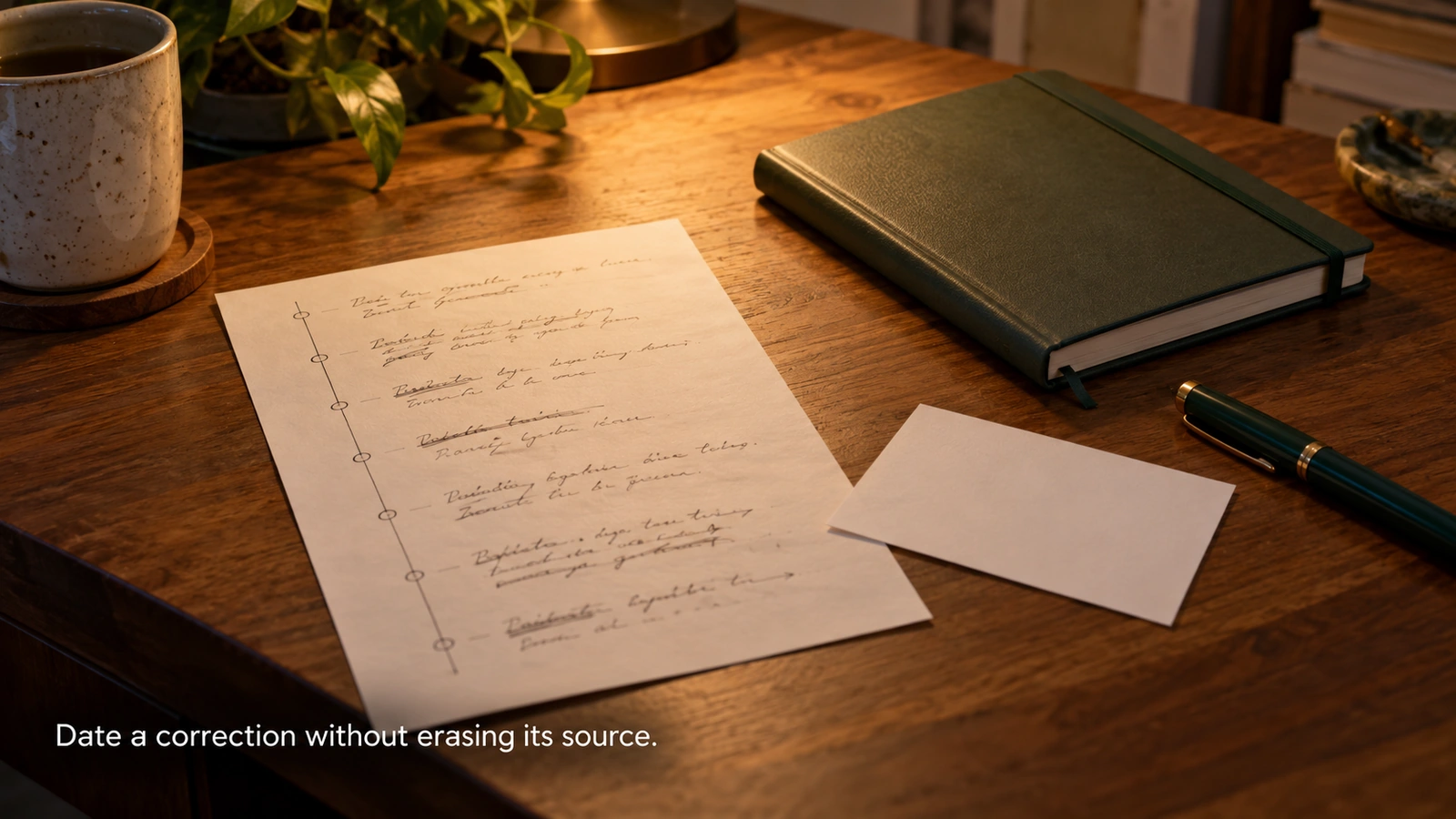
Finish when the timeline answers your limited question, or when you have compiled enough for now. Store it with attention to the details it brings together: a separate timeline may reveal information even when the source notebooks remain closed.
If finding source pages is the main obstacle, explore SoulFul GLO's paper journal index guide. It offers a separate navigation method that can help you locate selected entries without requiring a chronology of every page.
Frequently asked questions
Do I need a line drawn to scale?
No. A dated list or simple table can serve this personal compilation. If you draw a line, avoid spacing that implies a precision you do not have. Keep approximate dates labelled. The useful format is one that preserves the event, its date information and its source clearly.
Should every entry become an event?
No. Select what answers your question. An entry may contain several events, one event or no event you want in this timeline. Record the selection limits at the top so that the result does not appear to cover the whole period comprehensively.
What if I only know the order?
Keep the relationship you can support, such as one event occurring before another, alongside the relevant sources. Do not invent dates to turn that relationship into a calendar. You can leave the events in a separate group when their place among dated events remains unclear.
Can I add what I remember now?
Yes, if you label it as a present recollection and date the addition. Keep it distinct from the old entry's account. A memory can contribute to a personal compilation without becoming evidence that the original page contained that detail or that the date is certain.