
Someone is telling you about an ordinary experience, and you notice yourself preparing a reply before they finish. You have a related story, a practical suggestion or a question that would move the conversation somewhere else. You can pause that reply long enough to find out what the person is actually trying to say.
A short listening exercise makes that choice visible. Two willing adults agree on an everyday topic, take turns speaking and check whether a brief summary matches the speaker's meaning. This is a communication practice, not therapy, mediation or a promise that another person will feel understood. Use an ordinary low-stakes subject, with freedom for either person to stop.
Quick answer
Ask whether the other person wants to try a short listening turn. Agree on a manageable topic and whether they want listening, questions or suggestions. Let them speak without preparing a competing story. Offer a tentative summary in your own words, ask whether it matches, and accept corrections. Switch roles only if both people want to, then end without requiring a personal disclosure or a positive result.
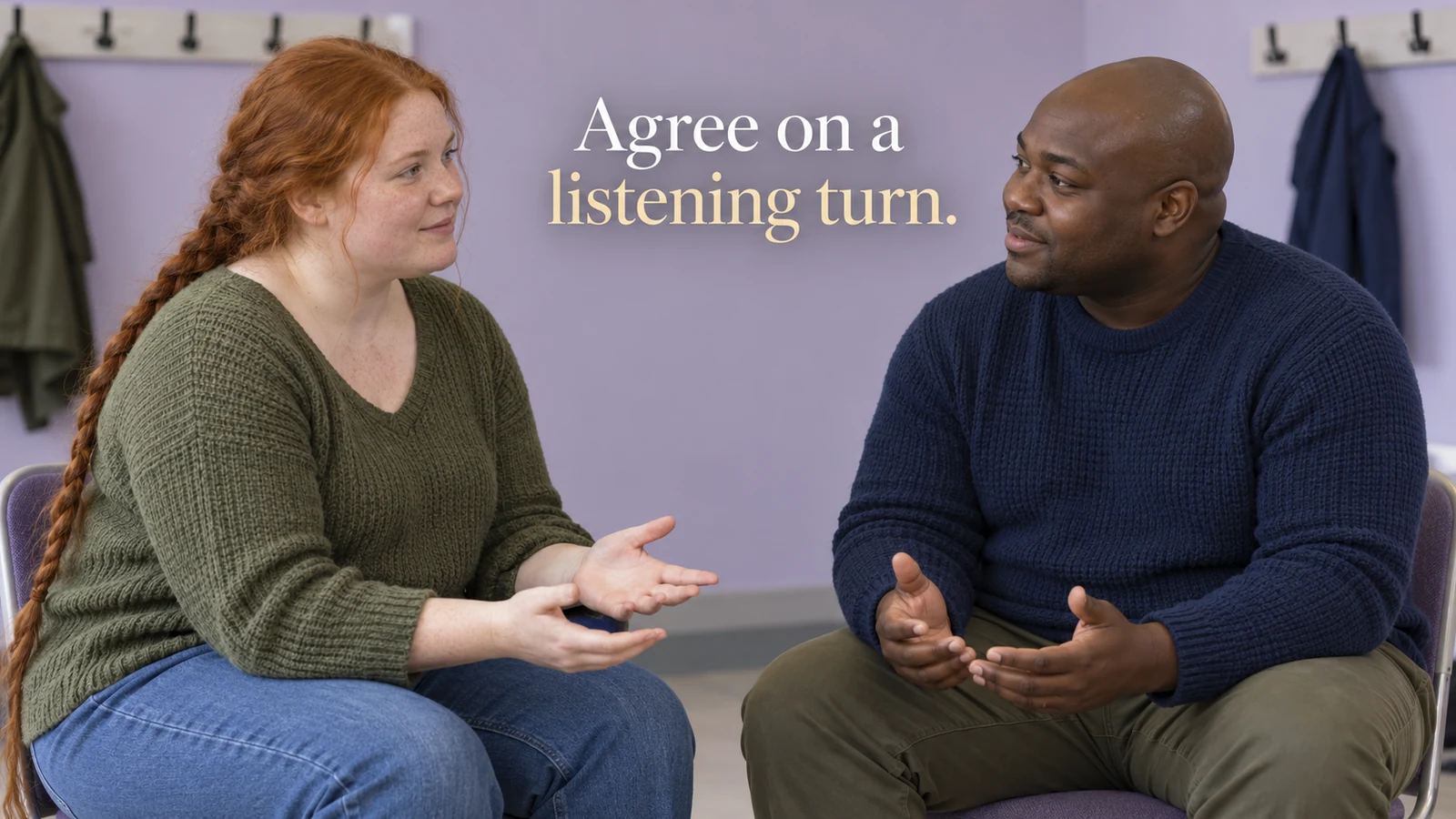
The point is to check understanding of this actual account. A smooth paraphrase is not useful if the speaker says it is wrong and you defend it. Likewise, listening does not require agreement, eye contact, unwanted touch or a commitment to solve the situation.
Ask for a listening turn rather than setting a hidden test
Begin with an invitation that explains the activity. You might ask, Would you like to try taking turns describing one ordinary part of the day, with the listener checking what they understood? Give the person enough information to choose. A conversation already underway does not automatically mean agreement to a structured exercise.
Choose a subject that both people are comfortable discussing. Describing a class, a small household project or a recent walk can provide plenty to listen to. There is no need to select a painful experience to make the exercise meaningful. The speaker chooses what to include and what remains private.
Agree on a practical ending before you start. It might be after one short account and a check-back, or before a commitment already on the calendar. Avoid treating a suggested duration as a target the speaker must fill. A brief description can be complete, and either person can decline another turn.
Do not use this exercise to manage threats, coercion, an escalating dispute or a crisis. Those circumstances require appropriate safety and support, not a demand to demonstrate better listening. An invitation is also inappropriate when someone has clearly said they do not want the conversation.
Check what kind of response is welcome
Ask what would be useful after the account: listening alone, a clarifying question, ideas or a later practical discussion. The answer may be simple. Someone describing a confusing class might want help identifying a question for the teacher; someone recalling a pleasant moment may simply want to share it.

Keep that agreement modest. Saying you can listen does not mean promising availability for every topic or an unlimited length of time. If you cannot give attention now, offer another time only if you genuinely intend to be available. A clear no is more accurate than agreeing while continuing a different task.
MIT Human Resources' active-listening guidance includes choosing when to listen, asking for clarification and checking a paraphrase with the speaker. Those are communication suggestions. They do not certify this exercise, predict a relationship outcome or require the speaker to accept the listener's interpretation.
The agreement can change. If the speaker begins asking for suggestions after initially wanting only a listener, check what question they now want help with. If you are uncertain whether a comment is a request, ask rather than automatically producing advice. Keep the response connected to what was actually invited.
Make attention practical instead of performing it
Choose an arrangement in which both people can participate comfortably. You might sit at an ordinary table, use two chairs at an angle or speak during an agreed call. Check audibility and available attention rather than assuming one seating arrangement works for everyone.
Discuss distractions proportionately. You can put a phone aside if responsibilities allow, or explain that you must remain available for a particular interruption. Do not make silence, a device-free room or constant eye contact conditions for being considered a good listener. Agree on what the two of you can actually do.
Body language is not a reliable code for another person's thoughts. Looking away, moving or pausing can have many explanations. Ask about practical needs and listen to what the person says. Avoid turning the exercise into a test of stillness, facial expression or whether someone appears calm enough.
You also do not need to imitate a therapist's voice. Ordinary language is usually enough. If a phrase sounds unnatural when you say it, use a simpler question. The activity is easier to understand when both people know what is being asked, rather than trying to recognise a special communication technique.
Listen for the account before choosing the reply
Let the speaker establish what the account is about. Pay attention to the details they select and the sequence they describe. You may notice a point you want clarified, but you do not have to interrupt every uncertain word. Keep the question available until there is a suitable pause.
When your own story comes to mind, recognise it as something different from the story you are hearing. Having experienced a similar class or household problem does not establish that the other person's experience was the same. Return to their actual description before deciding whether your example is relevant.

If you lose the thread, say so plainly. You can ask them to repeat a particular part instead of nodding and inventing the connection. For example, ask whether the changed plan happened before or after they arrived. A specific clarification is more useful than pretending that attention never wandered.
Do not gather extra personal detail merely because a question occurs to you. Consider whether the information matters to understanding what the speaker chose to share. They may prefer not to explain a name, location or background event. You can acknowledge that boundary without treating it as an obstacle you must overcome.
Offer a short summary that can be corrected
At a natural stopping point, summarise the central point in your own words. Keep it tentative and short enough for the speaker to inspect. You might say that you understood the changed meeting time to be the confusing part, then ask whether you have that right. Your wording should leave room for a different answer.
Separate what was said from a feeling or motive you inferred. If the person described repeated timetable changes, that does not establish that they felt angry, rejected or anxious. You can ask what mattered most to them without naming an emotion on their behalf. A paraphrase should not quietly add a diagnosis or explanation.
When the speaker corrects you, revise the summary rather than arguing that your version was almost right. The correction may be the most useful information in the exchange. If they say the problem was the missing room number rather than the time change, use that distinction in your next question.

Checking does not need to become repeated interrogation. Once the speaker says the summary is sufficient, move on or end as agreed. You are not trying to produce a perfect transcript. Understanding enough for this exchange can coexist with details that remain unclear or deliberately unshared.
Ask before moving into advice or another story
After the check-back, ask whether the person wants anything else. If they would like suggestions, identify the actual request before offering them. If they only wanted to describe an experience, a simple acknowledgement can be enough. You do not have to manufacture a lesson to complete the turn.
If you want to contribute your own perspective, ask whether this is a suitable moment. You can disagree with an idea while acknowledging that you understood the account. Keep those statements separate. Accepting a correction to your summary does not commit you to the same opinion or a practical arrangement.
For a separate preparation exercise, explore SoulFul GLO's guide to pausing before a difficult conversation. It concerns your observation, question and limit before an ordinary discussion. Use it for that purpose; the partner exercise here concerns listening to a willing person's actual words after a conversation begins.
Switch roles by agreement
If both people want another turn, agree who speaks next and retain the same choices about topic and response. Equal opportunity does not require identical speaking time or equally personal material. One person can describe a small practical event while the other chooses something entirely different.

The person who just spoke can now practise leaving room for the next account. Avoid using the new turn to correct every detail of the earlier one unless that was the agreed subject. A role switch is a new opportunity to listen, not a requirement to continue a point until someone agrees.
You can also finish after one turn. Thanking someone for the conversation need not imply that they owe a turn in return. If the arrangement did not work, describe the practical issue without scoring the person. Too little time, unclear instructions or an inconvenient setting can all be reasons to choose another occasion.
Two fictional check-backs
The changed classroom
In a fictional example, Sam describes arriving for a pottery class and finding that the session had moved. Their partner, Imani, summarises that the new time was inconvenient. Sam explains that the time was unchanged; the difficulty was finding the new room because the notice did not name the entrance.
Imani accepts the correction and asks whether Sam wants help drafting a question to the organiser. Sam says they only wanted to explain why they arrived late. The turn can end there. No solution or emotional breakthrough is required, and neither fictional person represents an actual customer.
A story held for later
In another fictional example, Elio begins recalling a similar event while Noor is describing a small repair project. Elio notices that the reply would change the subject and returns to Noor's account. At the pause, Elio asks whether the missing tool was the main obstacle. Noor says the instructions, rather than the tool, were unclear.
After that correction, Noor asks whether Elio has tried the same instruction. Elio can now share the related experience because it answers an actual question. The distinction is the invitation, not whether Elio's story was interesting. This example illustrates conversational choices and establishes no general result.
Finish without collecting a verdict
End at the agreed boundary or when either person wants to stop. You can ask whether the format was workable without requiring praise, a feeling of connection or a promise to repeat it. Keep any private note about your own listening choices brief and avoid recording the other person's account without explicit agreement.

If you want an individual writing activity afterward, explore SoulFul GLO's journal-prompt adaptation guide. Choose a question about your own attention or next conversation preference. The other person's disclosures do not become material you are entitled to preserve or publish because you listened to them.
Frequently asked questions
Do we have to make eye contact?
No fixed gaze is required here. Agree on a comfortable way to communicate and check practical understanding. Eye contact, stillness or a particular facial expression cannot prove that someone understood the account. Use clear questions rather than treating appearance as a score.
Does understanding mean agreeing?
No. You can accurately understand a view while holding a different one. First check what the speaker means; then, if invited, explain your perspective separately. Listening does not require accepting an unwanted request or abandoning a boundary.
What if my summary is wrong?
Accept the correction and try a shorter, more accurate version if needed. Do not require the speaker to defend the difference. If you still cannot follow a point, identify that uncertainty rather than filling it with your own explanation.
Can this resolve a serious conflict?
This article makes no such promise. It describes a voluntary exercise for ordinary, low-stakes conversation. Safety concerns, coercion, crises and disputes needing professional help are outside its scope. Either person can leave the exercise without completing another turn.