
You arrive at a yoga class with the equipment the teacher requested. Across the room, another participant has a coordinated set of accessories. Before the session begins, you start wondering whether your own arrangement makes you look less committed. Nothing in the class requirements changed, but the objects have become a comparison about belonging.
That is one ordinary place to consider aparigraha, commonly translated as non-possessiveness or non-grasping in yoga. The question here is not how to shop within a limit or arrange a smaller home. It is what happens when acquiring an object seems to promise proof that you are the kind of practitioner you want to be.
Quick answer
Notice the comparison and put its implied promise into words. Is the object needed for an actual instruction, wanted for enjoyment or being asked to prove your seriousness? Keep those reasons distinct. You can make a practical equipment decision without treating possessions as evidence of worth, belonging or a future inner experience. This reflection does not require owning less or arriving at a particular purchase decision.
Give aparigraha a source rather than a slogan
North Carolina State University's yoga teaching material identifies aparigraha among the yamas and translates it as non-hoarding or non-possessiveness. Duke University's recreation teaching also includes avoiding comparison among its everyday examples. These short introductions provide context for this original reflection, not a complete account of the principle across traditions.
If your class studies aparigraha, ask which source and interpretation the teacher uses. Keep that explanation distinct from a product advertisement or a photograph attached to a practice. A convenient idea about buying less should not silently become the whole meaning of a traditional teaching.
The examples below concern low-stakes comparisons around yoga possessions. They are not financial advice, a decluttering method or an assessment of another participant's choices. They offer a way to recognise the promise you have attached to an object before deciding whether you actually want it.
Catch the sentence the object seems to finish
A comparison can contain an unfinished sentence: “Once I have that, I will look serious,” or “Without that setup, I do not really belong.” Try completing the sentence in ordinary words. You do not need to agree with it or criticise yourself for noticing it.
Be specific about the promised proof. Looking organised, feeling accepted, practising regularly and understanding a teaching are different hopes. An object may have a useful function while being unable to establish those wider conclusions. Keeping the claims separate is more informative than deciding that wanting anything is a problem.
Sometimes no large promise is present. You simply like a colour or enjoy a well-made object. Recognise that preference honestly rather than inventing a need or an identity crisis. The reflection should help describe your actual reason, not manufacture a hidden motive every time something appeals to you.
Separate a requirement from a symbol of seriousness
An instructor's stated equipment requirement concerns an actual teaching arrangement. It can deserve an ordinary practical response. A possession that appears in somebody else's photograph supplies different information: it shows what is pictured, without establishing what your session requires or what their experience means.
If the requirement is unclear, ask the qualified instructor about the intended function and appropriate options. This article provides no prop substitution or movement instruction. Neither a philosophical reflection nor an attractive product can determine whether equipment or a practice is suitable for your individual needs.
Once the practical question is clear, notice whether another claim remains attached. “The class asks for this item” differs from “Everyone will know I am committed if I own the matching set.” The second sentence concerns imagined recognition. You do not have to treat that recognition as a condition for participating.
Another person's belongings do not explain their practice
You cannot infer why someone owns an item from seeing it beside their mat. It may have been provided, borrowed, replaced or chosen for reasons they have not shared. You also cannot infer how regularly they practise or what they understand from the appearance of their equipment.
Let those questions remain theirs. You do not need to discover a private explanation before making your own decision. A comparison loses useful detail when it turns a visible object into a complete story about the person carrying it.
Avoid reversing the judgment. A plain setup does not prove greater sincerity, and a coordinated one does not prove vanity. The task is to notice the story you are adding, rather than replacing admiration with criticism. Both responses can keep attention fixed on an imagined account of someone else.
Notice when ownership becomes a condition for beginning
An actual missing requirement may need resolution before an activity. An added identity condition works differently: you postpone until the setup seems to say the right thing about you. The threshold can move whenever a new image offers another version of what a committed person supposedly looks like.
Keep the proposed condition visible. Is it attached to the resource's instructions, an access need or a promise about how you will appear? The answer can change the next question. You may need clarification from the instructor, or you may simply recognise that the imagined audience has become part of the decision.
This is not a reason to force yourself to start. The activity might not suit the occasion, and wanting different arrangements can be reasonable. You can decide not to participate without claiming that an accessory would have made you ready, interested or different as a person.
A table for the claims around an object
Use the distinctions below to identify what you are asking an item to establish. They are an original reflection aid, not a product checklist or a rule about how many possessions anyone should own.
| Statement you notice | What it concerns | What to clarify | What remains separate |
|---|---|---|---|
| The instructor asks for this | A teaching requirement | Its intended function | Your seriousness as a person |
| I like its appearance | A preference | Whether you want it | A promised change in identity |
| Others will see I belong | Imagined recognition | Whose response you are predicting | The actual participation arrangement |
| I will practise once I own it | A future action | What is actually preventing a start | Ownership and commitment |
| Their setup looks complete | A visible comparison | What you know and what you assume | Their private experience |
An ordinary reflection with an ending
First, identify the particular object or image that prompted the comparison. Keep the occasion narrow enough to describe. You are not trying to discover your permanent relationship with possessions or review everything in your home.
Second, write or think the implied promise once. Name whether the item is being asked to provide a function, enjoyment or proof about you. Several reasons can coexist, but they do not become the same reason merely because they concern one object.
Third, check the practical requirement through the actual instruction when needed. Leave physical suitability and equipment use with appropriate guidance. Then return to the additional promise: does ownership really establish the recognition, identity or future behaviour you imagined?
Fourth, make the decision that is yours. You may still want the item, leave it undecided or decline. Keep the answer local. A purchase need not announce a new identity, and declining need not become a vow never to acquire anything again.
The simpler option is to notice the comparison and return to the present activity where appropriate. No note or exercise is compulsory. You can stop the reflection if it is unhelpful, and you do not need to wait until every desire or awkward feeling disappears.
Fictional demonstration: the matching set
In this invented example, Amara sees another participant unpack a matching set before class. She has what her own session requires, but thinks that the other person looks like someone who really practises yoga. She begins imagining a similar set as proof of her own commitment.
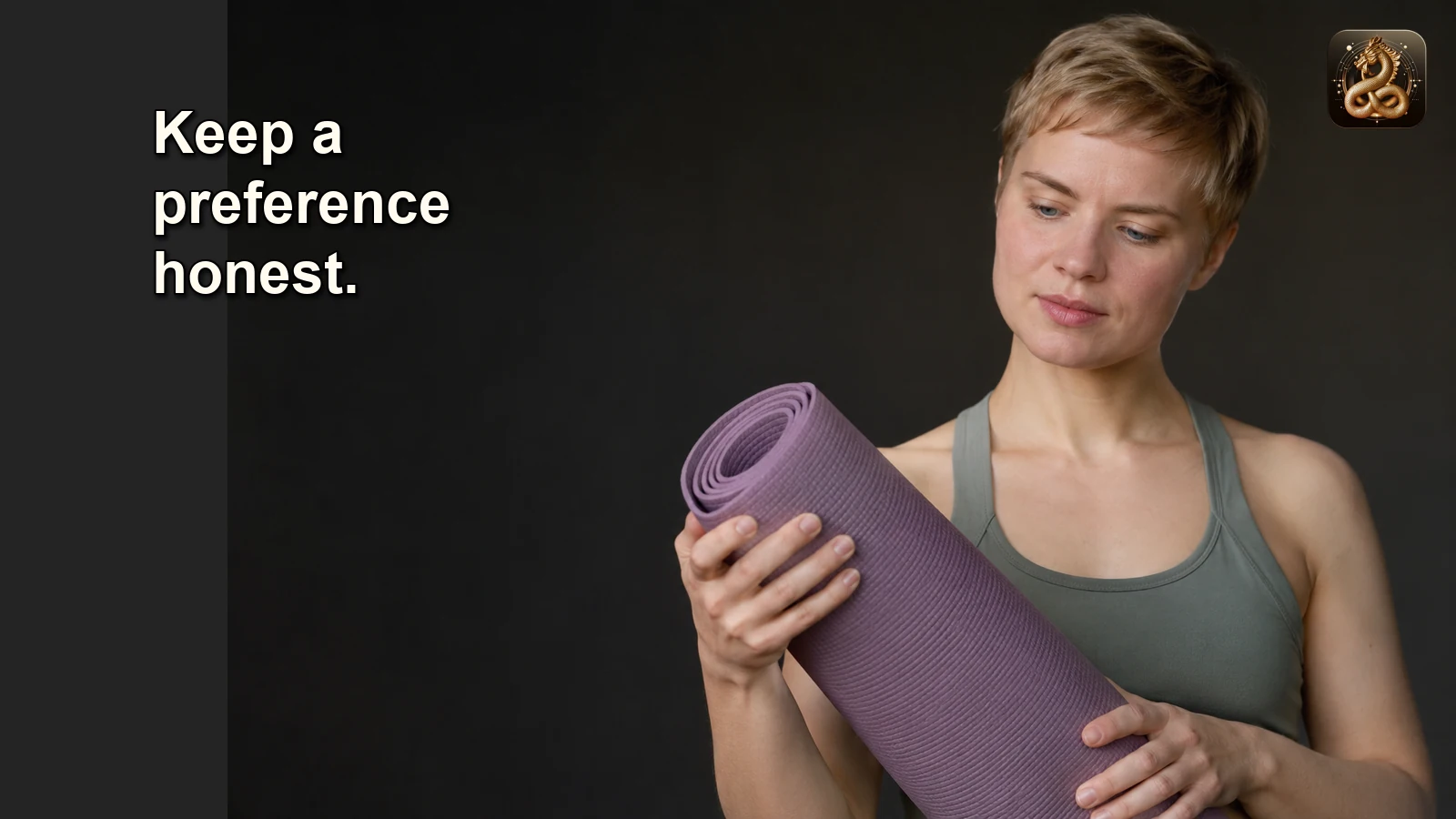
She pauses at that sentence rather than examining the other person's motives. She knows what is visible and does not know the rest of their experience. She also distinguishes two reasons she might want the objects: she likes their appearance, and she has attached a story about being recognised as serious.
Amara can keep the preference while declining to treat it as proof. Her eventual equipment choice remains undecided in the example. She returns to the actual class arrangement, which has not acquired a new matching-set requirement simply because she noticed somebody else's belongings.
In a second fictional situation, Joel imagines that owning a particular accessory will make him practise regularly. He identifies the action he is assigning to the object. He can ask what the actual session needs while recognising that the item cannot make the future decision to practise on his behalf.
These examples describe a distinction, not a testimonial or evidence that aparigraha changes behaviour. Another reader may notice a different promise or no comparison at all. The exercise should follow the actual thought, rather than requiring everyone to discover the same motive.
Keep the decision private when that is enough
You do not have to announce that you are buying, declining or learning non-grasping. Public explanation can add another imagined audience to a decision that was already small. If no practical arrangement depends on an explanation, leaving the reflection private can be a complete ending.
If someone asks about your equipment, answer the question you want to answer. You need not defend a plain setup or persuade them to prefer it. You can also enjoy discussing an item without presenting it as a necessary route to calm, belonging or a better version of yourself.
Notice the temptation to make restraint itself a possession of identity: “I am the kind of person who never wants more.” That new description can become another standard to maintain. Keep the observation modest enough to allow a different ordinary choice when the circumstances change.
Ask what a recommendation actually establishes
If someone recommends an item, listen for the reason they give. They may describe a function, a preference or their own experience. Those are useful distinctions even when you trust the person. A statement about what they enjoy does not automatically become a requirement for your participation, and their enthusiasm does not predict what you will feel. You can thank them, ask the relevant practical question and leave the decision open. There is no need to challenge their choice in order to keep your own. The recommendation remains one piece of information, rather than an instruction to prove your interest through ownership.
Frequently asked questions
Does aparigraha require getting rid of useful things?
This guide does not prescribe discarding possessions. Its narrow exercise concerns the meaning attached to acquiring another object. Study the teaching in context, and keep actual needs and responsibilities visible rather than treating a possession count as evidence of progress.
Is enjoying a coordinated setup wrong?
The reflection does not assign that verdict. A preference can remain a preference without becoming proof of seriousness or a promise of an inner experience. Another person's arrangement also does not explain their character or practice.
Can equipment support a real need?
Yes, an item can have a practical function within appropriate instruction. Clarify the actual requirement with a qualified instructor. Recognising a function is different from assuming that ownership establishes belonging or determines future commitment.
What if I notice the comparison again tomorrow?
Notice the specific sentence again if useful, then choose what to do. Recurrence is not a score or a reason to repeat an exercise until wanting disappears. An ordinary reflection can end while feelings remain mixed.
Ask about the teaching behind the term
Read SoulFul GLO's yoga study guide if you want to identify the source, interpretation and learning activity offered in a philosophy discussion. One everyday example can start a question without containing the whole teaching.
Keep equipment questions concrete
Use SoulFul GLO's yoga props guide for the separate task of understanding the names and functions on an actual class list. The equipment a session requires and the identity an object seems to promise remain different questions.