
A train ride can leave you with a stretch of time you would like to spend listening. You have found your seat, put your bag where it belongs and checked where you are getting off. Before you start a sound journey, pick the part of the trip that is actually available to you. An hour on the train can contain a few quiet minutes and several moments when you need to pay attention elsewhere.
A listening practice can give those quiet minutes a simple focus. A recording does not need to occupy the whole ride. Your stop, any change of train and any instructions from staff take priority. The useful question is when listening fits, and when you would rather leave the audio off.
Quick answer
As a seated passenger, wait until you know your stop and how you will check the journey’s progress. Choose a short stretch with room to stop well before you need to get ready to leave. Keep announcements or another reliable source of travel updates available to you. Pause if the service changes or you need to listen to staff. If you cannot follow the information you need with audio playing, leave the recording for another time.

Give the listening period a beginning and an ending
The beginning might be after the train has left the first busy station and you have checked that you are on the intended service. The ending might be before a known stop, at a scheduled change of train or as soon as there is an announcement you need to understand. Work from the service you are actually on. A familiar route can still have a different stopping pattern.

Think of this as choosing one part of the trip rather than subtracting track length from the timetable. You may be on the train for forty minutes, but if you need to confirm an unfamiliar connection soon, the useful listening period may be much shorter. That is enough to decide whether to start a brief recording or save it for later.
An obvious stopping point makes the decision easier to use. You might say to yourself, “I’ll stop when I next check the route,” or “I’ll put the headphones away before the station before mine.” Choose a boundary you can recognise with the information you actually have. A recording that ends on its own does not tell you where the train is.
Check how you get travel information
Find out what the service provides. There may be announcements, an onboard display, a route map or service updates you can check. Use a source you can actually access and understand in that carriage. A display behind you or an app you cannot open at that moment may be less useful than it sounds.

Try an ordinary check before settling into the audio. Can you see which stop the train is approaching without standing up? If you need to hear an announcement, can you readily pause and listen? Choose the way that works for you. Do not assume that the same arrangement will work after you change seats or move to another service.
If you are unfamiliar with the route or the update system, it may be easier to keep audio off until you have seen how the train identifies the next station. Ask staff for information when appropriate. If an announcement is unclear, stop the recording while you check. A missing detail about the route deserves attention before you return to the track.
Pick a recording that can stop cleanly
A short, familiar sound journey may be an easy option because you already know what you are choosing to hear. A longer recording can also work if you are comfortable stopping partway through. Choose a track with an accessible pause or stop control you can use without a long search. There is no need to arrange an uninterrupted listen just because the recording was designed as a complete session.
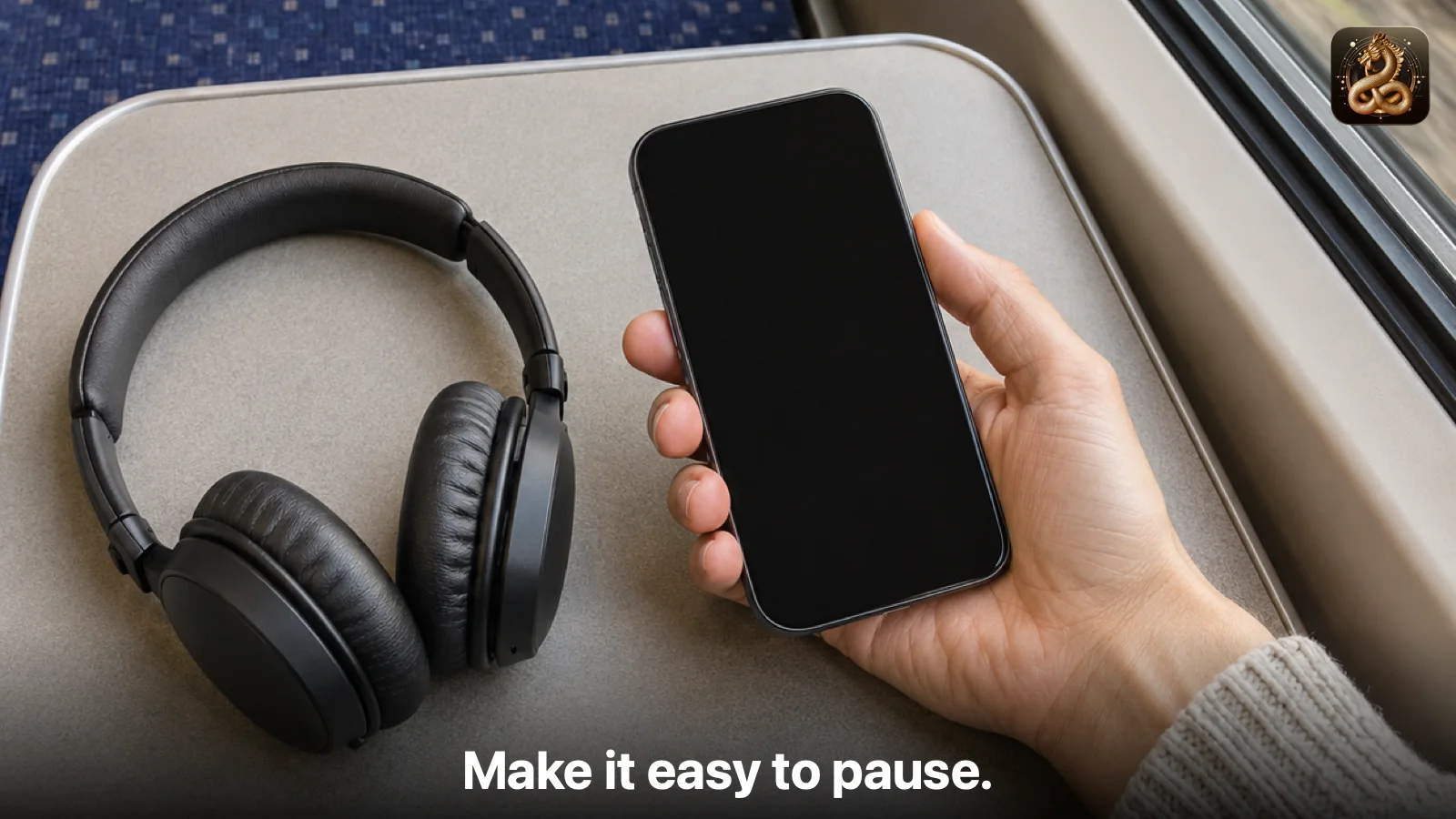
Check your playback setup before relying on it. If another recording begins automatically, you may miss the boundary you intended to use. You can turn off continuation if your player offers that option and you know where to find it. If you are unsure, stop the audio yourself at the point you chose rather than assuming that the player will do it.
For an example of how a listening practice can be used at home, read the SoulFul GLO online sound bath guide. A journey gives you a different set of conditions. Some days the right choice is to keep the recording for the point at which you can give it more of your attention.
Make room for people and service changes
Use whatever listening arrangement lets you respond to the information you need and respects the people nearby. If you cannot comfortably follow relevant instructions with headphones on, pause and remove them as needed. A speaker in a shared carriage introduces sound other passengers did not choose. Leave it off when that is the considerate choice or when the service asks you to.

A travel companion may be relying on you to notice a station or confirm a connection. Agree on the practical details before putting on headphones. If the other person is also listening, avoid making either of you the default person in charge unless you have actually agreed. You can both choose to wait until the route needs less attention.
Expect a plan to change if the service changes. A longer stop, an unexpected announcement or a move to a different carriage is a reason to check the trip first. Leave the recording paused while you make the next travel decision. You can return to it when you are settled and know what to expect, or you can stop for that ride.
Try two fictional journeys
Anika is on a familiar train for six stops. After checking the display and seeing that the service is running to her expected station, she plays a short recording. Her usual stop is still several stations away when she puts the phone back in her bag. She knows how to check the rest of the journey and has time to put on her coat before the train arrives. She could have listened longer, but the shorter stretch fit the ride.
Lewis has a change of trains at a station he has not visited. The original service information was clear, but an announcement mentions a change he did not catch. He pauses before trying to work out what happened. While he is sorting out the connection, he leaves the recording off. Later, on the second train, he finds a seat and decides there is enough settled time for a short listen.
Neither passenger needs to rate the experience. Anika kept a small plan that matched a familiar route. Lewis changed his plan when he needed information. Both used the same principle: a sound journey can fit into the parts of travel that are available for it.
Choose an alternative for a busy ride
If there are frequent announcements or you need to keep track of several things, skip the recording. You could look out of the window for a moment, rest your attention on a stable point or simply sit without adding an activity. You can also decide to do nothing in particular while you wait for the next part of the trip. There is no rule that every quiet minute needs a practice.

If you use a quiet pause, stay available to the conditions around you. Keep your place in the journey, follow staff directions and stop the exercise when it is time to prepare to leave. You can take the recording out again when you are seated and ready or make a separate plan to listen later.
Put the travel setup back before the end
Allow a little room between ending the recording and getting ready to go. You may need to put the device away, gather a bag or check the next part of your trip. That work is easier to plan while you are still seated and can decide what you need. If the arrangement changes unexpectedly, you can stop right away instead of trying to complete the last minute.
If your train has more than one service announcement for the same station, follow the information that applies to your route. For instance, hearing the name of your destination does not always mean it is the next stop. It might be part of a connection notice. If you are unsure, check the station sequence or ask staff before you resume listening.
One simple review can help for the next ride: did the way you checked your stop work from that seat? If it did, you have a useful detail for a similar trip. If it did not, consider leaving the audio off next time until you have a more usable way to follow the route.
Frequently asked questions
Is an alarm enough to make sure I get off at my stop?
A timer can remind you to check the journey, but it does not tell you where the train actually is. Delays and changes can make an estimate less useful. Keep track of the service using the information you can access, and give yourself time to stop listening before you need to get ready.
Can I listen between two stations?
Yes, if that is a settled part of the trip and you have a reliable way to keep track of the route. A short gap may suit you better than trying to complete a track. If the stops are close or the service information is unclear, wait for a longer stretch or leave audio off.
What if I cannot follow spoken announcements?
Check whether the service has another available way to share the information you need, such as a display or an accessible update channel. Use the information available on that journey and ask staff when appropriate. If you still cannot follow the route reliably while listening, keep the audio off and focus on the trip.
Do I have to finish a sound journey to use it as a practice?
A short period of listening can be the practice you chose. You can set a simple intention, such as noticing one steady layer until you need to return to the trip. There is no guaranteed effect attached to completing the recording, and stopping early does not require an explanation.
Make the next ride easy to decide about
Before your next ride, choose the point at which you would start and the point at which you would stop. If those points are hard to identify, leave your listening practice for somewhere else. If they are clear, use the stretch you actually have and let the rest of the journey be travel. You can also explore a sound journey to try at home when you want time for a longer listen.