
A guide asks you to name how you feel. You hear the instruction, but the word does not arrive as quickly as the next sentence. Several descriptions seem possible, or none seems quite right. You may find yourself searching for a more accurate answer instead of following the session you chose.
For an ordinary, optional meditation, the word can remain a rough description. It does not have to explain the whole day or identify what caused the feeling. Follow the actual resource's understandable invitation, while keeping room for a broad word, more than one response or honest uncertainty. You can also choose another practice.
This guide concerns that small in-session wording choice. It is not an emotion-identification system, a journal exercise or a method for diagnosing a condition. It does not promise that naming a feeling will change it.
Quick answer: use a description that fits well enough
When an understandable guided practice invites a feeling word, choose ordinary language you would actually use. Leave the label broad if that is more honest, allow mixed responses and avoid guessing at a hidden explanation. If nothing fits, keep the uncertainty rather than manufacturing an answer. Clarify an instruction you cannot follow or choose another focus.
There is no need to complete a vocabulary test before continuing. Check what the particular guide asks next. A recording that requires a step you cannot follow may be unsuitable for this occasion, even if its title sounds welcoming.
Let the first unclear moment stay small
An invitation to notice a present feeling can be brief. You may recognise something immediately, or you may need a moment. Difficulty choosing a word does not, by itself, explain your health, personality or ability to meditate. Keep the question as small as the instruction actually makes it.
Notice whether the task has expanded. The guide may ask for a simple description while you start reviewing conversations, comparing possible causes or searching for the emotion you think you ought to have. Those are additional activities. You can leave them aside without deciding whether the underlying situation has been resolved.
If naming feels unwelcome, keep stopping available. A recording cannot know your current circumstances. You may pause, look around and decide whether you want more of this focus. The right next choice need not be a better label; it may be another activity altogether.
Begin with words you already understand
Before starting an unfamiliar resource, preview how it explains the task. Does the speaker invite a plain description, introduce specialised vocabulary or expect earlier teaching? Understand the direction before trying to follow it. A gentle tone cannot supply the meaning of an unexplained instruction.
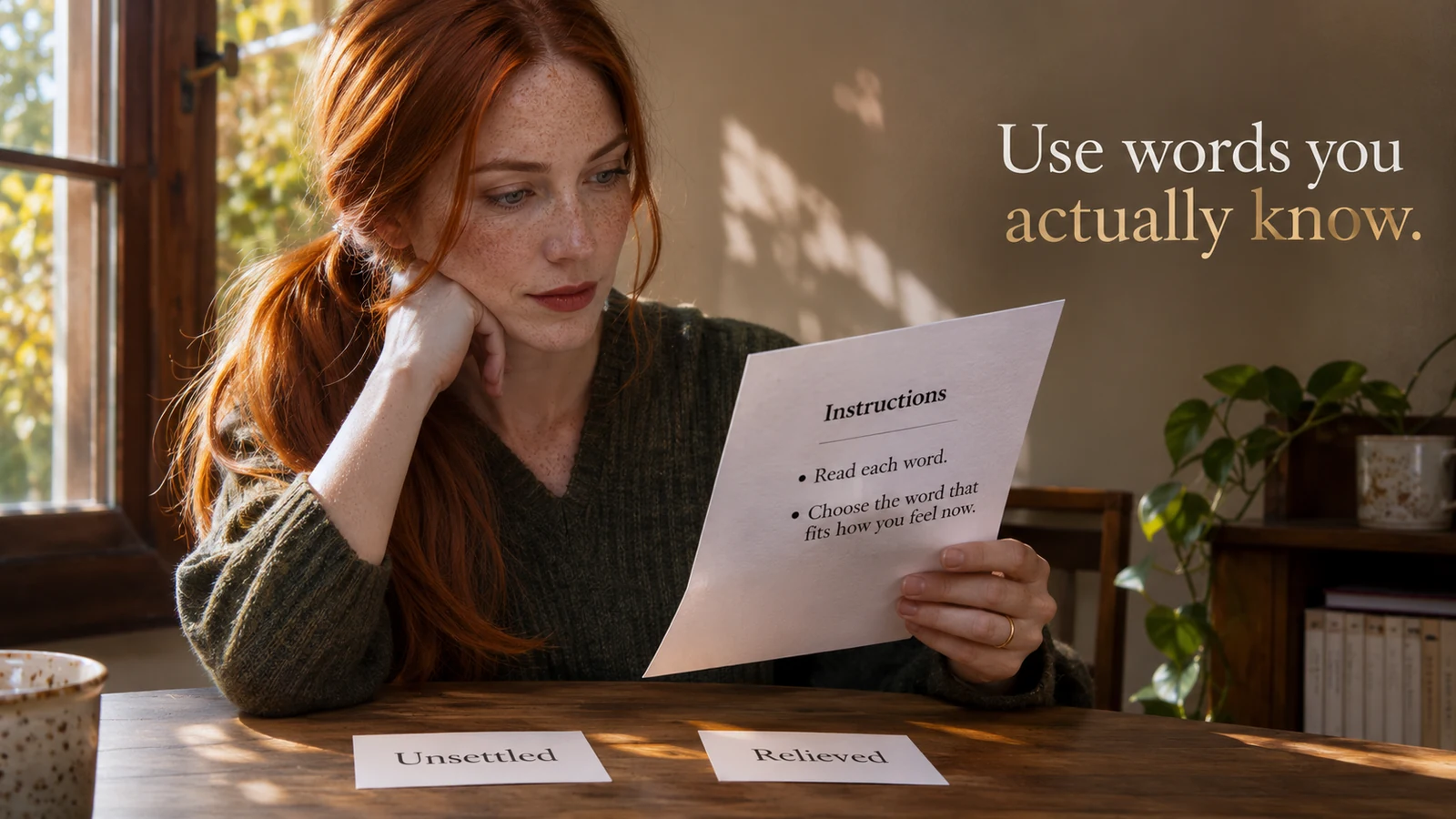
Use a familiar word where the resource allows one. You might describe yourself as unsettled, pleased, disappointed or unsure. These are original examples of ordinary wording, not a prescribed list or categories you must select from. Your own language may offer a different useful expression.
A broad description can be more accurate than a precise-sounding word you do not understand. There is no requirement here to move from fine or bad into a detailed taxonomy. If those words are all you want to use, inspect the guidance rather than treating this article as a rule to replace its instructions.
For a separate issue about understanding a recording's language, SoulFul GLO's second-language meditation guide covers previewing and clarification. Being able to follow the words and deciding which word describes you are different tasks.
Allow more than one response
More than one feeling word may seem appropriate. You might be pleased that an ordinary task is finished and nervous about a later conversation. Naming both does not require you to identify the stronger one, explain their relationship or make them agree. Check whether the practice leaves room for that plain account.

Keep the scope in the present. A feeling about one event need not become a verdict on the whole day. Likewise, a difficult response can coexist with something you value. The meditation does not decide which part deserves attention outside the session or what you should do about it.
If the recording asks for a single response and that does not fit, you can keep the mismatch visible. Ask the source about the invitation or select different guidance. Avoid forcing a combined experience into a confident answer merely to keep up with the speaker.
Choose an understandable practice
Explore SoulFul GLO's current guided meditation descriptions when considering another resource. Check the actual instructions and available information. This article does not establish that a particular feeling-naming session, personalised alternative or emotion tool is included.
Keep uncertainty instead of inventing a feeling
Unsure can describe the difficulty you are having with the invitation. It does not have to conceal a more impressive answer. You may also notice little that you want to describe. A quiet or ordinary response need not become gratitude, sadness or another emotion because the recording's example uses that word.

Separate uncertainty about the feeling from uncertainty about the instruction. If the direction is clear but no word fits, leave the description open where the practice permits. If you do not understand what the speaker wants you to attend to, clarification or other guidance addresses that different problem.
Avoid borrowing another listener's answer. Someone may describe feeling peaceful after a session while you feel distracted or unchanged. Their report does not identify your experience. You do not need to match it, dispute it or disclose your own response in order to choose what to do next.
There is also no need to produce an image, a colour or a body location to make an uncertain word more convincing. Those may belong to other instructions, but they are additional tasks. Follow what you understand rather than expanding a brief naming invitation into an improvised assessment.
Use a label as a description, not a score
A word can describe an experience without measuring it. Calling a feeling strong does not establish a number, a diagnosis or the success of the practice. This guide does not ask you to grade emotions, compare sessions or turn a changing response into evidence that meditation is working.
Keep an ordinary word separate from a clinical conclusion. Feeling nervous in one moment does not, by itself, establish a disorder. A label chosen during a recording cannot explain persistent or concerning symptoms. Seek appropriate qualified advice for health concerns rather than using this small task as a self-assessment.
The same limit applies to explanations about other people. Your feeling word does not prove their intention or show what they were thinking. An account such as feeling disappointed can remain an account of your response. Any later conversation or practical decision needs the facts actually available.
NCCIH's overview of meditation discusses varied practices, evidence limitations and possible negative experiences. General research does not establish that this wording choice, or a particular recording, produces emotional regulation or a health benefit.
Continue without searching for a perfect replacement
After choosing a workable description, listen for the actual next instruction. You do not have to keep checking whether the word remains exactly right. If the guidance invites another observation later, respond to that invitation then. Continuous monitoring is a different activity from following one brief cue.
A word can also change as your description changes. You might first choose uneasy and later prefer disappointed. That revision does not prove that the second word reveals a deeper truth. It can simply be the language that seems more appropriate now, without requiring an explanation of the difference.
If finding the exact word has taken over the session, decide whether to stop the search, pause the recording or choose different guidance. There is no missing score to recover. Keep the activity voluntary and proportionate to the attention you want to give it today.
Two fictional responses to a naming invitation
In this invented example, Mina understands a guide's invitation to name a present feeling. She considers several words and settles on unsettled. She does not know whether a more specific description would fit. The word lets her describe the moment without inventing a cause or deciding what a later conversation will mean.
When the guide moves to another instruction, Mina follows what she understands. She does not return repeatedly to improve the earlier answer. Her example illustrates a small wording decision, not a customer testimonial or proof that naming changed how she felt.
In another fictional situation, Sam feels pleased about finishing a project and apprehensive about the next task. The recording's example describes only satisfaction. Sam recognises that the example is not a report of his own experience. He keeps both ordinary descriptions available rather than choosing the more positive one to match it.
Later, the resource asks for an activity he does not understand. He pauses instead of guessing. Being able to name two feelings does not settle every instruction in a session or create an obligation to finish. Both examples leave the surrounding practical questions for another decision.
Keep another focus available
If you prefer a different attention task, choose guidance that actually explains one. A recording may invite listening to an ordinary sound, for example. Check its whole approach rather than assuming that changing one word turns a feeling-focused session into another practice. You can stop one resource before choosing another.

For a different kind of meditation, SoulFul GLO's compassion guide concerns recognising suffering and an intention of care. It does not require producing a particular emotion. Use it to understand that distinct focus, rather than combining two guides into a new therapeutic method.
At the end, put the audio aside and return to the activity ahead. Writing about the experience is optional and separate. You do not need a mood chart, a journal entry or a public explanation to establish that you made the practice choice you wanted.
Questions about choosing a feeling word
What if I can only think of a broad word?
Keep it broad if that is honest and the practice allows it. You do not need specialist vocabulary for this optional wording choice. If the resource requires something else, ask what it means or choose guidance you can follow.
Can two words fit at once?
They may both describe your current response. This guide does not require a winner. Check how the actual practice handles the invitation, and avoid forcing a single answer if that changes what you want to say.
Must the feeling change after I name it?
No particular change is promised here. You may notice a difference or none. Naming a feeling during one session does not establish a treatment effect, and an unchanged response is not a reason to keep practising until it changes.
What if the focus becomes uncomfortable?
Pause or stop. Choose another activity and seek appropriate support for concerning difficulties. Meditation remains optional self-care and should not replace needed care or delay medical attention.
Choose a manageable invitation
Read SoulFul GLO's current meditation options if you want another starting point. Choose an understandable task, let your description remain ordinary and keep the option to leave a feeling unnamed.