
The teacher begins a chant and several people join in. You recognise neither the wording nor what participants are being invited to do. Before trying to follow the group, you can ask about the practice and the choices available in that particular class.
Chanting can carry a religious, philosophical or teaching context. Treat it as something to understand from its actual source rather than as a generic sound exercise whose meaning you can infer from the room. Participation with your own voice is a different choice from hearing a recording.
This guide helps an adult participant ask practical questions. It does not supply a chant, translation, vocal technique or breathing instruction. No claim is made that joining produces a particular feeling, heals a condition or makes someone a more committed yoga student.
Quick answer: ask what is being offered and what joining means
Read the class information and ask the teacher which practice is included, where it comes from and how participants are invited to take part. If the wording or intended action is unclear, ask for an explanation. Check whether listening without joining, pausing or selecting another class is actually available.

You can respect a practice without pretending to understand it or agreeing to participate. Equally, a class's stated purpose deserves an accurate reading. Find an offering whose actual arrangements fit what you want, rather than assuming that every teacher will provide the same alternative.
Start with this class and its stated context
Look for the teacher's description, the named style or tradition and any information about the opening or closing. A general yoga label does not establish whether the class contains chanting, how long it lasts or what role it has.

For a concrete source-specific example, Sivananda Yoga India's Open Class page lists an opening prayer and a closing chant within its class structure. That identifies features of the described Sivananda offering. It does not establish a universal class format or that the offering is suitable for every reader.
Keep the source's own explanation attached. A brief translation found elsewhere might concern another wording or context. A clip from another teacher cannot establish what this teacher intends. Ask about the exact practice included in the class you are considering.
A practical question might be: “Does the class include a vocal practice, and where can I read your explanation of it?” You are requesting orientation, not asking for an entire tradition to be reduced to a sentence before class.
Distinguish listening, following words and making a declaration
Find out what participants are actually invited to do. Listening to the teacher, repeating a sound, following printed wording and making a spoken statement can involve different choices. The fact that voices occur together does not explain the invitation.
If words are supplied, ask what they mean in the context the teacher is presenting. Avoid inventing an English equivalent from how a phrase sounds. A familiar word within unfamiliar wording does not establish that you understand the whole passage.
Also ask whether the practice involves an action beyond speaking, such as a particular breathing or physical instruction. This article supplies no technique for that action. Understand the actual request before deciding whether you want to participate.
You can keep several questions separate: whether you understand the explanation, whether you accept the framing and whether you want to use your voice. A satisfactory answer to one does not automatically settle the others.
Ask what help is provided for unfamiliar wording
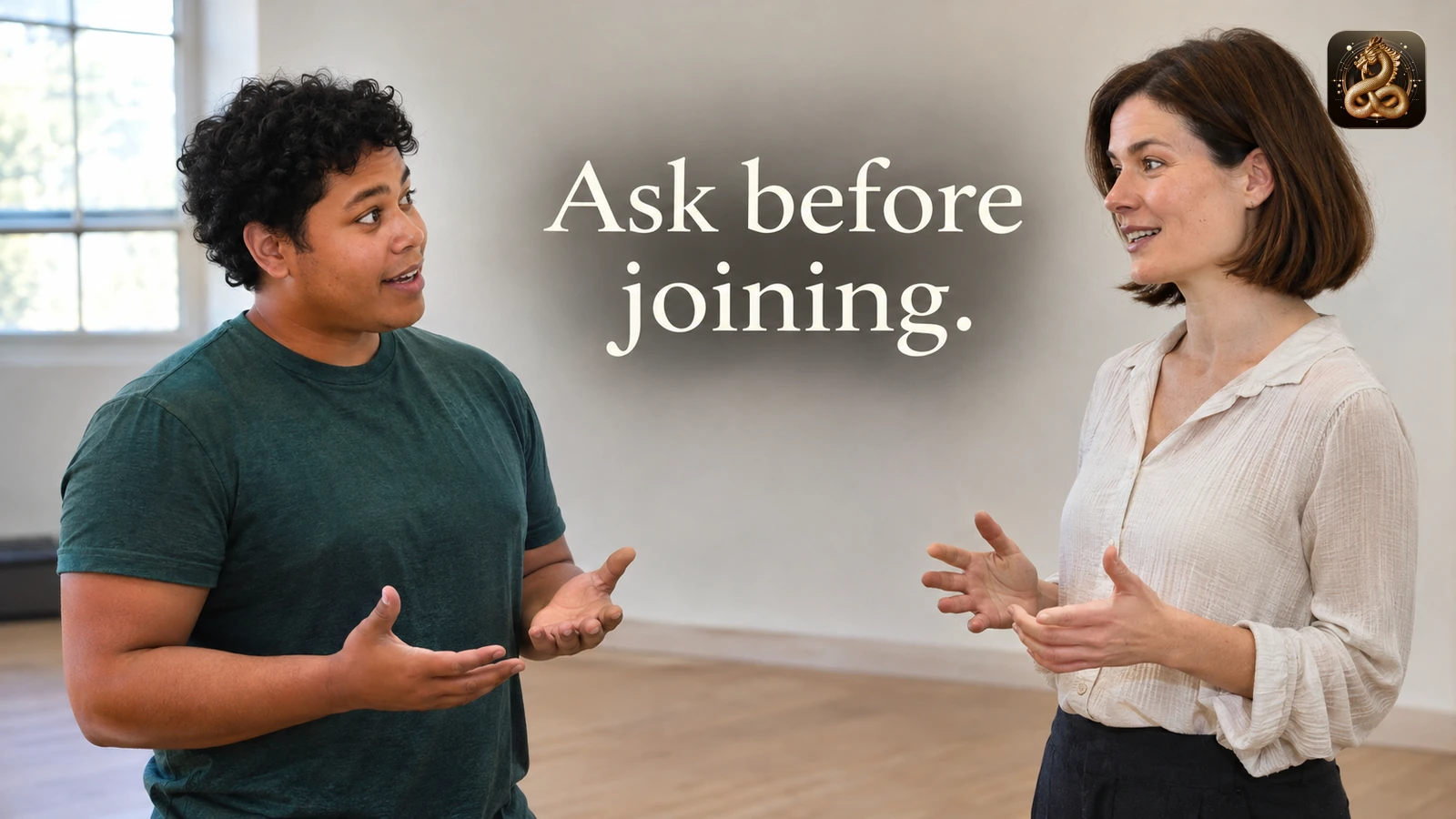
You do not need to arrive pretending that you already know the words. Ask whether the teacher explains the material, provides a reliable source or offers an introduction before expecting participation. Use the help actually available instead of guessing from another person's voice.
A written sheet can help identify wording, but it is not automatically a pronunciation lesson or explanation of meaning. Check what the resource supplies. If its content depends on prior teaching, ask how a newcomer is expected to obtain that context.
You can also say that you would rather understand the practice before making a participation choice. That is a practical boundary. It need not become a public account of your beliefs or a request for the rest of the class to justify theirs.
The teacher may suggest an introductory class, another resource or a later conversation. Assess that actual answer. A generic article cannot certify that a particular explanation is complete, accurate or appropriate for you.
Check listening and declining arrangements before relying on them
If you prefer not to join vocally, ask what the class actually offers. “May I listen during that part?” is clearer than silently assuming that remaining in the room means the same thing in every setting.

Find out whether there are other practical arrangements you need to know. Perhaps the teacher explains how to step aside or which class format omits the activity. These are possibilities to ask about, not promises that an alternative must exist.
You can choose another class when the stated arrangement does not fit. There is no requirement to participate simply because the surrounding movement practice appeals to you. You can also acknowledge that the vocal practice belongs to the offering rather than asking the teacher to describe it as meaningless sound.
If the question arises only after the class begins, keep your immediate choice within what you understand and want. You do not have to copy an unfamiliar action while waiting for a later explanation. Pause participation and ask when it can be addressed appropriately.
Read a separate guide when framing is the main question
SoulFul GLO's guide to spiritual language in meditation considers belief and values compatibility in guidance. Here the additional question is active vocal participation in a live yoga class, including what the teacher actually explains and offers.
Keep physical comfort separate from willingness
Wanting to join does not supply vocal or breathing suitability. Follow the actual instruction only when you understand it and want to participate, and ask appropriate individual questions when needed. This article does not assess voice, breath, hearing or medical concerns.
There is no loudness target here and no instruction to match another person's duration or intensity. A room with many voices can make comparison tempting, but another participant's action is not an individual prescription for you.
Stop if participation becomes uncomfortable or distressing. Seek appropriate advice for concerning symptoms. The meaning a source assigns to the practice does not require you to interpret discomfort as evidence that a process is working.
Keep participation choices available as the session changes. Agreement to one understandable invitation is not a promise to follow every later variation. Ask again when a materially different request is unclear.
Respect other participants without speaking for them
People in the room may know the material, be learning it or have reasons for listening quietly. Their visible participation does not give you a complete account of their beliefs or experience. Avoid treating a quiet person as resistant or a confident voice as proof of understanding.

Likewise, another person cannot establish your choice by speaking enthusiastically about the practice. You can appreciate their explanation while asking the teacher about the actual class. Preference and informed participation belong to the individual.
Do not record the group to work out the words later without an appropriate explicit arrangement. The class is not automatically a source of audio you may capture, transcribe or share. Use resources the teacher genuinely makes available for that purpose.
If you discuss the experience afterwards, keep the description factual and proportionate. You can say you listened, joined a particular explained activity or chose another format. Avoid publishing an invented translation or claiming what everybody in the room felt.
Two fictional participation decisions
The people and situations below are invented to illustrate questions and choices. They are not testimonials, descriptions of an actual studio or evidence of a wellness result.
Nadia reads that a class includes an opening chant. Before attending, she asks whether an explanation is provided and whether listening without joining is an available choice. The teacher describes the actual arrangement and directs her to the resource used in that class.
Nadia reads the supplied information and decides that she wants to attend under the stated listening arrangement. She does not claim that the practice has no meaning because she will not speak, or that every class in the same style offers the same option. Her decision remains with this offering.
Another fictional participant, Theo, wants to take part but cannot establish what an unfamiliar phrase asks. Hearing the group repeat it does not answer his question. He chooses not to join that part and asks the teacher later about the wording and introductory teaching.
Theo may decide to learn more or select another class. The example does not require a particular ending. Understanding enough to make a choice is a practical aim, while personal beliefs and future interest remain his own.
Let the experience remain specific
After class, you might know that you understood the teacher's explanation, found the printed wording useful or preferred to listen. Those observations can inform another participation decision without becoming a score for spirituality, belonging or progress.

You might also leave a question unanswered. A class encounter does not oblige you to study a tradition further, and curiosity does not establish that you should reproduce its practice independently from incomplete information.
If you seek more information, return to the source or a relevant qualified teacher. Keep attribution and context intact. A sound that resembles another recording is not sufficient evidence of shared wording, origin or purpose.
What the sources support
The Sivananda page supplies an example of a named class structure containing vocal practices. Yoga Alliance's Code of Conduct asks its members to communicate honestly and inform students about the origins and practices of the teaching offered. Those are source-specific statements, not certification of every yoga class.
The practical questions and fictional examples here are original editorial suggestions. No research is cited as proof that this participation workflow improves wellbeing, and no particular chant is recommended as a treatment. A class decision cannot replace appropriate care or individual professional advice.
Frequently asked questions
Do all yoga classes include chanting?
Do not infer the format from the word yoga alone. Check the actual description and ask the provider. The named source example establishes its own class structure, not a rule for every teacher or setting.
May I assume that listening is always offered instead?
Ask about the actual arrangement. The teacher may explain an option, recommend an introduction or suggest another class. Choose using the answer rather than relying on a generic assumption.
Does unfamiliar wording mean I should copy the group first?
You can ask for context before participating. Hearing the group does not establish meaning, pronunciation teaching or the physical action being invited. Keep your choice with what you understand and want.
Must I explain my personal beliefs to decline?
A practical question about participation can stay practical. Share only what is relevant and comfortable for you. If the offering does not fit your needs, another class or activity remains available.
Choose the actual invitation you want
For broader preparation, explore SoulFul GLO's yoga class-level guide. Check the vocal component separately from movement prerequisites, then choose participation using the source, explanation and real arrangements in front of you.