
You made tea while waiting for a friend yesterday. Today you made it while finishing a letter. The activity has the same name, but the occasions contain different details. A comparison journal can put those details beside each other without deciding which day was better or what either occasion says about you.
The useful question is small: what can these two accounts actually be compared on? You might notice where you paused, what you handled first or what else was happening. Keep the comparison close to the words you have, rather than turning two entries into a verdict about your habits.
This is an original writing exercise for an optional personal journal. It is not an experiment, a productivity assessment or evidence of a health benefit. Choose ordinary material you willingly want to retain. Two separate descriptions, a single paragraph or leaving the exercise alone are all available.
Quick answer
Choose two completed occasions involving the same ordinary activity. Identify each occasion, describe it separately and choose one shared question that both accounts can answer. Put the relevant details side by side. Record differences in circumstances alongside differences in actions. End with a limited observation, an open question or no conclusion.
Do not repeat an activity merely to create a second entry. Use occasions that already interest you. If you remember only one clearly, write about that one. The comparison is useful only when it preserves something you actually want to keep, rather than making an ordinary activity into another measurement task.
Choose an activity with a recognisable boundary
Begin with something you can name without summarising a whole day: preparing your own reading corner, packing your usual bag or starting a small drawing. You need a beginning and ending that make sense for your account. “My whole morning” may contain too many unrelated actions for a useful first comparison.
Select two occasions of roughly the same activity, not two versions you have already labelled successful and unsuccessful. Those labels can decide the comparison before you write it. “Packing the bag on Monday” and “packing it on Thursday” leave more room for actual details than “the organised day” and “the chaotic day.”
Give each occasion a practical reference. A date may help when you know it; a plain description can do when you do not. “Before the library visit” is preferable to an invented date. Keep a missing detail missing instead of filling the two accounts until they look equally complete.
Write each account before arranging the pair
Describe the first occasion on its own terms. What did you actually do, and what detail do you want to preserve? Then write the second without copying the first account's shape mechanically. The two passages can have different lengths. Equal word counts would not make the underlying occasions more comparable.
You can use existing entries if you want. Keep their original wording and dates available, then make a separate comparison note. Do not quietly revise the earlier entry so it now anticipates what you noticed later. A present interpretation belongs in the new note, even when it concerns an older experience.
If you rely on memory rather than a written record, say so. “I remember leaving the bag beside the door” is different from copying a dated sentence. Neither has to be disqualified from a private page, but the distinction stops a remembered detail from acquiring the certainty of a contemporaneous note.
Ask one question that fits both occasions
Choose a shared point of comparison after reading the accounts. “Where did I put the materials before beginning?” might fit two drawing sessions. “What did I enjoy?” fits only if enjoyment is something you recorded or now want to recall. You do not need to manufacture a feeling to complete a column.

The University of California, Berkeley Student Learning Center's comparison-writing guidance describes organising a comparison around points that appear in both subjects. That is an academic writing context. This guide adapts the organising idea for a private notebook; it makes no claim that the exercise produces the outcomes of a research study or a wellbeing programme.
Start with one point rather than a comprehensive assessment. A small question keeps the page readable and gives the comparison a defined purpose. If one account cannot answer it, choose another question or leave that part unmatched. A blank can preserve the real limit of the record.
Keep circumstances beside the actions
The same activity can happen under different conditions. You might have different materials, more company or another responsibility nearby. Record those circumstances when you know them. “I packed while the kettle boiled” offers context; “I was careless” gives a broader explanation that the two entries may not establish.
Keep a circumstance distinct from a cause. A visitor was present on one occasion, but the notebook does not prove that their presence caused every difference. You can write “I wonder whether the conversation mattered” while leaving the question open. The comparison can show a difference without explaining why it occurred.
Avoid turning the second occasion into a test of the first. There is no requirement that a later attempt improve. You may prefer a detail from each occasion, or neither. A record of two different experiences can be interesting without selecting a winner or setting a target for the next one.
A small table for a fairer comparison
Use a table when it makes the relationship easier to see. Put the same point in each row and keep an explicit place for limits. The following is an invented example about arranging a personal reading space; it is a writing demonstration, not a model of the right setup.
| Point to compare | First occasion | Second occasion | Limit to keep |
|---|---|---|---|
| Materials at the start | Book and loose note | Book only | Different reading material |
| First action remembered | Cleared one chair | Opened the window | Earlier actions not recorded |
| Pause during the activity | Answered the door | Set the book down | Duration not known |
| Detail worth retaining | Note stayed visible | Window made the room noisier | Personal observations, no overall score |
The table should serve the writing, rather than decide what your experience must contain. Use prose if the cells become cramped. You can compare one action in a sentence and leave everything else in the original entries. A neat layout does not increase the certainty of an uncertain memory.
A fictional demonstration, one decision at a time
In this invented example, Amara wants to compare two occasions of setting up a place to read. First she identifies them as “Saturday after lunch” and “Tuesday before dinner.” She has a short note from Saturday and a present recollection of Tuesday, so she labels those different sources.
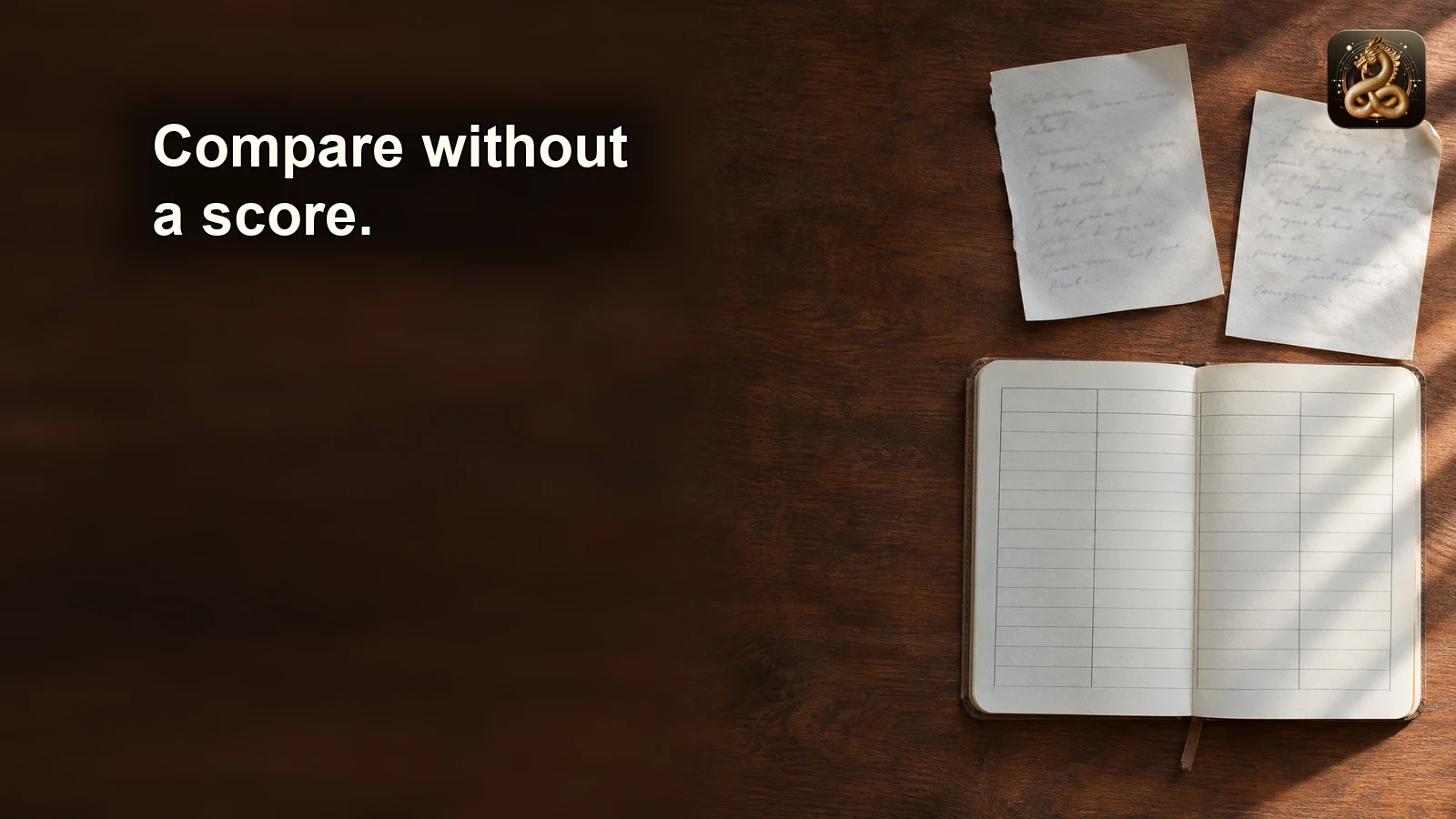
Next she writes the Tuesday recollection without consulting the Saturday note closely. She remembers opening the window and moving a cushion. She cannot remember whether she brought a drink. She leaves that point out instead of adding one because the older note mentions a cup.
Then Amara chooses the question “What did I arrange before opening the book?” She copies the relevant details into two short columns. Saturday's note says she cleared papers from the chair. Tuesday's account mentions the window and cushion. She keeps the different time of day beside the comparison.
Finally she writes, “I arranged different parts of the space on these occasions. I cannot compare how long I read.” She does not conclude that one setup made her more attentive. Her simpler option would be to keep the two original accounts without the table. She can stop there without planning another session.
Notice what the comparison cannot carry
Two entries do not establish a pattern across your life. They also do not reveal another person's intentions or show what would have happened under different conditions. Keep statements at the scale of the examples: “On these occasions” leaves a useful boundary that “I always” would remove.
A missing mention is not automatically an absence. If the first entry says nothing about noise, you cannot assume the room was silent. Write “not recorded” when that is the accurate comparison. You may still remember something now, but label it as a later recollection rather than an overlooked fact in the old note.
If you notice yourself scoring your character, return to the actual verbs. “I put the pencil away before lunch” is an action. “I finally became disciplined” is an interpretation with a much larger scope. You can keep a personal interpretation if you want while distinguishing it from what the account describes.
Leave the result optional
Make a modest comparison note you can recognise later
Give the new note its own date and a plain heading naming the activity and the two occasions. This distinguishes the comparison from either original account. You might write “Reading-space notes, Saturday and Tuesday, compared today.” The heading should describe the page's purpose without claiming that these examples represent your usual experience.
Keep a reference to the two source passages if they are elsewhere in the notebook. An actual page number or short subject label is enough when you can follow it. Check the reference once rather than relying on a number you intended to add later. You do not need to copy every unrelated sentence from the originals.
If you revisit this comparison another day, let that be another dated reading. Today's interpretation may change without making the earlier note dishonest. A useful private record can show when you noticed something, when you compared it and when you stopped wanting to pursue it. None of those dates makes the conclusion permanent or requires another comparison next week.
You may want a next step, but the page need not produce one. An observation can remain an observation. If a practical reminder appears, keep it wherever you normally keep reminders. The comparison itself does not require a habit tracker, a fixed schedule or a new rule about doing the activity correctly.
If the activity starts feeling like a performance because you are writing about it, you can stop comparing. Return to a single descriptive entry or another subject. You are allowed to enjoy making tea, drawing or reading without collecting evidence about how you do it.
Explore SoulFul GLO's guide to journaling without a to-do list if observations keep becoming assignments. Its focus is the difference between reflection and planning; you can use that choice while letting this particular comparison stay small.
Frequently asked questions
Must the occasions be consecutive days?
No. Choose occasions you can identify and want to compare. A gap is part of the context, not a failure in the method. Do not invent what happened between the entries. If the gap makes the comparison unhelpful, keep two separate descriptions instead.
Can I compare an entry with a memory?
Yes, for this informal exercise, provided you identify which is which. An older written note and a present recollection have different recording contexts. Keep uncertainty visible, and avoid changing the older account to match what you now remember or prefer.
What if one entry has much less detail?
Leave the unequal detail visible. Choose a point both can address, or mark the missing information as not recorded. A shorter account is not an inferior experience. There is no need to expand it with plausible details so the table looks balanced.
Does comparison have to end in a decision?
No. You can finish with one limited similarity, a difference, an open question or no summary. If you actually need to make a decision, treat that as a separate purpose. This exercise organises two accounts; it cannot decide what you should value.
Keep both occasions their own
Read SoulFul GLO's guide to reviewing older journal entries when you want more room for the context of earlier writing. Keep the originals available, make today's comparison a separate note and close the notebook whenever the page has done enough for you.