
You search for something to listen to during a quiet pause and find two very different recordings. One features close-up tapping and a softly spoken person. The other follows a developing instrumental soundscape. Both descriptions use relaxing language, but the word relaxing does not tell you which listening activity you would actually enjoy choosing.
ASMR and a sound journey are not interchangeable labels. A resource may combine elements, and an individual's response can vary. Before selecting either, inspect the actual sounds, any visual or personal-attention content and what the creator asks the listener to do. A short preference check is more useful than choosing the most ambitious benefit claim.
Quick answer
Choose by the experience you want to consider, not by an obligation to feel tingles or become relaxed. ASMR resources commonly feature particular sensory triggers, which may include whispering, tapping or slow visual actions. A sound journey can offer a broader musical or evolving listening focus. Check each actual resource, preview only if wanted, and keep an ordinary way to stop available.
This is a practical listening-choice guide. It does not teach you to produce ASMR, diagnose a response or promise sleep. It also makes no claim that SoulFul GLO provides an ASMR library. The comparison helps you recognise what is being offered before deciding whether it belongs in the pause you have today.
Know what the ASMR label does and does not establish
The University of Sheffield's research account describes ASMR as an experience reported by some people in response to particular sights and sounds. Its study concerned selected videos and participants who did or did not identify with that experience. Those limits matter: it does not establish that every resource will produce the same response for every listener.
You do not need to discover whether you belong to a category before making an ordinary content choice. A sound can be welcome, unwelcome or fairly uninteresting without requiring an explanation. If you do not notice tingles, that observation does not turn the session into a failed attempt or create a reason to increase playback volume.
Likewise, the ASMR label does not describe every detail of a recording. Some resources use speech, some focus on objects and others include role-play or visual attention. Read the actual description. A familiar category name should not become permission to assume that material you have not inspected will match your preferences.
Identify what you want to listen to
Begin with an ordinary preference rather than a desired internal result. You might want a wordless instrumental progression, a familiar spoken voice or a short exploration of gentle object sounds. These choices concern content. They do not tell you what your body or mood will do, and they need not become a permanent taste.
Consider whether you want someone addressing the listener directly. Personal-attention role-play can feel welcome to one person and intrusive to another. You can decline that style without proving anything about your openness. The same applies to whispered speech, tapping or mouth sounds. You are choosing an optional resource, not completing a tolerance exercise.
If your aim is to practise meditation, identify the attention task separately. Listening to a resource for enjoyment and using audible sound as an attention focus are different choices. A title promising relaxation does not automatically explain a meditation method. Look for the actual guidance instead of assuming the recording's genre supplies one.
Read the listing before trying a preview
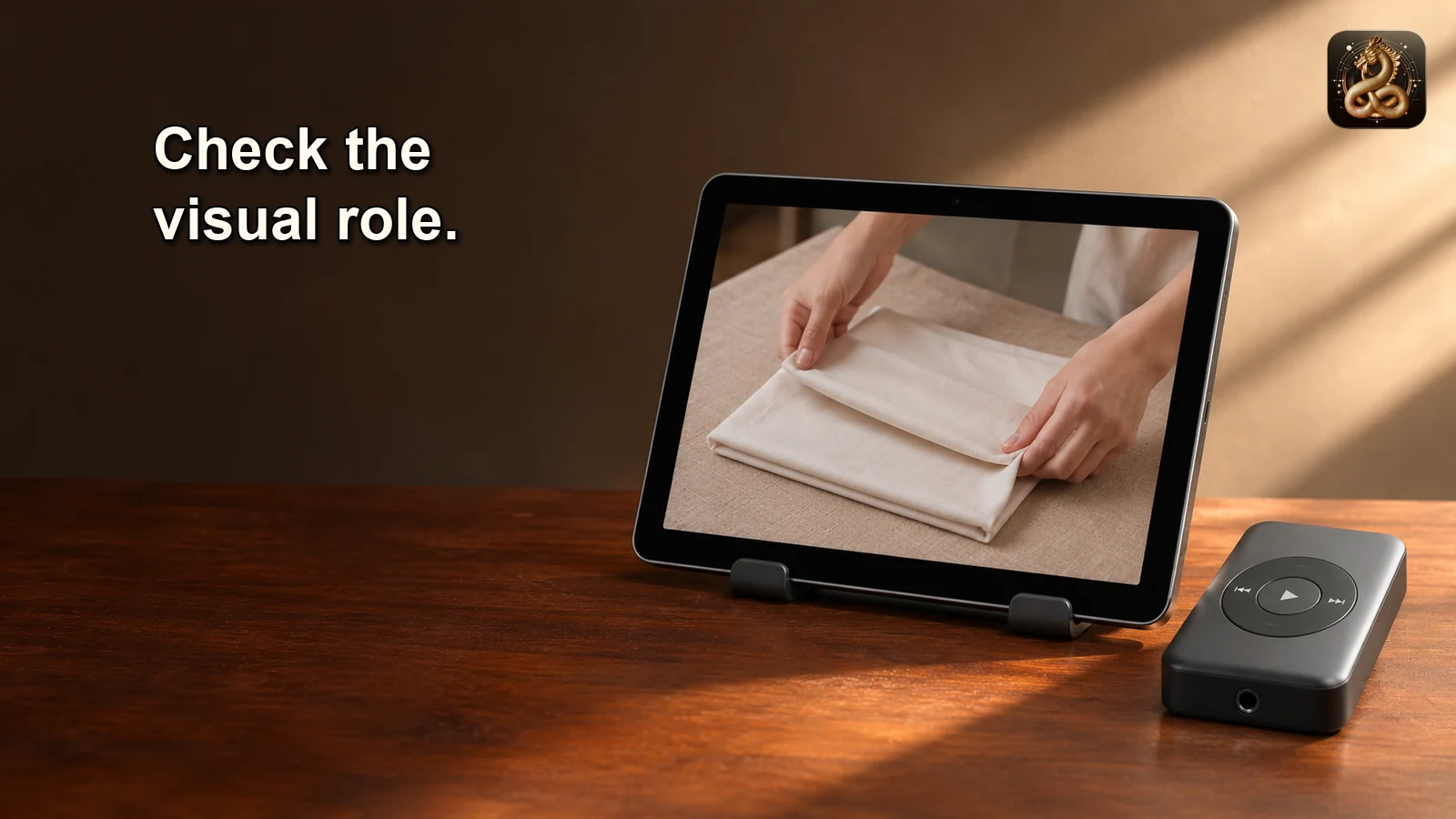
Look for a description of the sound sources, whether speech is included and whether the material depends on watching. A still cover image may conceal a moving video, while a silent preview may reveal little about the audio. Use the information genuinely available rather than guess from a thumbnail or a broad mood label.

Check duration and any known transitions that matter to you. A resource might move between several sound types or contain an introduction before the main material. You do not need a second-by-second account, but a description of the overall format can help you decide whether a preview would be welcome in the first place.
Compare two invented listings. Evening Calm says nothing about speech, visual activity or personal-attention role-play. Paper Sounds: No Speech describes paper handling without a spoken performance, giving a listener who dislikes whispering one useful distinction. These are fictional labels, not recommendations or verified provider descriptions. Even the clearer wording leaves questions about volume changes and later sound transitions unless those are stated. A reader can ask about those details, try an optional preview or leave; the title alone cannot guarantee the whole listening experience.
A small listening-choice plan
First, name the kind of content you are willing to encounter. Keep it concrete: ordinary instrumental sound, gentle object sounds, spoken guidance or no recorded sound today. Avoid turning that sentence into a promise that the content will calm you. A preference can guide selection while the response remains unknown.
Next, inspect one actual resource whose description seems to fit. Confirm the creator and the specific recording so that a similarly named item does not quietly replace it. You do not need an extensive comparison chart. One understandable candidate can be enough, and finding none is a complete reason to choose another activity.
Then, preview only if you want to and where it is appropriate to give attention. Begin at a comfortable ordinary level and use the available controls if it is unwelcome. Do not raise the sound to chase a response or cover the room. This article supplies no universal volume percentage or listening-safety certification.
Finally, choose whether to continue, select something different or finish. A short preview can establish a preference about the part heard. It does not prove what every later moment contains or what future listening will feel like. Keep the decision proportional to that limited information rather than turn one sample into a verdict about a whole genre.
Compare the actual listening features
| Feature to inspect | Possible ASMR resource | Possible sound journey | Your practical question |
|---|---|---|---|
| Main content | Particular close-up sounds or visual actions | Developing musical or environmental soundscape | Which content do I want today? |
| Speech | Whispering, soft speech, role-play or none | Spoken introduction, guidance or none | Is a voice welcome here? |
| Visual role | Slow actions may be part of the offering | Optional scenery or a meaningful visual element | Does this item require watching? |
| Intended use | Sensory experience described by its creator | Listening or meditation described by its creator | What task is actually explained? |
| Personal response | Tingles may occur for some listeners | Responses also vary | Can I leave the result open? |
These are possibilities to check, not definitions that certify every recording. A resource can combine features or use a category label loosely. Keep any uncertainty visible. If your choice depends on a feature that the description does not establish, ask or select something whose actual content you can understand.
Fictional demonstration: a welcome sound, not a required sensation
In this invented example, Lina sees an ASMR listing describing gentle paper sounds without speech. She is interested in that ordinary texture and reads the description before choosing a short preview. She notices that the repeated paper sound is pleasant enough for the moment. She does not experience tingles and does not need them to justify the preference.
Lina chooses to continue for the time available. At the ending, she returns to her afternoon without recording a score. The example does not establish a health effect, improved concentration or a change in sleep. It illustrates a content choice that can remain worthwhile for its modest purpose without a dramatic physical experience.
A simpler option would have been to finish after the preview or choose silence. Another person might dislike the same sound and stop immediately. Neither response needs a judgement about who is more sensitive, more relaxed or better able to listen. A recording can remain optional even when it is popular.
Another example: choosing a clear sound-journey task
Amir, another fictional listener, wants an understandable sound-focused meditation. He finds an item whose description explains following the audible sounds, and a separate ASMR video whose main feature is direct personal-attention role-play. He does not rank the formats. He chooses the first because its stated task matches what he wants to do.
Amir checks the actual recording and listening arrangement, then begins only if both still fit. He can notice a sound without identifying every instrument or expecting the experience to resemble a previous listen. If the recording changes in an unwelcome way, he can stop. The choice of format has not removed later participation choices.
For a related but separate distinction, read SoulFul GLO's guide to nature sounds and instrumental journeys. It compares content within a different listening decision. Here the question concerns what an ASMR offering contains and how that differs from the particular sound journey you are considering.
Keep research and preference in their own places
Research can examine a defined response under particular conditions. Your preference about a sample is another kind of information. Enjoying a sound does not establish the study's physiological result, and a published finding cannot determine that the sound will be pleasant for you. Neither needs to be stretched to make the listening decision feel important.
Be cautious with claims that a recording guarantees sleep, releases trauma or proves a healing mechanism. Such claims need evidence appropriate to the actual intervention and population. A reference about selected ASMR videos does not validate an unrelated sound journey, and general meditation research does not make every quiet audio product a treatment.
If a health concern is the reason you are looking for help, seek appropriate qualified advice rather than rely on a genre label. Optional listening can remain a personal choice alongside necessary care. You do not need to diagnose your own response or repeatedly try unwelcome material to show that you gave a category a chance.
Let the next choice stay ordinary
Afterwards, retain one practical observation if useful: the voice was unwanted, a description was accurate or instrumental sound fitted the occasion. You can also keep no note. Do not make an optional pause into another tracking project unless recording preferences actually helps you find what you want later.
Keep changes reversible. A choice made today does not require deleting other resources, adopting a new routine or recommending the same material to everybody. If you share a legitimate link with someone who asks, describe the content you noticed and leave their response open. Your preference is information about your experience, not a prediction of theirs.
You can also change your mind about a familiar category. A format that was welcome last week may not be what you want tonight. There is no need to explain that change through a theory about your body or prove the earlier preference wrong.
Frequently asked questions
Do I have to feel tingles for ASMR content to count?
This guide sets no required sensation. You can choose content because it is welcome or leave it because it is not. The cited research distinguishes participants who report the phenomenon from those who do not. Do not turn a category label into a test that requires stronger or longer listening.
Is ASMR the same as meditation?
Do not treat the labels as interchangeable. Inspect the actual content and the task its creator explains. A sensory video may offer something different from guided attention, although resources can combine elements. If meditation is your purpose, find understandable instructions rather than assume any quiet sound supplies the method.
Does a study prove that an ASMR recording will help me sleep?
No individual sleep result follows from the evidence discussed here. The research account concerns selected material, participants and measured responses. It cannot establish an effect from every recording or for a particular listener. Keep treatment questions and persistent sleep concerns with appropriate professional support.
Can I stop a preview simply because I dislike the sound?
Yes. An optional preview creates no obligation to continue or explain the preference. You can choose other content, silence or another activity. Do not interpret discomfort as a sign that you must listen harder, increase volume or wait until the reaction changes.
If you prefer to inspect a sound journey before selecting it, use SoulFul GLO's guide to a journey's title and listening fit. Choose from actual descriptions, retain your stopping choice and let a realistic preference be enough information for the next ordinary decision.